
We read your photo as:
Identify the series combination.
ScanSolve AI Answer
Step-by-step solution
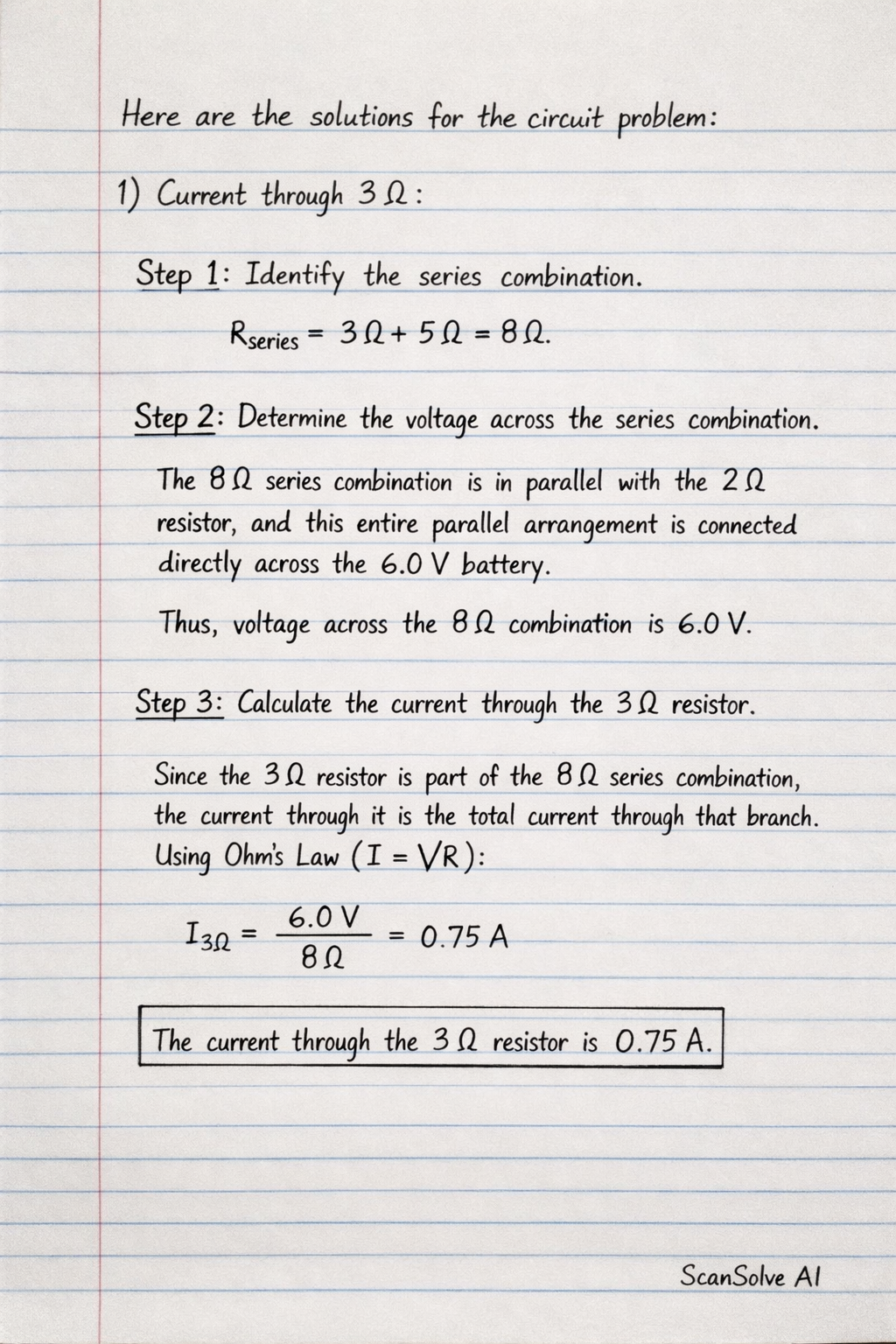
6 stepsHere are the solutions for the circuit problem:
1) Current through :
Identify the series combination.
The and resistors are connected in series. Their equivalent resistance is:
Determine the voltage across the series combination.
The series combination is in parallel with the resistor, and this entire parallel arrangement is connected directly across the battery. Therefore, the voltage across the series combination is .
Calculate the current through the resistor.
Since the resistor is part of the series combination, the current flowing through it is the total current through that branch. Using Ohm's Law ():
The current through the resistor is .
2) If each cell has an internal resistance of , determine the total resistance in the circuit:
Calculate the total external resistance ().
The and resistors are in series:
This is in parallel with the resistor. The equivalent resistance of this parallel combination is:
Calculate the total internal resistance ().
The battery has an EMF of . Assuming standard cells, the number of cells in the battery is:
Each cell has an internal resistance of . So, the total internal resistance for 4 cells in series is:
Determine the total resistance in the circuit.
The total resistance in the circuit is the sum of the total external resistance and the total internal resistance:
The total resistance in the circuit is $\boxed{\text{4.
Still stuck on this one?
Ask a follow-up, and the answer starts from this question.
More Mathematics Questions
Handwritten Step-by-Step Solution
Get this as a handwritten image on WhatsApp — like a tutor wrote it for you.
Try on WhatsApp