
We read your photo as:
If 3n + 2 = 8, find the value of n. Arrange (3)/(4), 0.8, (5)/(8), 0.65 in descending order. Mr Mensah left his house at 9:45 am and reached his village at 4:15 pm. Find the time spent.
ScanSolve AI Answer
Answer
Step-by-step solution
13 stepsHere are the solutions to the questions:
Part 1· 2 steps
If , find the value of .
Subtract 2 from both sides of the equation.
Divide both sides by 3.
The correct option is D.
Part 2· 3 steps
Arrange the following: in descending order.
Convert all numbers to decimal form for easy comparison.
Arrange the decimal values in descending order (from largest to smallest).
Write the numbers back in their original form.
The correct option is A.
Part 3· 3 steps
Mr Mensah left his house at 9:45 am and reached his village at 4:15 pm. Find the time spent.
Calculate the time from 9:45 am to 12:00 pm.
From 9:45 am to 10:00 am = 15 minutes.
From 10:00 am to 12:00 pm = 2 hours.
Total time from 9:45 am to 12:00 pm = 2 hours 15 minutes.Calculate the time from 12:00 pm to 4:15 pm.
This is 4 hours 15 minutes.
Add the two time durations.
Total time spent = (2 hours 15 minutes) + (4 hours 15 minutes)
Total time spent = 6 hours 30 minutes.
The correct option is C.
Part 4· 3 steps
In a test, of the learners passed. If the number of learners who failed was 69, how many passed?
Determine the fraction of learners who failed.
If of the learners passed, then the fraction who failed is .
So, of the learners failed.
Use the number of failed learners to find the total number of learners.
If of the total learners is 69, then the total number of learners is .
Calculate the number of learners who passed.
The number of learners who passed is of the total learners.
The correct option is B.
Part 5· 2 steps
Factorize: .
Identify the greatest common factor (GCF) for the terms and .
The GCF of the numerical coefficients (3 and 9) is 3.
The GCF of the variable and is .
The GCF of the variable and is .
So, the overall GCF is .Factor out the GCF from each term.
The correct option is A.
Try one yourself
A new problem that tests the same skill.
Still stuck on this one?
Ask a follow-up, and the answer starts from this question.
More Mathematics Questions
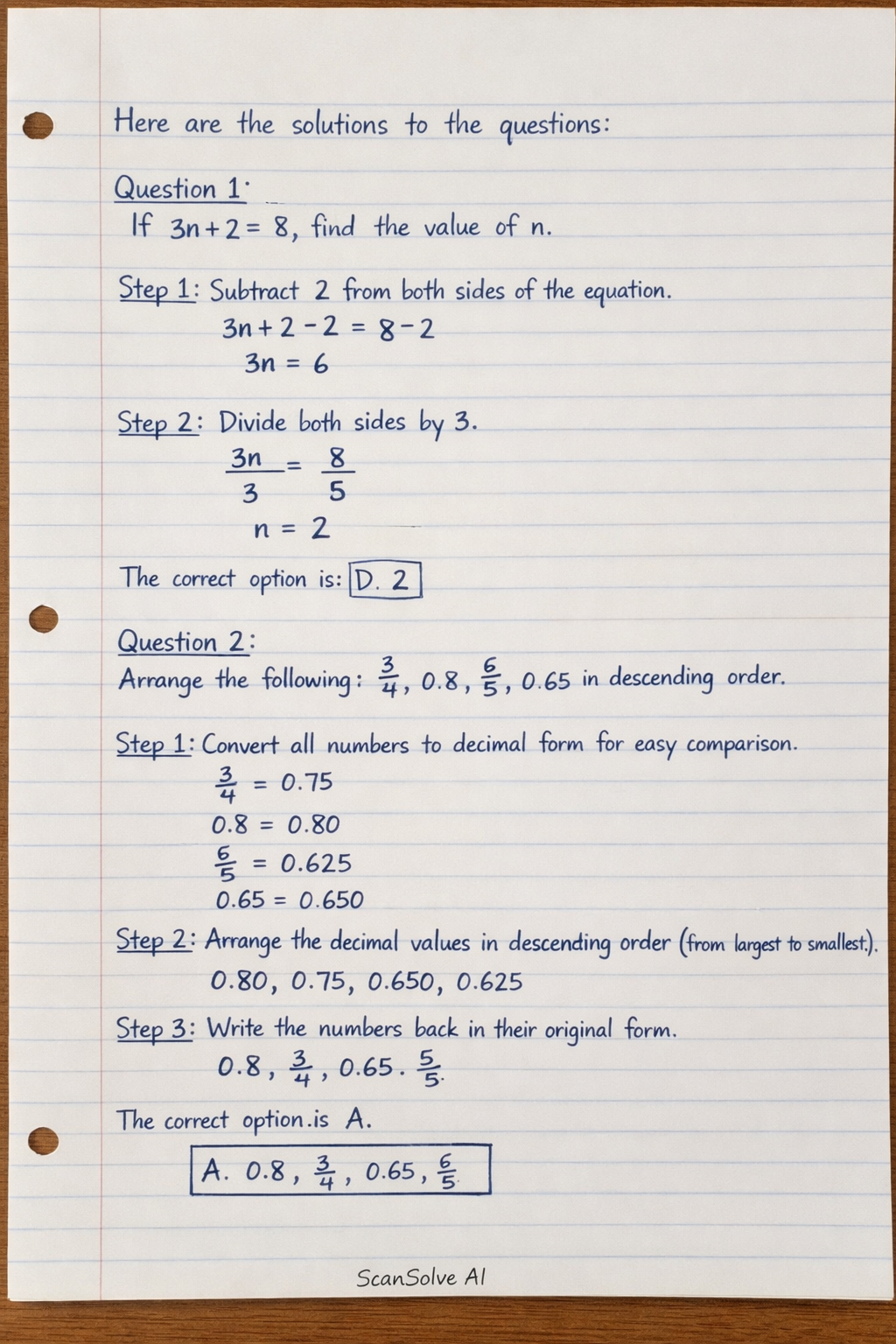
Handwritten Step-by-Step Solution
Get this as a handwritten image on WhatsApp — like a tutor wrote it for you.
Try on WhatsApp