
We read your photo as:
If A is a subset of B (A B), which of the following statements is false?
ScanSolve AI Answer
- C.
Given that , this means that every element of set is also an element of set .
Let's evaluate each statement:
-
A. Since all elements of are in , the elements common to both and are precisely the elements of . This statement is TRUE.
-
B. Since all elements of are already in , combining and results in the set itself. This statement is TRUE.
-
C. This statement implies that the intersection of and is equal to . For this to be true, must be a subset of (). However, we are given . If both and were true, then and would be equal (). But does not necessarily mean . For example, if and , then . In this case, , which is , not . Therefore, this statement is generally FALSE.
-
D. Every element of A is in B This is the definition of . This statement is TRUE.
The final answer is .
Still stuck on this one?
Ask a follow-up, and the answer starts from this question.
More Mathematics Questions
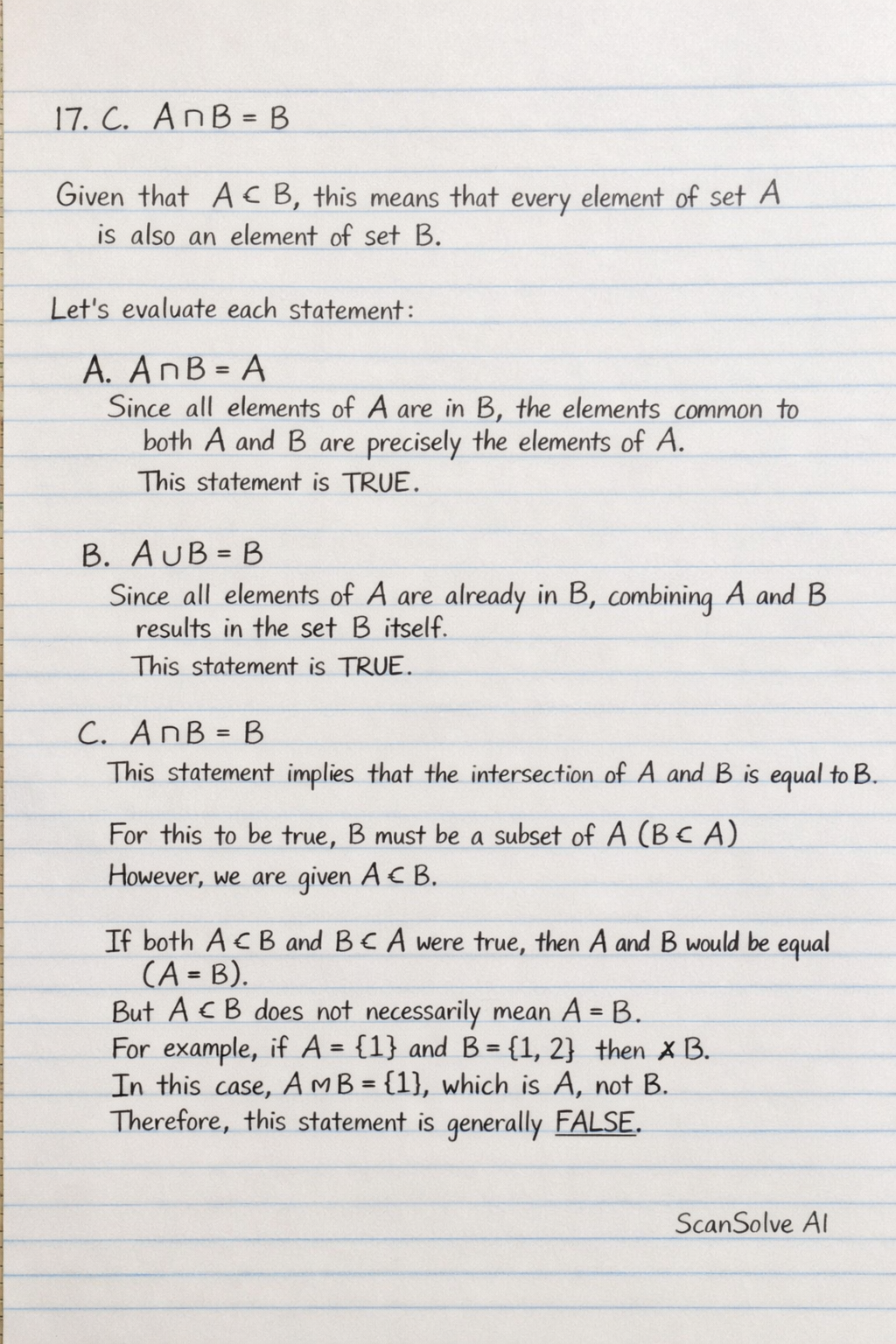
Handwritten Step-by-Step Solution
Get this as a handwritten image on WhatsApp — like a tutor wrote it for you.
Try on WhatsApp