We read your photo as:

If alpha and beta the roots of 3x2 + 5x − 1 = 0, construct new equations whose roots are (a) 5 alpha, 5 beta (b) alpha2, beta2 (c) 1/alpha, 1/beta (d) alpha + 1/beta, beta + 1/alpha

Mathematics

ScanSolve AI Answer

Answers

4 parts
a

3x2+25x−25=03x^2 + 25x - 25 = 0

b

9x2−31x+1=09x^2 - 31x + 1 = 0

c

x2−5x−3=0x^2 - 5x - 3 = 0

d

3x2−10x−4=03x^2 - 10x - 4 = 0

Step-by-step solution

12 steps

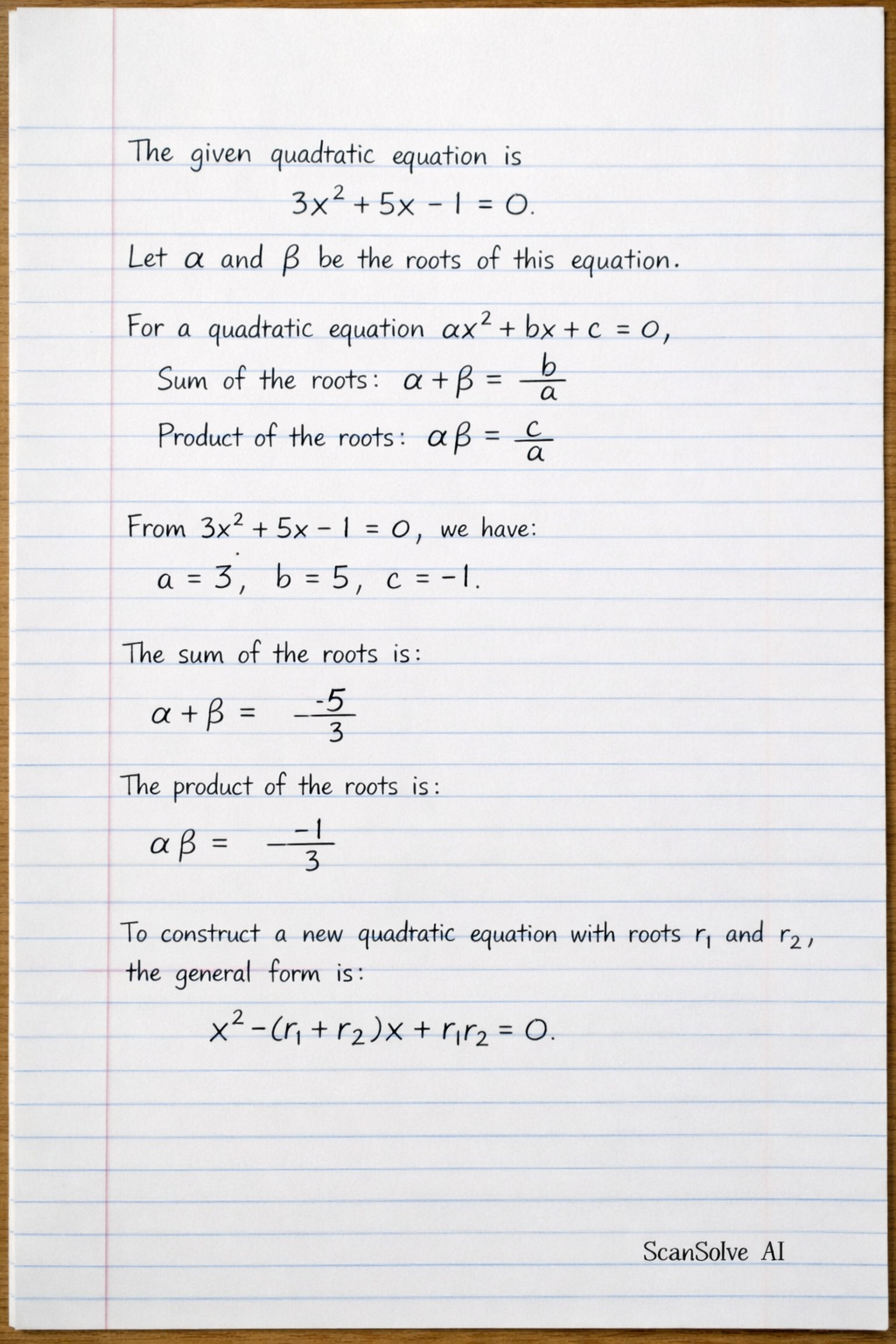
The given quadratic equation is 3x2+5x−1=03x^2 + 5x - 1 = 0.
Let α\alpha and β\beta be the roots of this equation.
For a quadratic equation ax2+bx+c=0ax^2 + bx + c = 0, the sum of the roots is α+β=−ba\alpha + \beta = -\frac{b}{a} and the product of the roots is αβ=ca\alpha \beta = \frac{c}{a}.

From 3x2+5x−1=03x^2 + 5x - 1 = 0, we have a=3a=3, b=5b=5, c=−1c=-1.
The sum of the roots is:

α+β=−53\alpha + \beta = -\frac{5}{3}

The product of the roots is:

αβ=−13\alpha \beta = \frac{-1}{3}

To construct a new quadratic equation with roots r1r_1 and r2r_2, the general form is x2−(r1+r2)x+r1r2=0x^2 - (r_1 + r_2)x + r_1 r_2 = 0.

Part a· 3 steps

Roots are 5α,5β5\alpha, 5\beta

  1. Calculate the sum of the new roots.

    S′=5α+5β=5(α+β)=5(−53)=−253S' = 5\alpha + 5\beta = 5(\alpha + \beta) = 5\left(-\frac{5}{3}\right) = -\frac{25}{3}
  2. Calculate the product of the new roots.

    P′=(5α)(5β)=25αβ=25(−13)=−253P' = (5\alpha)(5\beta) = 25\alpha\beta = 25\left(-\frac{1}{3}\right) = -\frac{25}{3}
  3. Form the new quadratic equation.

    x2−S′x+P′=0x^2 - S'x + P' = 0 x2−(−253)x+(−253)=0x^2 - \left(-\frac{25}{3}\right)x + \left(-\frac{25}{3}\right) = 0 x2+253x−253=0x^2 + \frac{25}{3}x - \frac{25}{3} = 0

    Multiply by 3 to clear the denominators:

    3x2+25x−25=0\boxed{3x^2 + 25x - 25 = 0}

Part b

9x2−31x+1=09x^2 - 31x + 1 = 0

Roots are α2,β2\alpha^2, \beta^2

  1. Calculate the sum of the new roots.

    S′=α2+β2=(α+β)2−2αβS' = \alpha^2 + \beta^2 = (\alpha + \beta)^2 - 2\alpha\beta S′=(−53)2−2(−13)=259+23=259+69=319S' = \left(-\frac{5}{3}\right)^2 - 2\left(-\frac{1}{3}\right) = \frac{25}{9} + \frac{2}{3} = \frac{25}{9} + \frac{6}{9} = \frac{31}{9}
  2. Calculate the product of the new roots.

    P′=α2β2=(αβ)2=(−13)2=19P' = \alpha^2 \beta^2 = (\alpha\beta)^2 = \left(-\frac{1}{3}\right)^2 = \frac{1}{9}
  3. Form the new quadratic equation.

    x2−S′x+P′=0x^2 - S'x + P' = 0 x2−319x+19=0x^2 - \frac{31}{9}x + \frac{1}{9} = 0

    Multiply by 9 to clear the denominators:

    9x2−31x+1=0\boxed{9x^2 - 31x + 1 = 0}

Part c

x2−5x−3=0x^2 - 5x - 3 = 0

Roots are 1α,1β\frac{1}{\alpha}, \frac{1}{\beta}

  1. Calculate the sum of the new roots.

    S′=1α+1β=β+ααβS' = \frac{1}{\alpha} + \frac{1}{\beta} = \frac{\beta + \alpha}{\alpha\beta} S′=−53−13=5S' = \frac{-\frac{5}{3}}{-\frac{1}{3}} = 5
  2. Calculate the product of the new roots.

    P′=(1α)(1β)=1αβP' = \left(\frac{1}{\alpha}\right)\left(\frac{1}{\beta}\right) = \frac{1}{\alpha\beta} P′=1−13=−3P' = \frac{1}{-\frac{1}{3}} = -3
  3. Form the new quadratic equation.

    x2−S′x+P′=0x^2 - S'x + P' = 0 x2−5x−3=0x^2 - 5x - 3 = 0 x2−5x−3=0\boxed{x^2 - 5x - 3 = 0}

Part d

3x2−10x−4=03x^2 - 10x - 4 = 0

Roots are α+1β,β+1α\alpha + \frac{1}{\beta}, \beta + \frac{1}{\alpha}

  1. Calculate the sum of the new roots.

    S′=(α+1β)+(β+1α)=(α+β)+(1α+1β)S' = \left(\alpha + \frac{1}{\beta}\right) + \left(\beta + \frac{1}{\alpha}\right) = (\alpha + \beta) + \left(\frac{1}{\alpha} + \frac{1}{\beta}\right)

    We know α+β=−53\alpha + \beta = -\frac{5}{3} and 1α+1β=α+βαβ=−53−13=5\frac{1}{\alpha} + \frac{1}{\beta} = \frac{\alpha + \beta}{\alpha\beta} = \frac{-\frac{5}{3}}{-\frac{1}{3}} = 5.

    S′=−53+5=−53+153=103S' = -\frac{5}{3} + 5 = -\frac{5}{3} + \frac{15}{3} = \frac{10}{3}
  2. Calculate the product of the new roots.

    P′=(α+1β)(β+1α)=αβ+α(1α)+(1β)β+(1β)(1α)P' = \left(\alpha + \frac{1}{\beta}\right)\left(\beta + \frac{1}{\alpha}\right) = \alpha\beta + \alpha\left(\frac{1}{\alpha}\right) + \left(\frac{1}{\beta}\right)\beta + \left(\frac{1}{\beta}\right)\left(\frac{1}{\alpha}\right) P′=αβ+1+1+1αβ=αβ+2+1αβP' = \alpha\beta + 1 + 1 + \frac{1}{\alpha\beta} = \alpha\beta + 2 + \frac{1}{\alpha\beta} P′=(−13)+2+1−13=−13+2−3P' = \left(-\frac{1}{3}\right) + 2 + \frac{1}{-\frac{1}{3}} = -\frac{1}{3} + 2 - 3 P′=−13−1=−13−33=−43P' = -\frac{1}{3} - 1 = -\frac{1}{3} - \frac{3}{3} = -\frac{4}{3}
  3. Form the new quadratic equation.

    x2−S′x+P′=0x^2 - S'x + P' = 0 x2−103x−43=0x^2 - \frac{10}{3}x - \frac{4}{3} = 0

    Multiply by 3 to clear the denominators:

    3x2−10x−4=0\boxed{3x^2 - 10x - 4 = 0}
Was this helpful?

Try one yourself

A new problem that tests the same skill.

Still stuck on this one?

Ask a follow-up, and the answer starts from this question.

Got a different question?Ask your own question
Handwritten step-by-step solution preview

Handwritten Step-by-Step Solution

Get this as a handwritten image on WhatsApp — like a tutor wrote it for you.

Try on WhatsApp