

This mathematics problem involves applying core mathematical principles and formulas. Below you will find a complete step-by-step solution with detailed explanations for each step, helping you understand not just the answer but the method behind it.
ScanSolve AI Answer
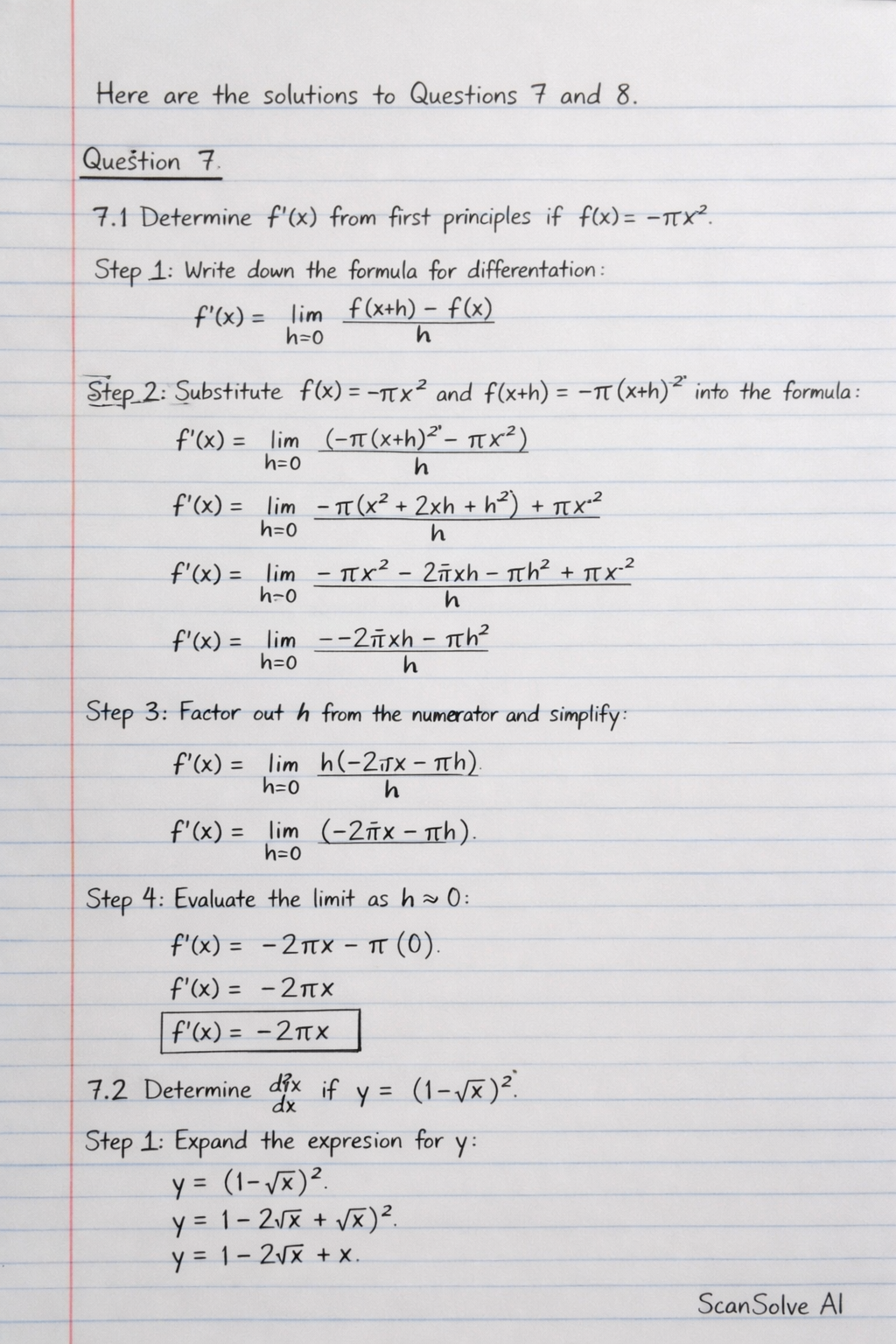
Here are the solutions to Questions 7 and 8. Question 7 7.1 Determine f'(x) from the first principles if f(x) = - x^2. Step 1: Write down the formula for differentiation from first principles. f'(x) = _h 0 (f(x+h) - f(x))/(h) Step 2: Substitute f(x) = - x^2 and f(x+h) = - (x+h)^2 into the formula. f'(x) = _h 0 (- (x+h)^2 - (- x^2))/(h) f'(x) = _h 0 (- (x^2 + 2xh + h^2) + x^2)/(h) f'(x) = _h 0 (- x^2 - 2 xh - h^2 + x^2)/(h) f'(x) = _h 0 (-2 xh - h^2)/(h) Step 3: Factor out h from the numerator and simplify. f'(x) = _h 0 (h(-2 x - h))/(h) f'(x) = _h 0 (-2 x - h) Step 4: Evaluate the limit as h 0. f'(x) = -2 x - (0) f'(x) = -2 x f'(x) = -2 x 7.2 Determine (dy)/(dx) if y = (1-sqrt(x))^2. Step 1: Expand the expression for y. y = (1 - x^1/2)^2 y = 1 - 2x^1/2 + (x^1/2)^2 y = 1 - 2x^1/2 + x Step 2: Differentiate each term with respect to x. (dy)/(dx) = (d)/(dx)(1) - (d)/(dx)(2x^1/2) + (d)/(dx)(x) (dy)/(dx) = 0 - 2 ((1)/(2)x^(1)/(2)-1) + 1 (dy)/(dx) = -x^-1/2 + 1 (dy)/(dx) = -(1)/(sqrt(x)) + 1 (dy)/(dx) = 1 - (1)/(sqrt(x)) 7.3 Determine g'(x) if g(x) = (x(x^2-100)-x^2+100)/(x-1). Step 1: Simplify the expression for g(x) by factoring the numerator. g(x) = (x(x^2-100) - (x^2-100))/(x-1) g(x) = ((x-1)(x^2-100))/(x-1) For x ≠ 1, we can cancel the (x-1) terms: g(x) = x^2 - 100 Step 2: Differentiate g(x) = x^2 - 100 with respect to x. g'(x) = (d)/(dx)(x^2) - (d)/(dx)(100) g'(x) = 2x - 0 g'(x) = 2x g'(x) = 2x 7.4 If h(x) = 7 - (2)/(x^2), calculate the value of h'(2)+4. Step 1: Rewrite h(x) using negative exponents. h(x) = 7 - 2x^-2 Step 2: Determine h'(x). h'(x) = (d)/(dx)(7) - (d)/(dx)(2x^-2) h'(x) = 0 - 2(-2x^-2-1) h'(x) = 4x^-3 h'(x) = (4)/(x^3) Step 3: Calculate h'(2). h'(2) = (4)/((2)^3) h'(2) = (4)/(8) h'(2) = (1)/(2) Step 4: Calculate h'(2)+4. h'(2)+4 = (1)/(2) + 4 h'(2)+4 = (1)/(2) + (8)/(2) h'(2)+4 = (9)/(2) h'(2)+4 = (9)/(2) Question 8 The graph below represents the function f(x) = -x^3 + dx + q with A(-1;0) and B(2;0). 8.1 Show that d=3 and q=2. Step 1: Use point A(-1;0) to form an equation. Substitute x=-1 and f(x)=0 into f(x) = -x^3 + dx + q: 0 = -(-1)^3 + d(-1) + q 0 = -(-1) - d + q 0 = 1 - d + q d - q = 1 (Equation 1) Step 2: Use point B(2;0) to form another equation. Substitute x=2 and f(x)=0 into f(x) = -x^3 + dx + q: 0 = -(2)^3 + d(2) + q 0 = -8 + 2d + q 2d + q = 8 (Equation 2) Step 3: Solve the system of equations. Add Equation 1 and Equation 2: (d - q) + (2d + q) = 1 + 8 3d = 9 d = 3 Step 4: Substitute d=3 into Equation 1 to find q. 3 - q = 1 -q = 1 - 3 -q = -2 q = 2 Therefore, d=3 and q=2. d=3 and q=2 8.2 Determine the coordinates of turning point C. Step 1: Write the full equation for f(x) using d=3 and q=2. f(x) = -x^3 + 3x + 2 Step 2: Find the derivative f'(x) to locate turning points. f'(x) = (d)/(dx)(-x^3 + 3x + 2) f'(x) = -3x^2 + 3 Step 3: Set f'(x)=0 to find the x-coordinates of the turning points. -3x^2 + 3 = 0 -3x^2 = -3 x^2 = 1 x = ± 1 The turning points occur at x=-1 and x=1. From the graph, point C is the turning point with a positive x-coordinate, so x_C = 1. Step 4: Substitute x_C=1 into f(x) to find the y-coordinate of C. f(1) = -(1)^3 + 3(1) + 2 f(1) = -1 + 3 + 2 f(1) = 4 The coordinates of turning point C are (1;4). C(1;4) That's 2 down. 3 left today — send the next one.