If m is an odd integer, prove that (m4 + 4m2 + 11) / 16 is an integer. If a, b, c are positive real numbers, prove that sqrt(b/a) sqrt(c/b) sqrt(a/c) = 1.
|Mathematics
If m is an odd integer, prove that (m4 + 4m2 + 11) / 16 is an integer. If a, b, c are positive real numbers, prove that sqrt(b/a) sqrt(c/b) sqrt(a/c) = 1.
ScanSolve AI Answer
Answer
The expression simplifies to an integer p+2j+1.
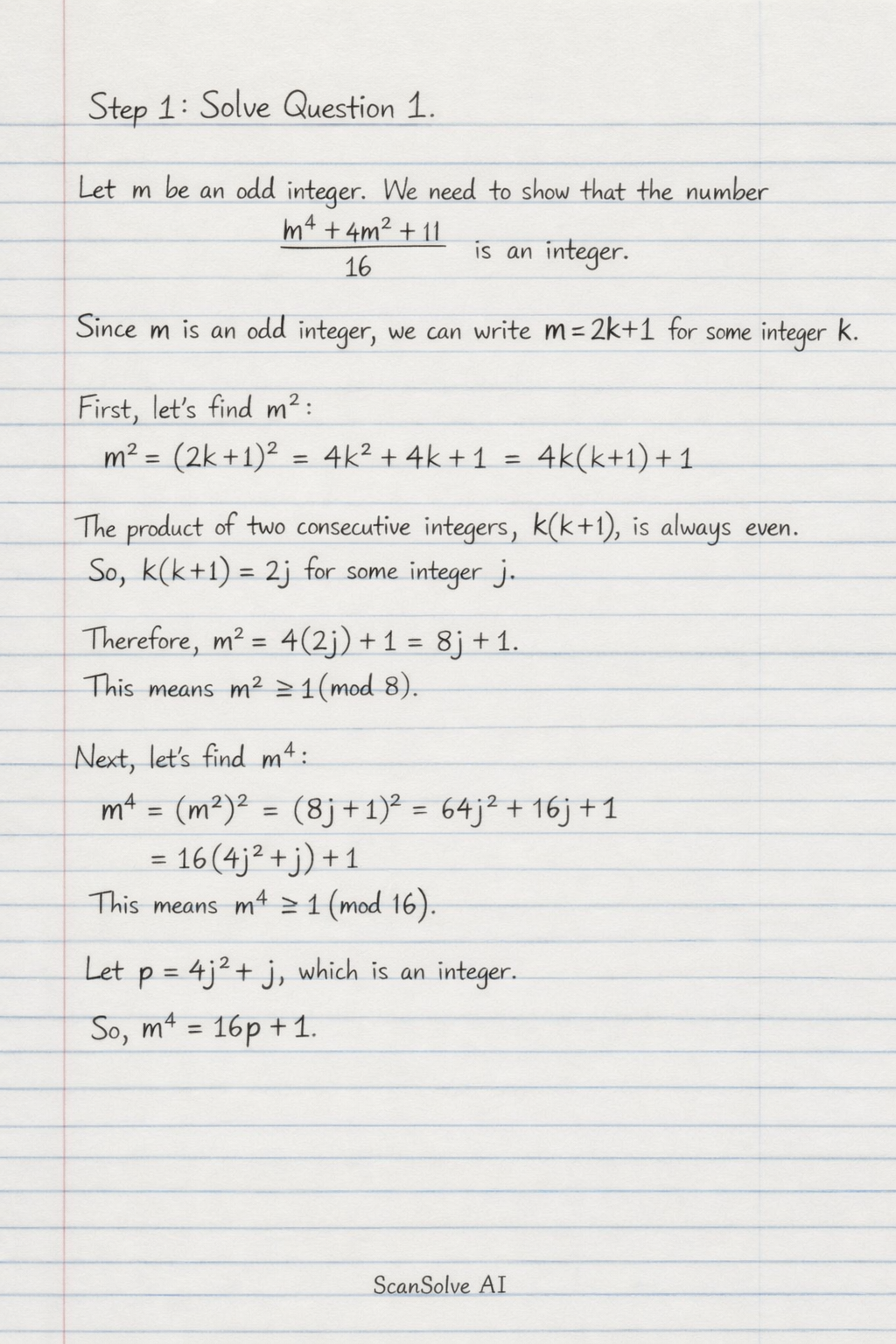
Step 1: Solve Question 1.
Let m be an odd integer. We need to show that the number 16m4+4m2+11 is an integer.
Since m is an odd integer, we can write m=2k+1 for some integer k.
First, let's find m2:
m2=(2k+1)2=4k2+4k+1=4k(k+1)+1
The product of two consecutive integers, k(k+1), is always an even number. So, k(k+1)=2j for some integer j.
Therefore, m2=4(2j)+1=8j+1. This means m2≡1(mod8).
Next, let's find m4:
m4=(m2)2=(8j+1)2=64j2+16j+1=16(4j2+j)+1
This means m4≡1(mod16). Let p=4j2+j, which is an integer. So, m4=16p+1.
Now substitute m4=16p+1 and m2=8j+1 into the given expression:
16m4+4m2+11=16(16p+1)+4(8j+1)+11=1616p+1+32j+4+11=1616p+32j+16
Factor out 16 from the numerator:
=1616(p+2j+1)=p+2j+1
Since p and j are integers, their sum p+2j+1 is also an integer.
Thus, the number 16m4+4m2+11 is an integer.
Theexpressionsimplifiestoanintegerp+2j+1.
Step 2: Solve Question 2.
Given that a,b,c are positive real numbers, we need to show that ab×bc×ca=1.
We can use the property of square roots that x×y=xy and yx=yx.
Combine the terms under a single square root:
ab×bc×ca=ab×bc×ca
Multiply the fractions inside the square root:
=a⋅b⋅cb⋅c⋅a
Cancel out the common terms in the numerator and denominator:
=1=1
Thus, ab×bc×ca=1.
ab×bc×ca=1
Step 3: Solve Question 3.
Given n=23. We need to find −n.
Substitute the given value of n into the expression −n:
−n=−(23)−n=−23−23
Step 4: Solve Question 4.
Let a and b be positive real numbers. We need to show that ba+ab≥2.
We know that for any real number x, (x−y)2≥0.
Consider the expression (ba−ab)2. Since a and b are positive, ba and ab are real numbers.
Therefore,
(ba−ab)2≥0
Expand the square:
(ba)2−2baab+(ab)2≥0ba−2ba⋅ab+ab≥0ba−21+ab≥0ba−2+ab≥0
Add 2 to both sides of the inequality:
ba+ab≥2
This proves the statement.
ba+ab≥2
Step 5: Solve Question 5.
Let x be a real number. We need to show that x2+x21≥2, for x=0.
We know that the square of any real number is non-negative.
Consider the expression (x−x1)2. Since x is a real number and x=0, x−x1 is a real number.
Therefore,
(x−x1)2≥0
Expand the square:
x2−2⋅x⋅x1+(x1)2≥0x2−2+x21≥0
Add 2 to both sides of the inequality:
x2+x21≥2
This proves the statement.
x2+x21≥2
Was this helpful?
Need help with your own homework?
Get instant step-by-step solutions to any question. Free to start.
If m is an odd integer, prove that (m4 + 4m2 + 11) / 16 is an integer. If a, b, c are positive real numbers, prove that sqrt(b/a) sqrt(c/b) sqrt(a/c) = 1.
This mathematics problem involves applying core mathematical principles and formulas. Below you will find a complete step-by-step solution with detailed explanations for each step, helping you understand not just the answer but the method behind it.
ScanSolve AI Answer
Step 1: Solve Question 1. Let m be an odd integer. We need to show that the number (m^4 + 4m^2 + 11)/(16) is an integer. Since m is an odd integer, we can write m = 2k+1 for some integer k. First, let's find m^2: m^2 = (2k+1)^2 = 4k^2 + 4k + 1 = 4k(k+1) + 1 The product of two consecutive integers, k(k+1), is always an even number. So, k(k+1) = 2j for some integer j. Therefore, m^2 = 4(2j) + 1 = 8j + 1. This means m^2 1 8. Next, let's find m^4: m^4 = (m^2)^2 = (8j+1)^2 = 64j^2 + 16j + 1 = 16(4j^2 + j) + 1 This means m^4 1 16. Let p = 4j^2 + j, which is an integer. So, m^4 = 16p + 1. Now substitute m^4 = 16p+1 and m^2 = 8j+1 into the given expression: (m^4 + 4m^2 + 11)/(16) = ((16p+1) + 4(8j+1) + 11)/(16) = (16p + 1 + 32j + 4 + 11)/(16) = (16p + 32j + 16)/(16) Factor out 16 from the numerator: = (16(p + 2j + 1))/(16) = p + 2j + 1 Since p and j are integers, their sum p+2j+1 is also an integer. Thus, the number (m^4 + 4m^2 + 11)/(16) is an integer. The expression simplifies to an integer p+2j+1. Step 2: Solve Question 2. Given that a, b, c are positive real numbers, we need to show that sqrt((b)/(a)) × sqrt((c)/(b)) × sqrt((a)/(c)) = 1. We can use the property of square roots that sqrt(x) × sqrt(y) = sqrt(xy) and sqrt((x)/(y)) = sqrt(x)sqrt(y). Combine the terms under a single square root: sqrt((b)/(a)) × sqrt((c)/(b)) × sqrt((a)/(c)) = sqrt((b)/(a) × (c)/(b) × (a)/(c)) Multiply the fractions inside the square root: = sqrt((b · c · a)/(a · b · c)) Cancel out the common terms in the numerator and denominator: = sqrt(1) = 1 Thus, sqrt((b)/(a)) × sqrt((c)/(b)) × sqrt((a)/(c)) = 1. sqrt((b)/(a)) × sqrt((c)/(b)) × sqrt((a)/(c)) = 1 Step 3: Solve Question 3. Given sqrt(n) = (3)/(2). We need to find -sqrt(n). Substitute the given value of sqrt(n) into the expression -sqrt(n): -sqrt(n) = -((3)/(2)) -sqrt(n) = -(3)/(2) -(3)/(2) Step 4: Solve Question 4. Let a and b be positive real numbers. We need to show that (a)/(b) + (b)/(a) 2. We know that for any real number x, (x-y)^2 0. Consider the expression (sqrt((a)/(b)) - sqrt((b)/(a)))^2. Since a and b are positive, sqrt((a)/(b)) and sqrt((b)/(a)) are real numbers. Therefore, (sqrt((a)/(b)) - sqrt((b)/(a)))^2 0 Expand the square: (sqrt((a)/(b)))^2 - 2sqrt((a)/(b))sqrt((b)/(a)) + (sqrt((b)/(a)))^2 0 (a)/(b) - 2sqrt((a)/(b) · (b)/(a)) + (b)/(a) 0 (a)/(b) - 2sqrt(1) + (b)/(a) 0 (a)/(b) - 2 + (b)/(a) 0 Add 2 to both sides of the inequality: (a)/(b) + (b)/(a) 2 This proves the statement. (a)/(b) + (b)/(a) 2 Step 5: Solve Question 5. Let x be a real number. We need to show that x^2 + (1)/(x^2) 2, for x 0. We know that the square of any real number is non-negative. Consider the expression (x - (1)/(x))^2. Since x is a real number and x 0, x - (1)/(x) is a real number. Therefore, (x - (1)/(x))^2 0 Expand the square: x^2 - 2 · x · (1)/(x) + ((1)/(x))^2 0 x^2 - 2 + (1)/(x^2) 0 Add 2 to both sides of the inequality: x^2 + (1)/(x^2) 2 This proves the statement. x^2 + (1)/(x^2) 2