
We read your photo as:
If Owawa makes 7200 revolution in 5 hours, how many revolution does it make per minute?
ScanSolve AI Answer
Answer
Step-by-step solution
17 stepsHere are the solutions to the questions:
Part 37· 3 steps
If Owawa makes 7200 revolution in 5 hours, how many revolution does it make per minute?
Identify the total revolutions and total time.
Total revolutions = 7200
Total time = 5 hoursConvert the total time from hours to minutes.
There are 60 minutes in 1 hour.
Calculate the revolutions per minute.
Owawa makes 24 revolutions per minute.
The correct option is (b).
Part 38· 4 steps
The average score of 30 students in a Mathematics test is 6. If 28 out of 30 students scored a sum of 160 marks, find the average mark of the two remaining students.
Calculate the total score of all 30 students.
Total number of students = 30
Average score of 30 students = 6
Total score = Average score Number of studentsIdentify the sum of scores for the 28 students.
Sum of scores for 28 students = 160
Calculate the sum of scores for the remaining students.
Number of remaining students =
Sum of scores for remaining 2 students = Total score - Sum of scores for 28 studentsCalculate the average mark of the two remaining students.
Average mark =
The average mark of the two remaining students is 10.
The correct option is (d).
Part 39· 4 steps
Find the simple interest on N280 for years at 3% per annum.
Identify the principal, rate, and time.
Principal (P) = N280
Rate (R) = 3% per annum =
Time (T) = years = 2.5 yearsUse the formula for simple interest.
Substitute the values and calculate the simple interest.
The simple interest is N21.
Since N21 is not an option, and N301 (option d) is the total amount (Principal + Simple Interest), we assume the question implicitly asks for the total amount.
Amount = Principal + Simple Interest
Amount = N280 + N21 = N301
The total amount after years is N301.The correct option is (d).
Part 40· 3 steps
Find the increase of N240 by ratio 3:5.
Interpret the ratio.
The phrase "increase of N240 by ratio 3:5" means that the original amount (N240) corresponds to the first part of the ratio (3), and the new amount corresponds to the second part (5).
Let the original amount be .
Let the new amount be .
The ratio of original to new is .Calculate the new amount.
The new amount after the increase is N400.
The question asks for "the increase".
The actual increase is . However, N160 is not an option, while N400 is an option. This suggests the question is asking for the new value after the increase, rather than the amount of the increase itself.
The correct option is (c).
Part 41· 3 steps
Find the area of the trapezium below.
Identify the dimensions of the trapezium from the figure.
The figure shows a right-angled trapezium.
The parallel sides are the top and bottom horizontal lines.
Length of the top parallel side () = 24 cm.
Length of the bottom parallel side () = .
The height () is the perpendicular distance between the parallel sides, which is the vertical line on the right = 10 cm.Use the formula for the area of a trapezium.
Substitute the values and calculate the area.
The area of the trapezium is .
The correct option is (c).
Try one yourself
A new problem that tests the same skill.
Still stuck on this one?
Ask a follow-up, and the answer starts from this question.
More Mathematics Questions
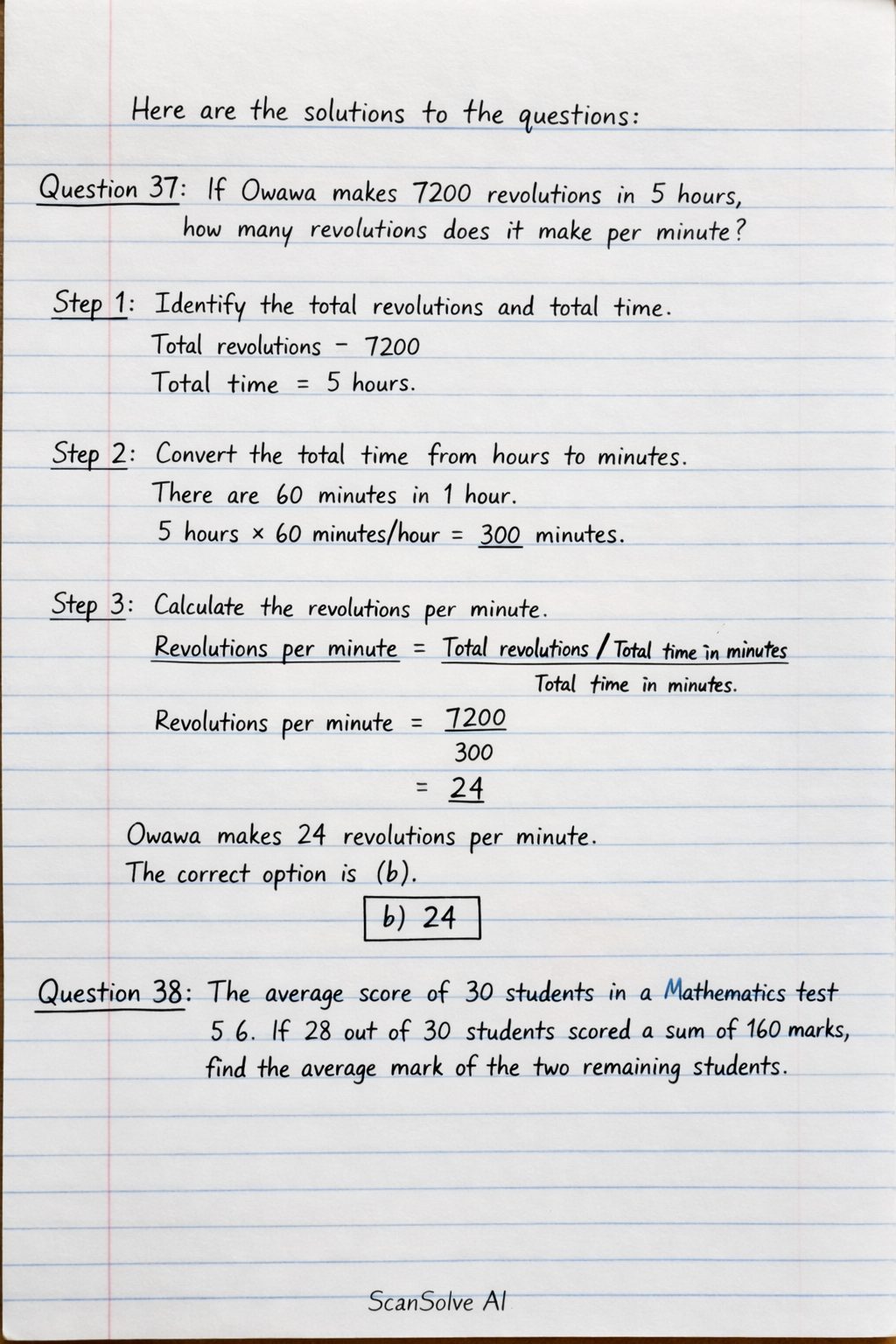
Handwritten Step-by-Step Solution
Get this as a handwritten image on WhatsApp — like a tutor wrote it for you.
Try on WhatsApp