

This mathematics problem involves applying core mathematical principles and formulas. Below you will find a complete step-by-step solution with detailed explanations for each step, helping you understand not just the answer but the method behind it.
ScanSolve AI Answer
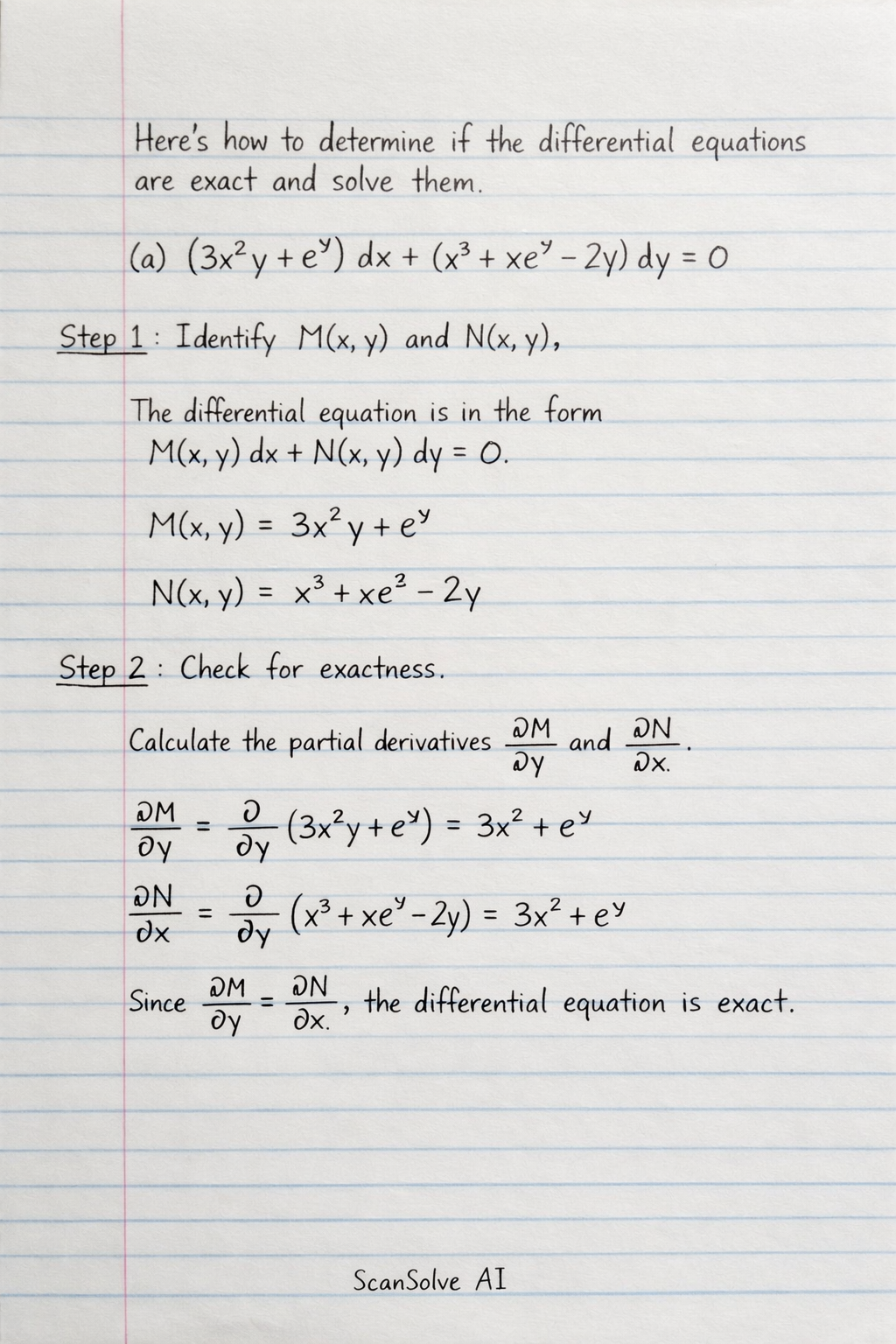
Here's how to determine if the differential equations are exact and solve them. a) (3x^2y + e^y)dx + (x^3 + xe^y - 2y)dy = 0 Step 1: Identify M(x,y) and N(x,y). The differential equation is in the form M(x,y)dx + N(x,y)dy = 0. M(x,y) = 3x^2y + e^y N(x,y) = x^3 + xe^y - 2y Step 2: Check for exactness. Calculate the partial derivatives ( M)/( y) and ( N)/( x). ( M)/( y) = ()/( y)(3x^2y + e^y) = 3x^2 + e^y ( N)/( x) = ()/( x)(x^3 + xe^y - 2y) = 3x^2 + e^y Since ( M)/( y) = ( N)/( x), the differential equation is exact. Step 3: Find the potential function F(x,y). Integrate M(x,y) with respect to x, treating y as a constant: F(x,y) = (3x^2y + e^y) dx = x^3y + xe^y + g(y) Now, differentiate F(x,y) with respect to y and set it equal to N(x,y): ( F)/( y) = ()/( y)(x^3y + xe^y + g(y)) = x^3 + xe^y + g'(y) Equating this to N(x,y): x^3 + xe^y + g'(y) = x^3 + xe^y - 2y g'(y) = -2y Integrate g'(y) with respect to y to find g(y): g(y) = -2y dy = -y^2 + C_0 Substitute g(y) back into F(x,y): F(x,y) = x^3y + xe^y - y^2 + C_0 The general solution is F(x,y) = C, where C is an arbitrary constant. x^3y + xe^y - y^2 = C b) ( y - y x)dx + (x y + x)dy = 0 Step 1: Identify M(x,y) and N(x,y). The differential equation is in the form M(x,y)dx + N(x,y)dy = 0. M(x,y) = y - y x N(x,y) = x y + x Step 2: Check for exactness. Calculate the partial derivatives ( M)/( y) and ( N)/( x). ( M)/( y) = ()/( y)( y - y x) = y - x ( N)/( x) = ()/( x)(x y + x) = y - x Since ( M)/( y) = ( N)/( x), the differential equation is exact. Step 3: Find the potential function F(x,y). Integrate M(x,y) with respect to x, treating y as a constant: F(x,y) = ( y - y x) dx = x y - y(- x) + g(y) F(x,y) = x y + y x + g(y) Now, differentiate F(x,y) with respect to y and set it equal to N(x,y): ( F)/( y) = ()/( y)(x y + y x + g(y)) = x y + x + g'(y) Equating this to N(x,y): x y + x + g'(y) = x y + x g'(y) = 0 Integrate g'(y) with respect to y to find g(y): g(y) = 0 dy = C_0 Substitute g(y) back into F(x,y): F(x,y) = x y + y x + C_0 The general solution is F(x,y) = C, where C is an arbitrary constant. x y + y x = C 3 done, 2 left today. You're making progress.