
We read your photo as:
If the roots of a quadratic equation are alpha and beta, and we know that alpha + beta = -3 and alpha2 + beta2 = 21, find the equation whose roots are (alpha)/(beta-2) and (beta)/(alpha-2).
ScanSolve AI Answer
Answer
Step-by-step solution
4 stepsTo find the equation whose roots are and , we first need to find the sum and product of the original roots, and .
Find the product of the original roots, .
We are given:
We know the identity: .
Substitute the given values into the identity:Subtract 21 from both sides:
Divide by 2:
So, the sum of the original roots is , and the product is .
Calculate the sum of the new roots.
Let the new roots be and .
The sum of the new roots is :Combine the fractions by finding a common denominator:
Expand the numerator:
Substitute the known values and :
Expand the denominator:
Substitute the known values and :
Now, calculate the sum of the new roots:
Calculate the product of the new roots.
The product of the new roots is :
We already found and .
Form the quadratic equation.
A quadratic equation with roots and is given by .
Substitute the calculated values for and :To eliminate the fractions, multiply the entire equation by the least common multiple of the denominators (which is 4):
Try one yourself
A new problem that tests the same skill.
Still stuck on this one?
Ask a follow-up, and the answer starts from this question.
More Mathematics Questions
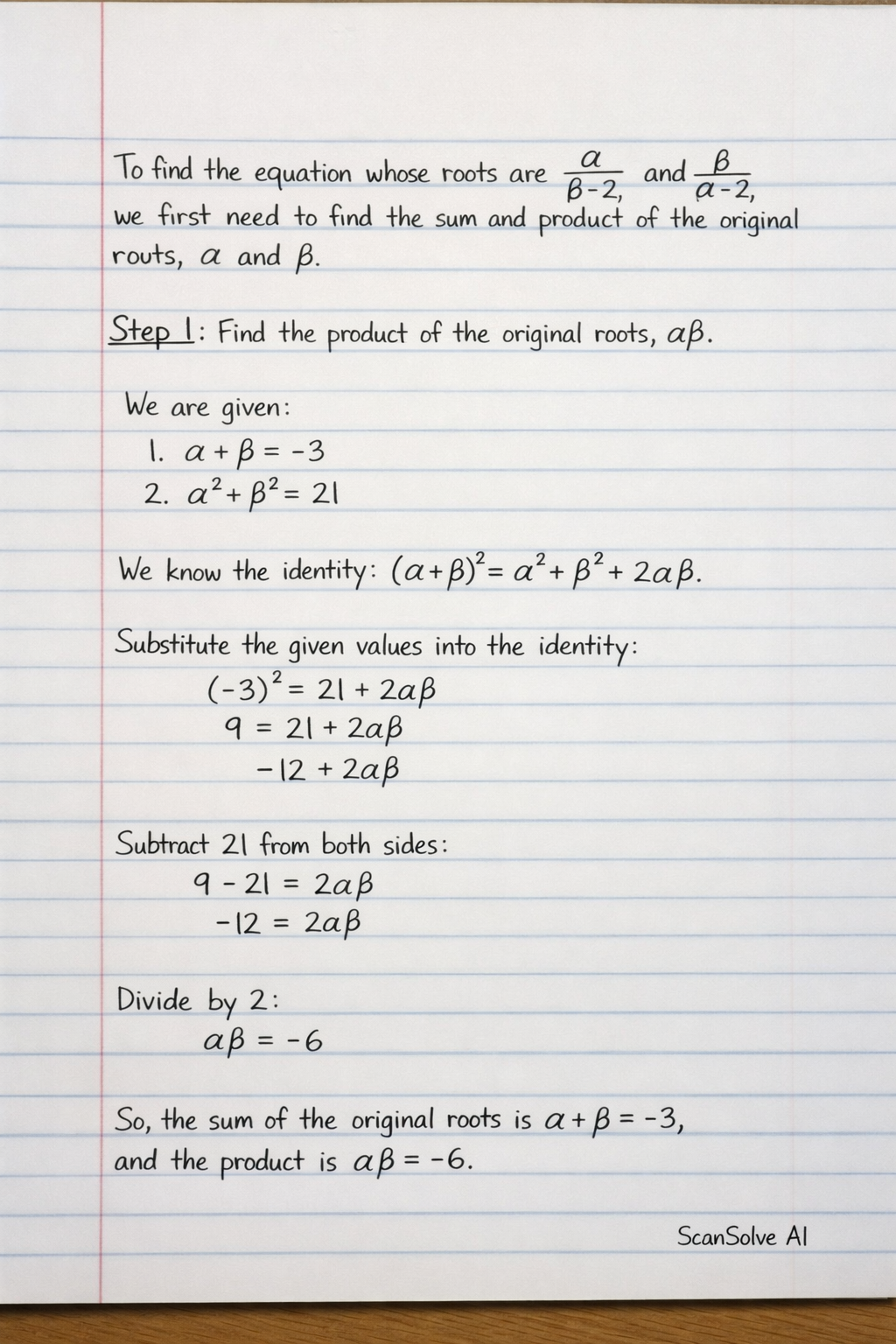
Handwritten Step-by-Step Solution
Get this as a handwritten image on WhatsApp — like a tutor wrote it for you.
Try on WhatsApp