
We read your photo as:
If theta is an angle, then 2theta + (1+)(1-) = ?
Mathematics
ScanSolve AI Answer
Step-by-step solution
6 stepsQuestion 73: If is an angle, then
Simplify the product .
This is a difference of squares, which follows the formula .
Here, and .Substitute this simplified term back into the original expression.
The expression becomes:
Use the Pythagorean trigonometric identity.
Recall the identity: .
Substitute with in the expression.
Combine like terms.
The value of the expression is 2.
Compare the result with the given options.
A. -1
B. 0
C. 1
D. 2The calculated value matches option D.
The final answer is .
Was this helpful?
Still stuck on this one?
Ask a follow-up, and the answer starts from this question.
Got a different question?Ask your own question
More Mathematics Questions
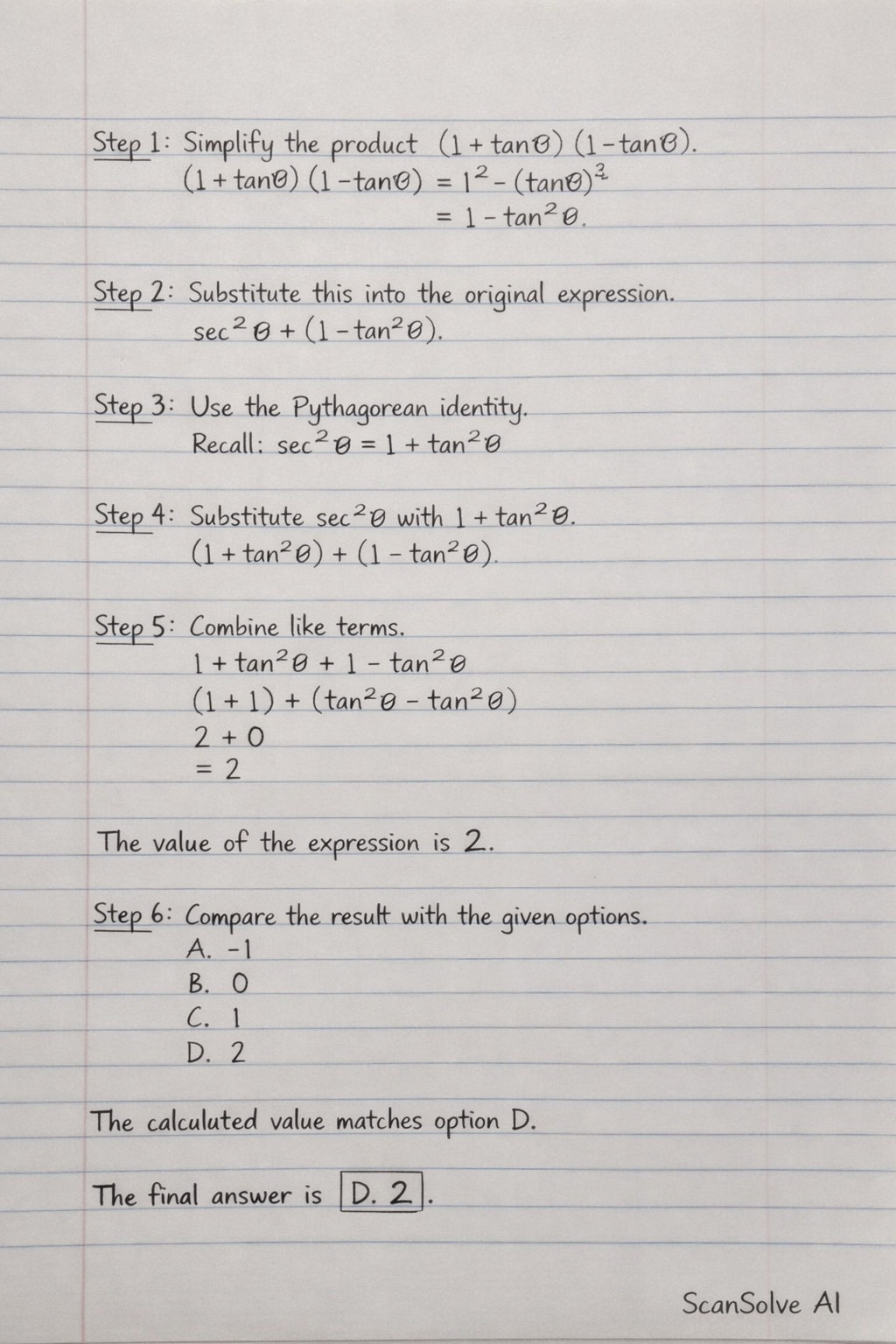
Handwritten Step-by-Step Solution
Get this as a handwritten image on WhatsApp — like a tutor wrote it for you.
Try on WhatsApp