
We read your photo as:
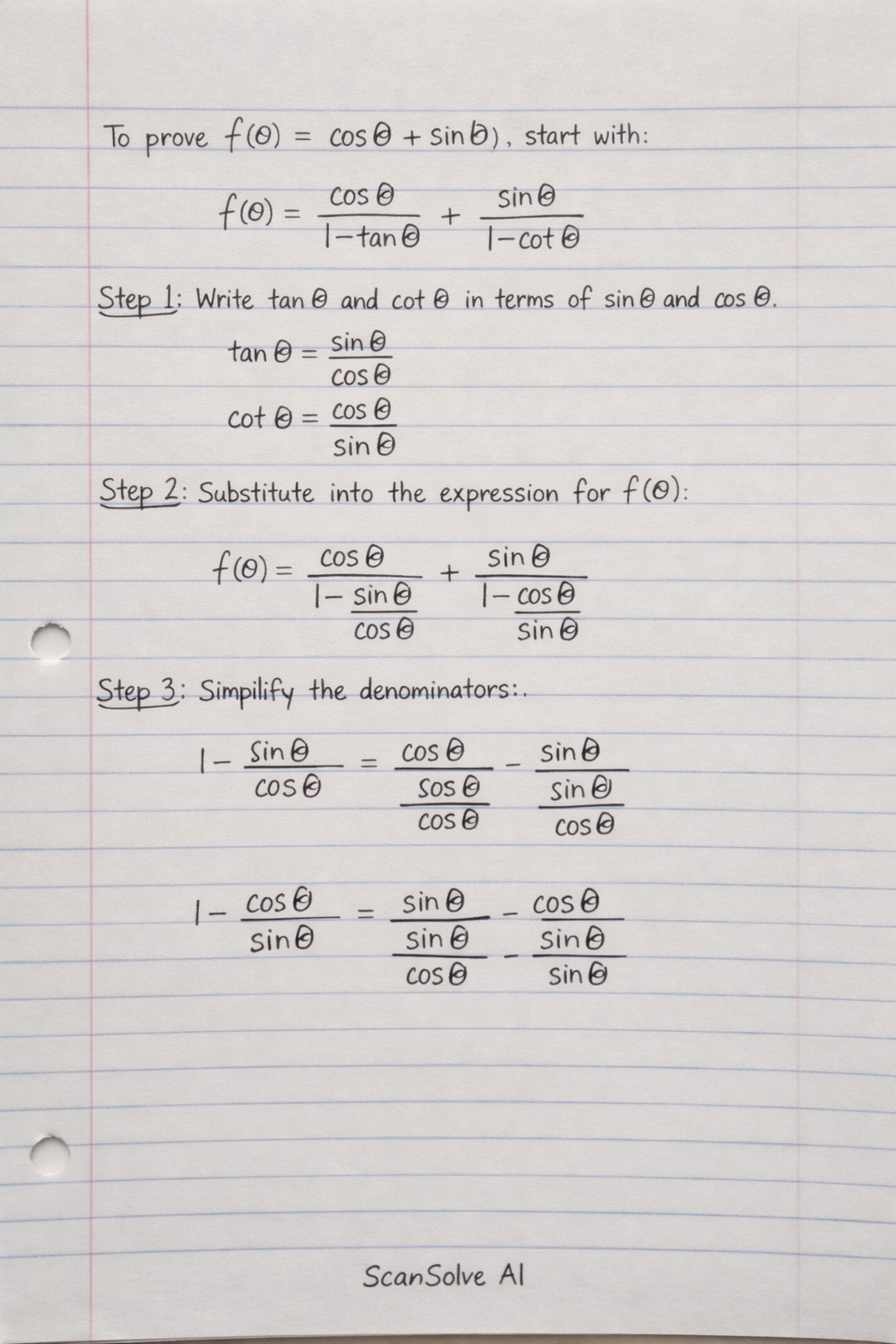
Prove the identity ( theta)/(1- theta) + ( theta)/(1− theta) = theta + theta.
Mathematics
ScanSolve AI Answer
Answer
Step-by-step solution
10 stepsTo prove the identity , we start with the given expression for :
Express and in terms of and .
We know that and .
Substitute these into the expression for .
Simplify the denominators by finding a common denominator for each term.
Substitute the simplified denominators back into the expression for .
Invert the denominators and multiply.
Notice that the denominators are negatives of each other
.
Rewrite the second term with the common denominator .Combine the fractions since they now have a common denominator.
Apply the difference of squares identity, , where and .
Substitute this back into the expression for .
Cancel out the common term , assuming .
Thus, we have proven that .
The final answer is .
Was this helpful?
Try one yourself
A new problem that tests the same skill.
Still stuck on this one?
Ask a follow-up, and the answer starts from this question.
Got a different question?Ask your own question
More Mathematics Questions
QProve the Identity: ( theta + 2theta * theta)/( theta) = thetaQProve the identity f( heta) = ( theta)/(1- theta) + ( theta)/(1- theta) theta + theta.QProve the identity ( 3theta - 3theta)/(1 − 2 2theta) = theta + theta. Identify any errors in the…QProve that (2(pi + theta) (3pi)/(2) + theta)2((3pi)/(2) - theta) 2(pi - theta) (2pi - theta) =
Handwritten Step-by-Step Solution
Get this as a handwritten image on WhatsApp — like a tutor wrote it for you.
Try on WhatsApp