
If x²+2=0 and x²=-4 give rise to complex numbers, what if the constant is an odd number
ScanSolve AI Answer
Answer
Step-by-step solution
4 stepsConsider the general form of the equation .
This equation can be rearranged to solve for :
If the constant is a positive odd number (like 1, 3, 5, etc.), let's use as an example.
To find , we take the square root of both sides.
We know that (the imaginary unit).
So, we can rewrite the expression:
These solutions are complex numbers.
The parity (odd or even) of a positive constant in an equation of the form does not change the nature of the solutions. As long as is positive, will be negative, and taking the square root of a negative number will always result in complex numbers.
The solutions will still be complex numbers.
Try one yourself
A new problem that tests the same skill.
Still stuck on this one?
Ask a follow-up, and the answer starts from this question.
More Mathematics Questions
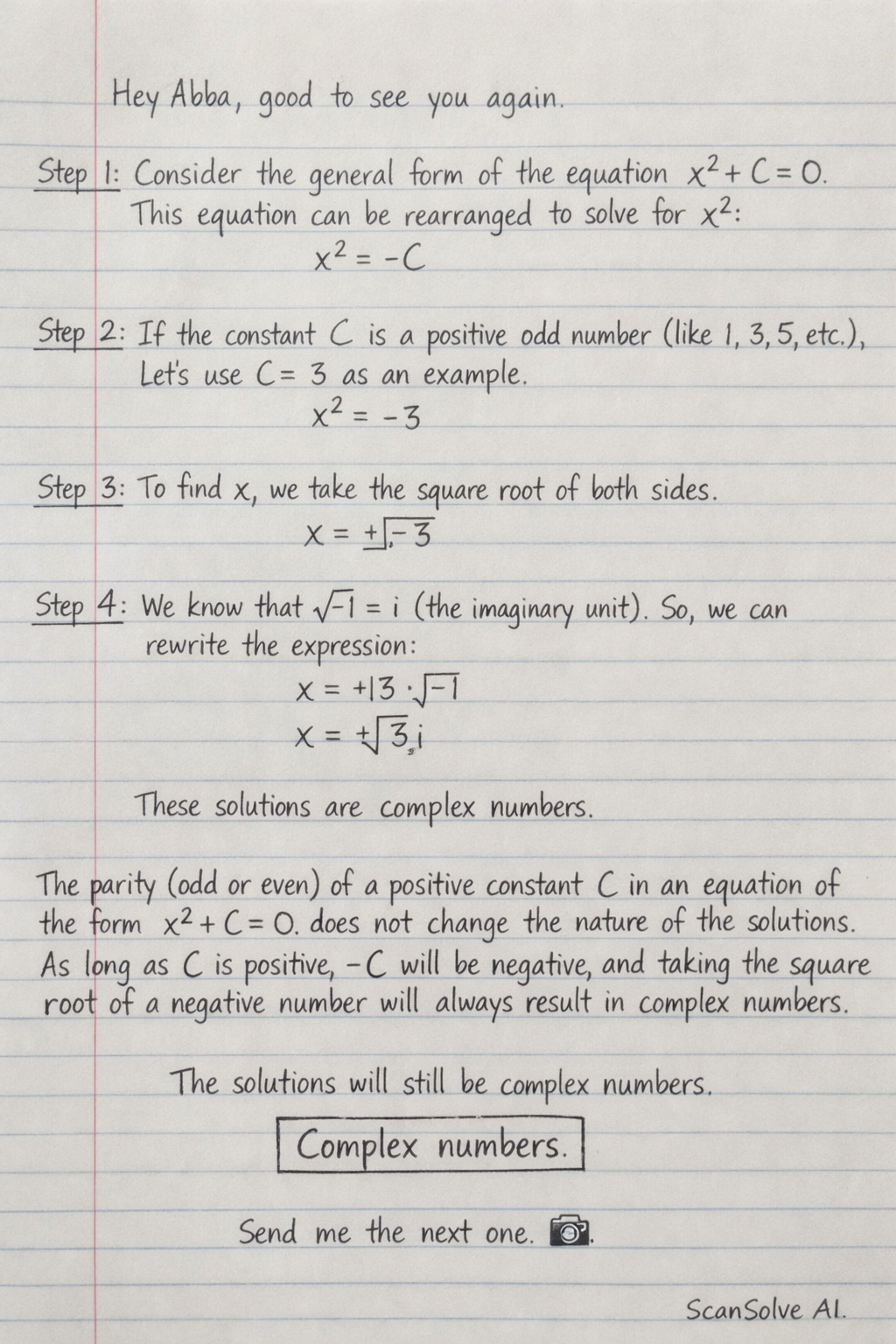
Handwritten Step-by-Step Solution
Get this as a handwritten image on WhatsApp — like a tutor wrote it for you.
Try on WhatsApp