We read your photo as:

If x and y are real, solve the equation: (jx)/(1+jy) = (3x+j4)/(x+3y)

Mathematics

ScanSolve AI Answer

Step-by-step solution

10 steps

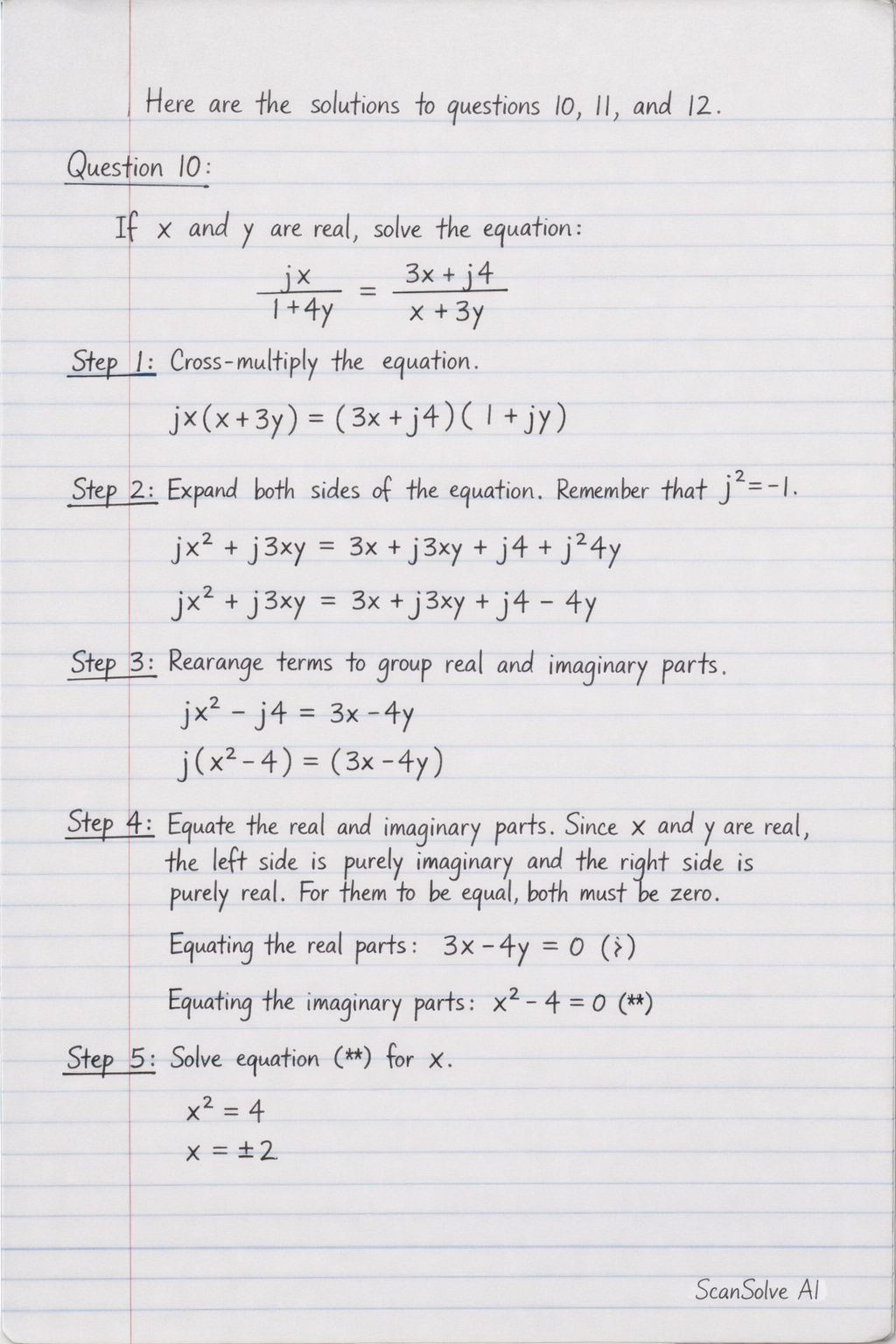
Here are the solutions to questions 10, 11, and 12.

Question 10:
If xx and yy are real, solve the equation:

jx1+jy=3x+j4x+3y\frac{jx}{1+jy} = \frac{3x+j4}{x+3y}
  1. Cross-multiply the equation.

    jx(x+3y)=(3x+j4)(1+jy)jx(x+3y) = (3x+j4)(1+jy)
  2. Expand both sides of the equation.

    Remember that j2=−1j^2 = -1.

    jx2+j3xy=3x+j3xy+j4+j24yjx^2 + j3xy = 3x + j3xy + j4 + j^24y jx2+j3xy=3x+j3xy+j4−4yjx^2 + j3xy = 3x + j3xy + j4 - 4y
  3. Rearrange terms to group real and imaginary parts.

    jx2−j4=3x−4yjx^2 - j4 = 3x - 4y j(x2−4)=(3x−4y)j(x^2 - 4) = (3x - 4y)
  4. Equate the real and imaginary parts.

    Since xx and yy are real, the left side is purely imaginary and the right side is purely real. For them to be equal, both must be zero.
    Equating the real parts:

    3x−4y=0(∗)3x - 4y = 0 \quad (*)

    Equating the imaginary parts:

    x2−4=0(∗∗)x^2 - 4 = 0 \quad (**)
  5. Solve equation (∗∗)(**) for xx.

    x2=4x^2 = 4 x=±2x = \pm 2
  6. Substitute the values of xx into equation (∗)(*) to find yy.

    Case 1: x=2x=2

    3(2)−4y=03(2) - 4y = 0 6−4y=06 - 4y = 0 4y=64y = 6 y=64=32y = \frac{6}{4} = \frac{3}{2}

    Case 2: x=−2x=-2

    3(−2)−4y=03(-2) - 4y = 0 −6−4y=0-6 - 4y = 0 4y=−64y = -6 y=−64=−32y = \frac{-6}{4} = -\frac{3}{2}

    The solutions are x=2,y=32\boxed{x=2, y=\frac{3}{2}} and x=−2,y=−32\boxed{x=-2, y=-\frac{3}{2}}.

    Question 11:
    If z=a+jbc+jdz = \frac{a+jb}{c+jd}, where a,b,ca, b, c and dd are real quantities, show that

    (a) if zz is real then ab=cd\frac{a}{b} = \frac{c}{d}

    (b) if zz is entirely imaginary then ab=−dc\frac{a}{b} = -\frac{d}{c}

  7. Express zz in the form X+jYX+jY by multiplying the numerator and denominator by the conjugate of the denominator.

    z=a+jbc+jd×c−jdc−jdz = \frac{a+jb}{c+jd} \times \frac{c-jd}{c-jd} z=(a+jb)(c−jd)c2−(jd)2z = \frac{(a+jb)(c-jd)}{c^2 - (jd)^2} z=ac−ajd+jbc−j2bdc2−j2d2z = \frac{ac - ajd + jbc - j^2bd}{c^2 - j^2d^2}

    Since j2=−1j^2 = -1:

    z=ac−ajd+jbc+bdc2+d2z = \frac{ac - ajd + jbc + bd}{c^2 + d^2} z=(ac+bd)+j(bc−ad)c2+d2z = \frac{(ac+bd) + j(bc-ad)}{c^2+d^2} z=ac+bdc2+d2+jbc−adc2+d2z = \frac{ac+bd}{c^2+d^2} + j\frac{bc-ad}{c^2+d^2}

    Let the real part be X=ac+bdc2+d2X = \frac{ac+bd}{c^2+d^2} and the imaginary part be Y=bc−adc2+d2Y = \frac{bc-ad}{c^2+d^2}.

    a) If zz is real, its imaginary part must be zero.

    Y=0Y = 0 bc−adc2+d2=0\frac{bc-ad}{c^2+d^2} = 0

    Since c2+d2≠0c^2+d^2 \neq 0, the numerator must be zero:

    bc−ad=0bc-ad = 0 bc=adbc = ad

    Divide both sides by bdbd (assuming b≠0b \neq 0 and d≠0d \neq 0):

    bcbd=adbd\frac{bc}{bd} = \frac{ad}{bd} cd=ab\frac{c}{d} = \frac{a}{b}

    This shows that if zz is real, then ab=cd\boxed{\frac{a}{b} = \frac{c}{d}}.

    b) If zz is entirely imaginary, its real part must be zero.

    X=0X = 0 ac+bdc2+d2=0\frac{ac+bd}{c^2+d^2} = 0

    Since c2+d2≠0c^2+d^2 \neq 0, the numerator must be zero:

    ac+bd=0ac+bd = 0 ac=−bdac = -bd

    Divide both sides by bcbc (assuming b≠0b \neq 0 and c≠0c \neq 0):

    acbc=−bdbc\frac{ac}{bc} = \frac{-bd}{bc} ab=−dc\frac{a}{b} = -\frac{d}{c}

    This shows that if zz is entirely imaginary, then ab=−dc\boxed{\frac{a}{b} = -\frac{d}{c}}.

    Question 12:
    Given that (a+b)+j(a−b)=(1+j)2+j(2+j)(a+b)+j(a-b) = (1+j)^2 + j(2+j), obtain the values of aa and bb.

  8. Simplify the right-hand side (RHS) of the equation.

    (1+j)2+j(2+j)(1+j)^2 + j(2+j)

    Expand (1+j)2(1+j)^2:

    (1+j)2=12+2(1)(j)+j2=1+2j−1=2j(1+j)^2 = 1^2 + 2(1)(j) + j^2 = 1 + 2j - 1 = 2j

    Expand j(2+j)j(2+j):

    j(2+j)=2j+j2=2j−1j(2+j) = 2j + j^2 = 2j - 1

    Now, add the simplified parts:

    2j+(2j−1)=4j−12j + (2j - 1) = 4j - 1

    So, the RHS is −1+4j-1 + 4j.

  9. Equate the real and imaginary parts of the given equation.

    The equation is now:

    (a+b)+j(a−b)=−1+4j(a+b)+j(a-b) = -1 + 4j

    Equating the real parts:

    a+b=−1(1)a+b = -1 \quad (1)

    Equating the imaginary parts:

    a−b=4(2)a-b = 4 \quad (2)
  10. Solve the system of linear equations for aa and bb.

    Add equation (1) and equation (2):

    (a+b)+(a−b)=−1+4(a+b) + (a-b) = -1 + 4 2a=32a = 3 a=32a = \frac{3}{2}

    Substitute the value of aa into equation (1):

    32+b=−1\frac{3}{2} + b = -1 b=−1−32b = -1 - \frac{3}{2} b=−22−32b = -\frac{2}{2} - \frac{3}{2} b=−52b = -\frac{5}{2}

    The values are a=32,b=−52\boxed{a=\frac{3}{2}, b=-\frac{5}{2}}.

Was this helpful?

Still stuck on this one?

Ask a follow-up, and the answer starts from this question.

Got a different question?Ask your own question
Handwritten step-by-step solution preview

Handwritten Step-by-Step Solution

Get this as a handwritten image on WhatsApp — like a tutor wrote it for you.

Try on WhatsApp