

This mathematics problem involves applying core mathematical principles and formulas. Below you will find a complete step-by-step solution with detailed explanations for each step, helping you understand not just the answer but the method behind it.
ScanSolve AI Answer
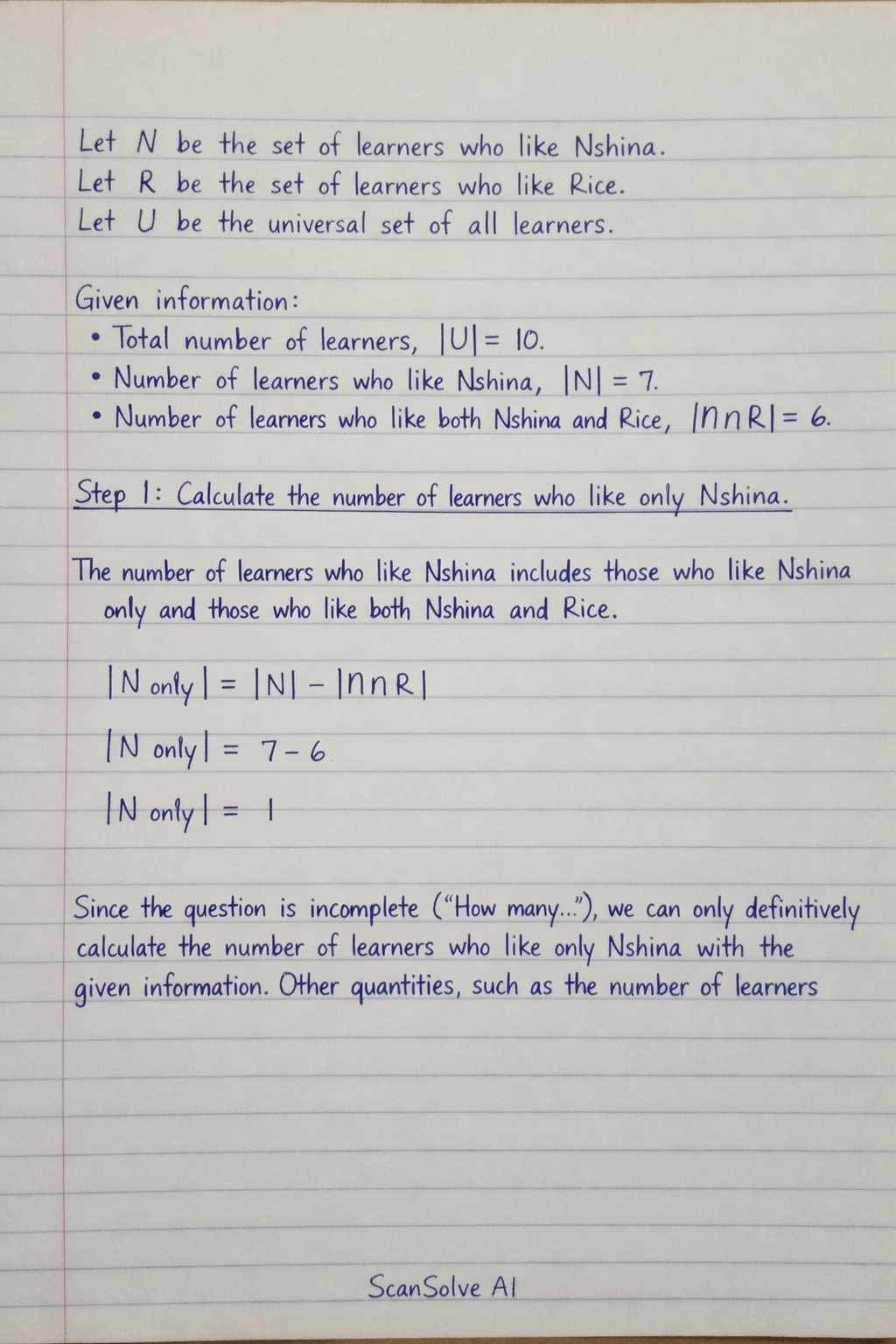
Let N be the set of learners who like Nshina. Let R be the set of learners who like Rice. Let U be the universal set of all learners. Given information: • Total number of learners, |U| = 10. • Number of learners who like Nshina, |N| = 7. • Number of learners who like both Nshina and Rice, |N R| = 6. Step 1: Calculate the number of learners who like only Nshina. The number of learners who like Nshina includes those who like Nshina only and those who like both Nshina and Rice. |N only| = |N| - |N R| |N only| = 7 - 6 |N only| = 1 Since the question is incomplete ("How many..."), we can only definitively calculate the number of learners who like only Nshina with the given information. Other quantities, such as the number of learners