
We read your photo as:
In a geometric sequence, the sum of the first two terms is 135, and the sum of the third and fourth terms is 60. If the common ratio is positive, calculate the common ratio, the first term, and the su
ScanSolve AI Answer
Answers
2 partsStep-by-step solution
4 stepsLet the first term of the exponential sequence be and the common ratio be .
The terms of a geometric sequence are .
Given information:
-
The sum of the first two terms is 135: (Equation 1)
-
The sum of the third and fourth terms is 60: (Equation 2)
-
The common ratio is positive.
Part i· 2 steps
Calculate the common ratio and the first term.
Divide Equation 2 by Equation 1 to find the common ratio .
Simplify the fraction:
Take the square root of both sides:
Since the common ratio is positive, we take the positive value.
Substitute the value of into Equation 1 to find the first term .
The common ratio is and the first term is .
Part ii243
Calculate the limit of the sum of the first terms as becomes large.
This refers to the sum to infinity of a geometric series, denoted as . The formula for the sum to infinity is , provided that .
Check the condition for the sum to infinity.
We have .
Since , the sum to infinity exists.
Calculate the sum to infinity using and .
The limit of the sum of the first terms as becomes large is .
Try one yourself
A new problem that tests the same skill.
Still stuck on this one?
Ask a follow-up, and the answer starts from this question.
More Mathematics Questions
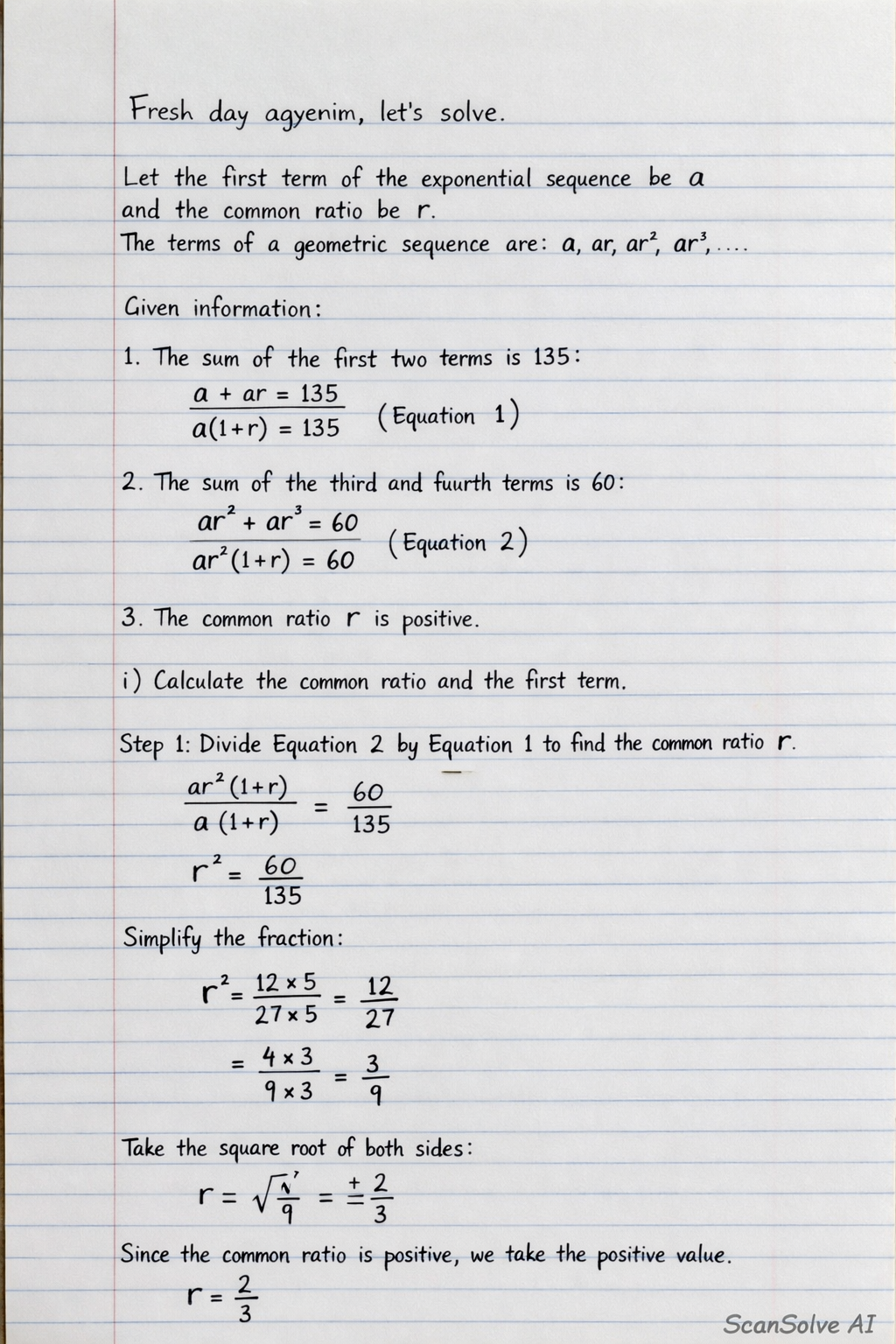
Handwritten Step-by-Step Solution
Get this as a handwritten image on WhatsApp — like a tutor wrote it for you.
Try on WhatsApp