
We read your photo as:
In a parallelogram ABCD, AB=10 cm, BC=14 cm, and angle B is 50 degrees. D and E are the midpoints of AB and AC respectively. Calculate DE and angle ADE.
ScanSolve AI Answer
Step-by-step solution
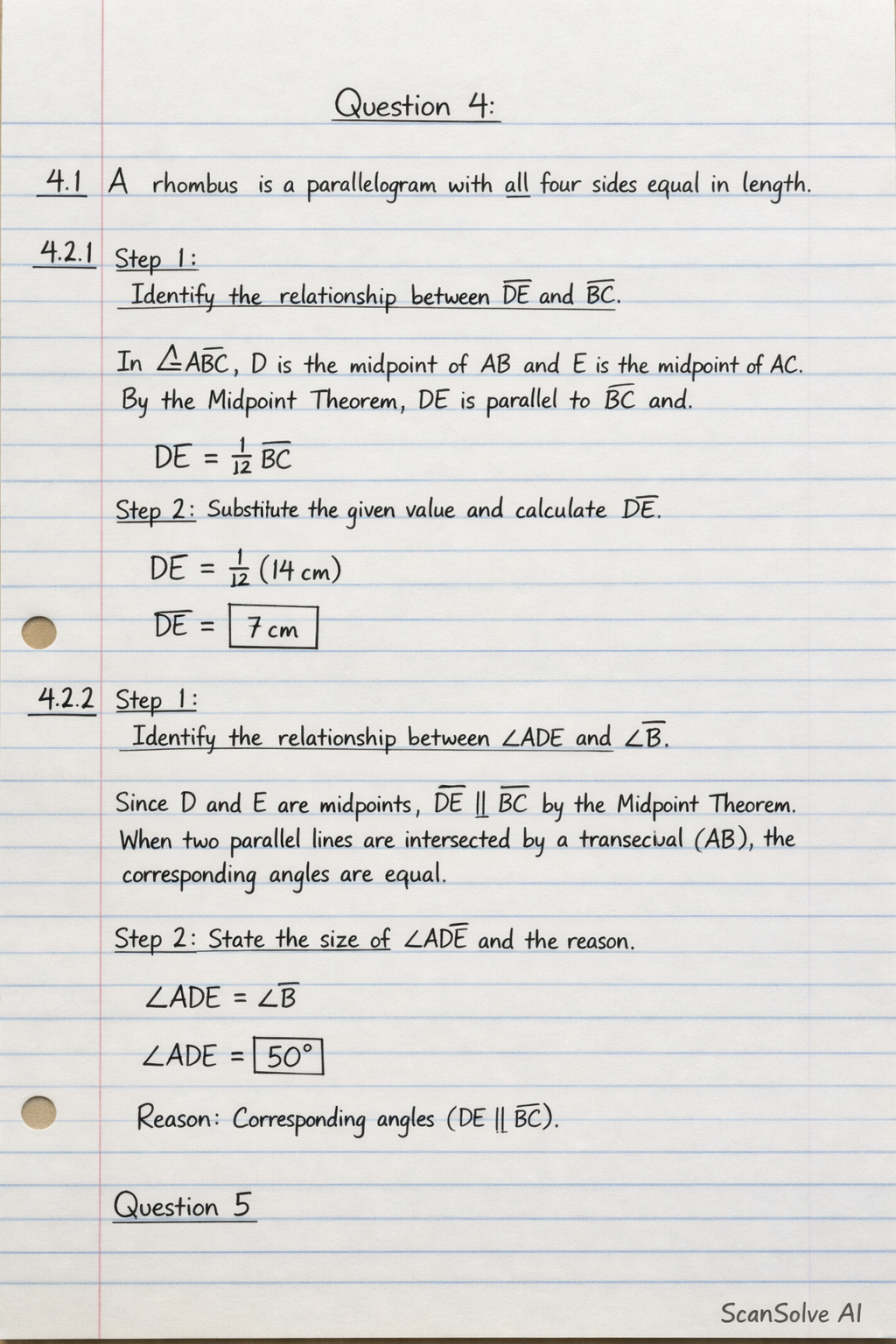
10 stepsQuestion 4
4.1 A rhombus is a parallelogram with all four sides equal in length.
4.2.1
Identify the relationship between and .
In , is the midpoint of and is the midpoint of . By the Midpoint Theorem, the line segment connecting the midpoints of two sides of a triangle is parallel to the third side and is half the length of the third side.
Substitute the given value and calculate .
4.2.2
Identify the relationship between and .
Since and are midpoints, by the Midpoint Theorem. When two parallel lines are intersected by a transversal (), the corresponding angles are equal.
State the size of and the reason.
Reason: Corresponding angles ().
Question 5
5.1
Identify properties of a parallelogram .
In parallelogram , and (opposite sides of a parallelogram are parallel and equal).
Use the given perpendicular lines.
Given and , this means and .
Prove congruence using AAS.
Consider and :
- (Given and )
- (Opposite sides of parallelogram )
- (Alternate interior angles, since and is a transversal) Therefore, (AAS congruence criterion).
5.2
Use the result from 5.1.
Since (proven in 5.1), their corresponding sides are equal.
Therefore, .Determine the relationship between and .
Given and . If two lines are perpendicular to the same line, then they are parallel to each other.
Therefore, .Conclude that is a parallelogram.
Since one pair of opposite sides ( and ) in quadrilateral is both equal in length and parallel, is a parallelogram.
Still stuck on this one?
Ask a follow-up, and the answer starts from this question.
More Mathematics Questions
Handwritten Step-by-Step Solution
Get this as a handwritten image on WhatsApp — like a tutor wrote it for you.
Try on WhatsApp