
We read your photo as:
In a parallelogram ABCD, the bisectors of angles A and B meet at point K. Prove that angle AKB is a right angle.
ScanSolve AI Answer
Answer
Step-by-step solution
6 stepsIdentify properties of a parallelogram.
In a parallelogram ABCD, consecutive angles are supplementary. This means that the sum of adjacent angles is .
Therefore, .Use the definition of angle bisectors.
AK bisects , which means it divides the angle into two equal parts.
So, .
BK bisects , which means it divides the angle into two equal parts.
So, .Combine the properties from Step 1 and Step 2.
Divide the equation from Step 1 by 2:
Substitute the expressions for and from Step 2 into this equation:
Apply the angle sum property in .
The sum of angles in any triangle is . For :
Solve for .
Substitute the result from Step 3 into the equation from Step 4:
Subtract from both sides:
Conclude the perpendicularity.
Since , it means that line segment AK is perpendicular to line segment BK.
Try one yourself
A new problem that tests the same skill.
Still stuck on this one?
Ask a follow-up, and the answer starts from this question.
More Mathematics Questions
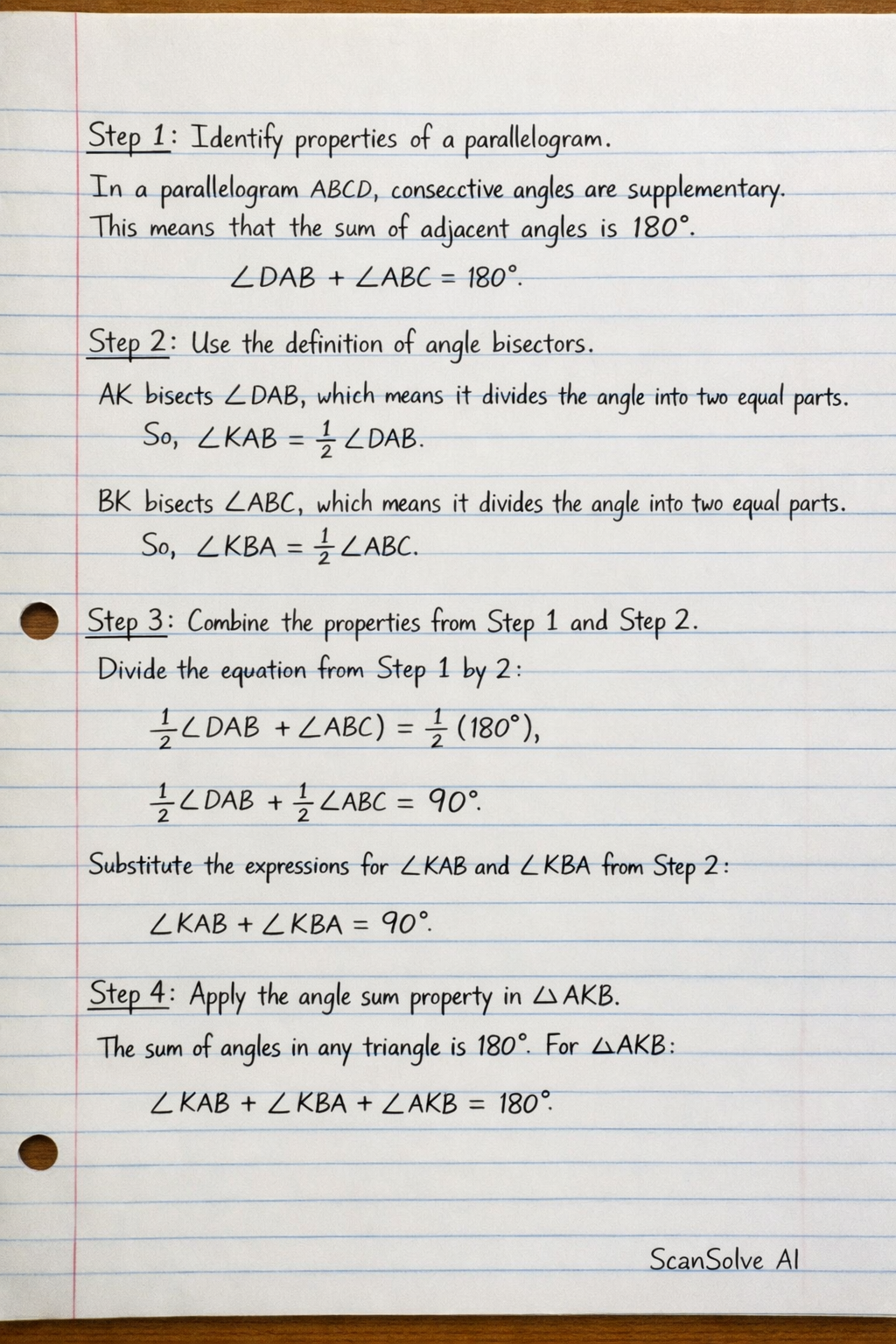
Handwritten Step-by-Step Solution
Get this as a handwritten image on WhatsApp — like a tutor wrote it for you.
Try on WhatsApp