We read your photo as:

In a right-angled triangle, the longest side has a length of 300 mm, while the horizontal length is 250 mm. Calculate the vertical length and both included angles.

Mathematics

ScanSolve AI Answer

Answers

6 parts
5.1
0.3420
5.2
0.8660
5.3
1
6.1

56.48∘56.48^\circ

6.2

55.15∘55.15^\circ

6.3

88.21∘88.21^\circ

Step-by-step solution

4 steps

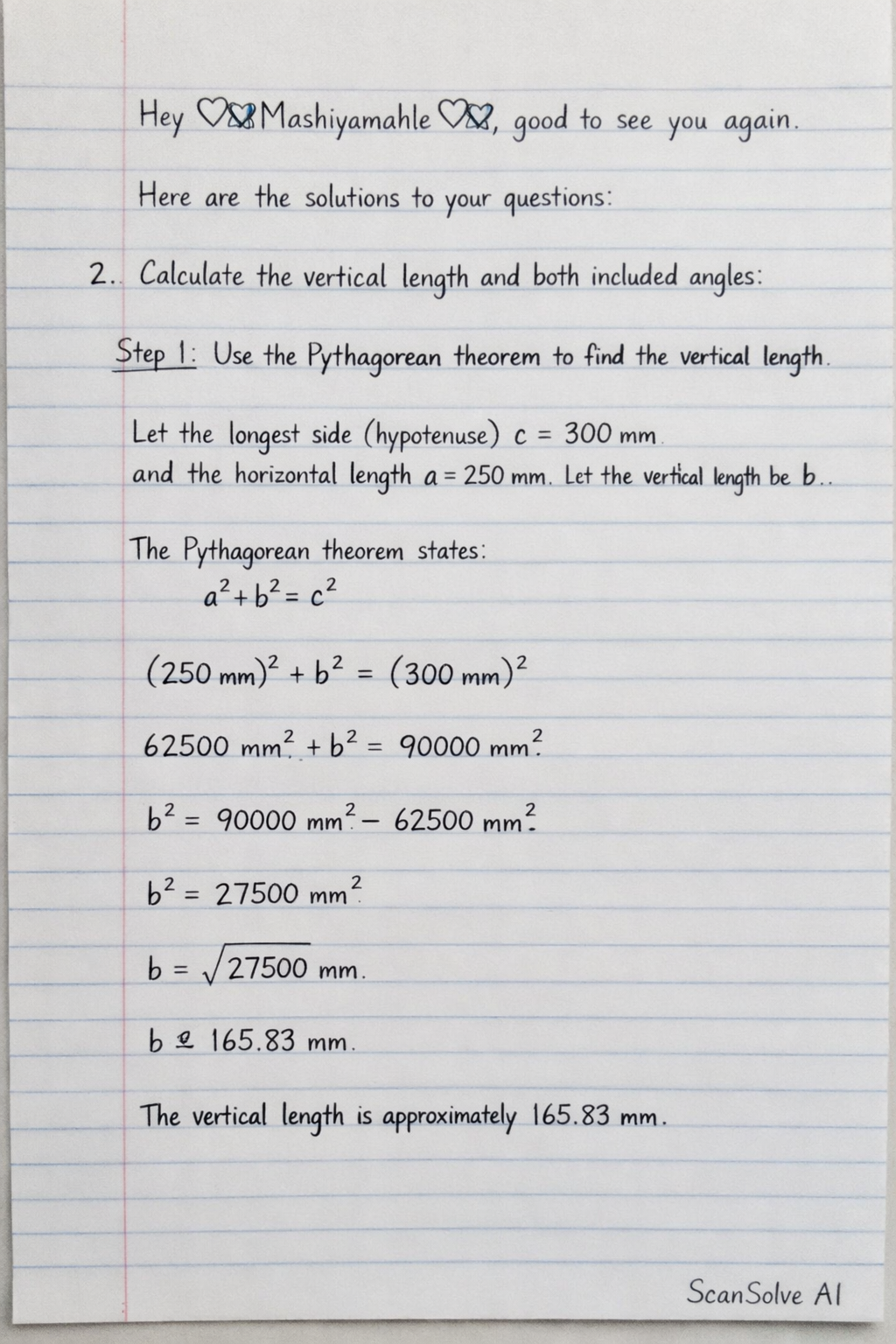
Here are the solutions to your questions:

2. Calculate the vertical length and both included angles.

  1. Use the Pythagorean theorem to find the vertical length.

    Let the longest side (hypotenuse) be c=300c = 300 mm and the horizontal length be a=250a = 250 mm. Let the vertical length be bb.
    The Pythagorean theorem states a2+b2=c2a^2 + b^2 = c^2.

    (250 mm)2+b2=(300 mm)2(250\, \text{mm})^2 + b^2 = (300\, \text{mm})^2 62500 mm2+b2=90000 mm262500\, \text{mm}^2 + b^2 = 90000\, \text{mm}^2 b2=90000 mm2−62500 mm2b^2 = 90000\, \text{mm}^2 - 62500\, \text{mm}^2 b2=27500 mm2b^2 = 27500\, \text{mm}^2 b=27500 mmb = \sqrt{27500}\, \text{mm} b≈165.83 mmb \approx 165.83\, \text{mm}

    The vertical length is approximately 165.83 mm.

  2. Calculate the included angles using trigonometric ratios.

    Let θ1\theta_1 be the angle opposite the vertical side (bb) and adjacent to the horizontal side (aa).

    cos⁡(θ1)=adjacenthypotenuse=250 mm300 mm\cos(\theta_1) = \frac{\text{adjacent}}{\text{hypotenuse}} = \frac{250\, \text{mm}}{300\, \text{mm}} cos⁡(θ1)=2530=56\cos(\theta_1) = \frac{25}{30} = \frac{5}{6} θ1=arccos⁡(56)\theta_1 = \arccos\left(\frac{5}{6}\right) θ1≈33.56∘\theta_1 \approx 33.56^\circ

    Let θ2\theta_2 be the angle opposite the horizontal side (aa) and adjacent to the vertical side (bb).

    sin⁡(θ2)=oppositehypotenuse=250 mm300 mm\sin(\theta_2) = \frac{\text{opposite}}{\text{hypotenuse}} = \frac{250\, \text{mm}}{300\, \text{mm}} sin⁡(θ2)=56\sin(\theta_2) = \frac{5}{6} θ2=arcsin⁡(56)\theta_2 = \arcsin\left(\frac{5}{6}\right) θ2≈56.44∘\theta_2 \approx 56.44^\circ

    Alternatively, since the sum of angles in a triangle is 180∘180^\circ and one angle is 90∘90^\circ:

    θ2=180∘−90∘−θ1=90∘−33.56∘≈56.44∘\theta_2 = 180^\circ - 90^\circ - \theta_1 = 90^\circ - 33.56^\circ \approx 56.44^\circ

    The vertical length is approximately 165.83 mm, and the included angles are approximately 33.56∘33.56^\circ and 56.44∘56.44^\circ.

    3. Work out the longest side of a right-angled triangle if the shorter sides are 50 mm and 220 mm.

  3. Use the Pythagorean theorem.

    Let the shorter sides be a=50a = 50 mm and b=220b = 220 mm. Let the longest side (hypotenuse) be cc.

    c2=a2+b2c^2 = a^2 + b^2 c2=(50 mm)2+(220 mm)2c^2 = (50\, \text{mm})^2 + (220\, \text{mm})^2 c2=2500 mm2+48400 mm2c^2 = 2500\, \text{mm}^2 + 48400\, \text{mm}^2 c2=50900 mm2c^2 = 50900\, \text{mm}^2 c=50900 mmc = \sqrt{50900}\, \text{mm} c≈225.61 mmc \approx 225.61\, \text{mm}

    The longest side is approximately 225.61 mm\boxed{225.61\, \text{mm}}.

    4. Work out the shorter side of a right-angled triangle if the longest side is 120 mm and the other shorter side is 90 mm.

  4. Use the Pythagorean theorem.

    Let the longest side (hypotenuse) be c=120c = 120 mm and one shorter side be a=90a = 90 mm. Let the other shorter side be bb.

    a2+b2=c2a^2 + b^2 = c^2 (90 mm)2+b2=(120 mm)2(90\, \text{mm})^2 + b^2 = (120\, \text{mm})^2 8100 mm2+b2=14400 mm28100\, \text{mm}^2 + b^2 = 14400\, \text{mm}^2 b2=14400 mm2−8100 mm2b^2 = 14400\, \text{mm}^2 - 8100\, \text{mm}^2 b2=6300 mm2b^2 = 6300\, \text{mm}^2 b=6300 mmb = \sqrt{6300}\, \text{mm} b≈79.37 mmb \approx 79.37\, \text{mm}

    The shorter side is approximately 79.37 mm\boxed{79.37\, \text{mm}}.

    5. Use your calculator to work out the ratios for these angles:

    5.1 sin 20°

    sin⁡(20∘)≈0.3420\sin(20^\circ) \approx \boxed{0.3420}

    5.2 cos 30°

    cos⁡(30∘)≈0.8660\cos(30^\circ) \approx \boxed{0.8660}

    5.3 tan 45°

    tan⁡(45∘)=1\tan(45^\circ) = \boxed{1}

    6. Use your calculator to work out the angles for these ratios:

    6.1 sin x = 0.8337

    x=arcsin⁡(0.8337)x = \arcsin(0.8337) x≈56.48∘x \approx \boxed{56.48^\circ}

    6.2 cos x = 8/14

    cos⁡x=814=47\cos x = \frac{8}{14} = \frac{4}{7} x=arccos⁡(47)x = \arccos\left(\frac{4}{7}\right) x≈55.15∘x \approx \boxed{55.15^\circ}

    6.3 tan x = 32

    x=arctan⁡(32)x = \arctan(32) x≈88.21∘x \approx \boxed{88.21^\circ}
Was this helpful?

Still stuck on this one?

Ask a follow-up, and the answer starts from this question.

Got a different question?Ask your own question
Handwritten step-by-step solution preview

Handwritten Step-by-Step Solution

Get this as a handwritten image on WhatsApp — like a tutor wrote it for you.

Try on WhatsApp