
We read your photo as:
Write in figures: One and a half million. 2) Express % as a decimal. 3) Expand 72 x 53. 4) Which of these years was a leap year: 2020, 2021, 2022?
ScanSolve AI Answer
Step-by-step solution
34 steps1) Numbers can either be written in figures, words or Roman numerals. Write in figures: One and a half million
Understand "one million".
One million is 1,000,000.
Understand "half million".
Half a million is .
Combine "one million" and "half million".
.
In figures, one and a half million is .2) Fractions can be expressed as decimals. Express % as a decimal
This question asks how to express a percentage as a decimal in general.Understand that "percent" means "per hundred" or "out of 100".
To convert a percentage to a decimal, divide the percentage value by 100.
For example, if you have , it is equivalent to as a decimal.
So, to express a percentage as a decimal, you divide the number by 100. For example, .3) Numbers written in index form can be expanded. Expand
Expand .
.
Expand .
.
Multiply the expanded values.
.
The expanded form is .4) Some years are called leap years. Which of these years was a leap year: 2020, 2021, 2022?
Recall the rules for a leap year.
A year is a leap year if it is divisible by 4, unless it is a century year (like 1900) which must be divisible by 400.
Check each given year.
- For 2020: . Since 2020 is divisible by 4, it is a leap year.
- For 2021: with a remainder of 1. So, 2021 is not a leap year.
- For 2022: with a remainder of 2. So, 2022 is not a leap year. The leap year among the given years is .
5) A mixed fraction can be converted to an improper fraction. Convert to an improper fraction.
Multiply the whole number by the denominator.
.
Add the numerator to the result from Step 1.
.
Place this sum over the original denominator.
The improper fraction is .
6) Write 16.53675 correct to 4 significant figures.
Identify the first four significant figures.
These are 1, 6, 5, 3.
Look at the fifth significant figure, which is 6.
Since the fifth significant figure (6) is 5 or greater, round up the fourth significant figure (3).
The number becomes 16.54.
16.53675 correct to 4 significant figures is .7) Given that and , calculate
Substitute the values of and into the expression.
Calculate the values inside the parentheses.
Square the numbers.
Add the results.
The value of the expression is .
8) The sum of two numbers is 502. If one of the numbers is 128, what is the value of the other number?
Let the two numbers be and .
Given .
Let one number be .
Substitute this into the equation.
.Solve for .
.
.
The value of the other number is .9) Modular arithmetic deals with the remainder. What is ?
Perform the addition.
.
Find the remainder when 10 is divided by 4.
with a remainder of .
So, .
is .10) A clock loses 2 minutes in every 3 hours. How many minutes does it lose in 15 hours?
Determine the rate of loss per hour.
Loss rate = .
Calculate the total loss for 15 hours.
Total loss = Loss rate Total hours
The clock loses in 15 hours.
11) After spending of my money on bread and on eggs, what fraction have I left?
Find the total fraction of money spent.
Total spent = .
Find a common denominator for the fractions, which is 12.
Add the fractions.
The total money is represented by 1 (or ).
Subtract the spent fraction from 1 to find the fraction left.
The fraction of money left is .
12) If , and , Find
Identify the universal set .
.
Find the intersection of Set A and Set B ().
This includes elements common to both A and B.
The common elements are 6 and 10.
.Find the complement of , denoted as .
This includes all elements in the universal set that are not in .
Elements in :
Elements in :
Remove from :
.
.
Still stuck on this one?
Ask a follow-up, and the answer starts from this question.
More Mathematics Questions
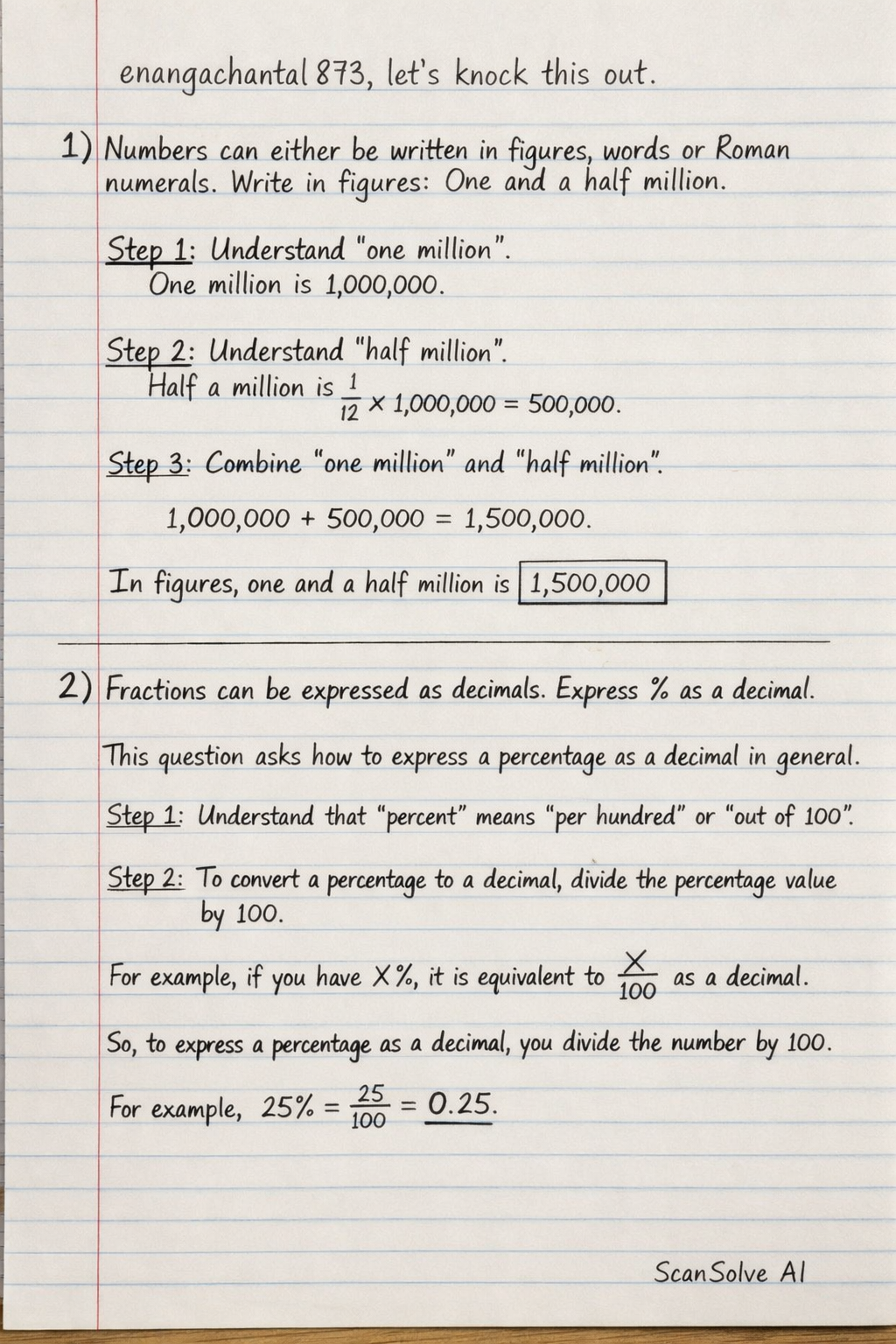
Handwritten Step-by-Step Solution
Get this as a handwritten image on WhatsApp — like a tutor wrote it for you.
Try on WhatsApp