
In thé questions WE asked to proove that A3+B3 =-8/27
Mathematics
ScanSolve AI Answer
Answer
Step-by-step solution
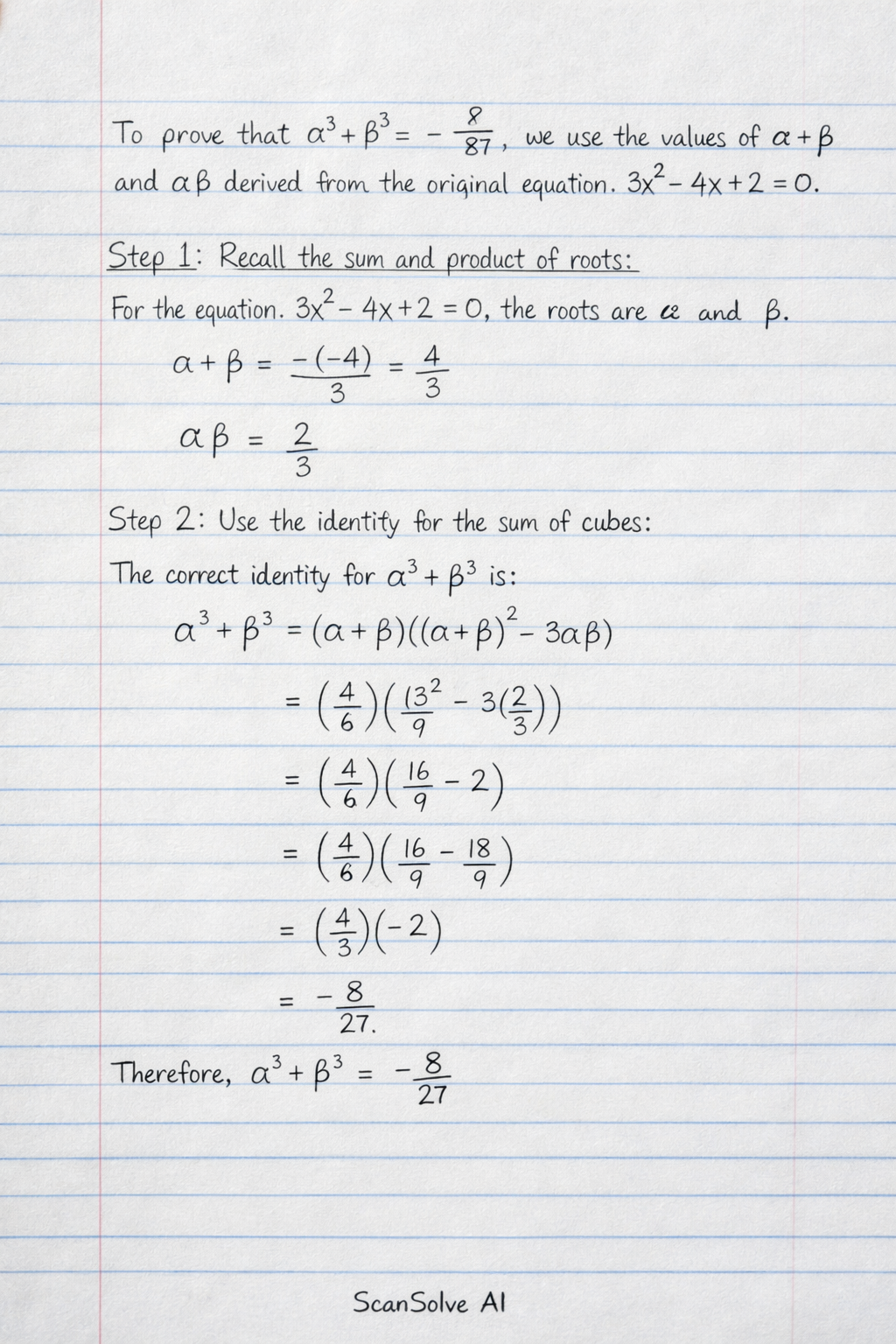
3 stepsTo prove that , we use the values of and derived from the original quadratic equation .
Recall the sum and product of roots.
For the equation , the roots are and .
Use the identity for the sum of cubes.
The correct identity for is:
Substitute the values of and into the identity.
Was this helpful?
Try one yourself
A new problem that tests the same skill.
Still stuck on this one?
Ask a follow-up, and the answer starts from this question.
Got a different question?Ask your own question
More Mathematics Questions
QShow that ( 3A − A)/( 3A + A) = 2AQA = (5/3 − 9/5) : (4 − 2/3) B = (6 / (6 − 5/2) − 2/3) × 7/4 C = (7 × 52 × 37) / (26 × 53 × 72) 2…QRésoudre les exercices suivants : 1) Vrai ou faux : a) L'inverse de l'opposé de 7/3 est 3/7. b)…QIf A=[2 3 −1/3 0 2], B=[1 1/2] and C=[1 −2] then prove that (AB)C = A(BC).QGiven the matrices A= ( −6 0 ) ( 2 −4 ), B= ( 5 −2 ) ( −3 1 ) Find i) A+B ii) A-B iii) 2A+3B iv)…
Handwritten Step-by-Step Solution
Get this as a handwritten image on WhatsApp — like a tutor wrote it for you.
Try on WhatsApp