
We read your photo as:
In the diagram A(-8;6); B; C; and D; are the vertices of a rhombus. The equation of BD is 3x−y=0. The diagonals of a rhombus intersect at K. 2.1 Calculate the perimeter of ABCD. Leave your answer in surd form 2.2 Determine the equation of diagonal AC in the form y=mx+c
ScanSolve AI Answer
Answers
2 partsStep-by-step solution
5 stepsHere are the solutions to the coordinate geometry problems:
Part 2.1· 2 steps
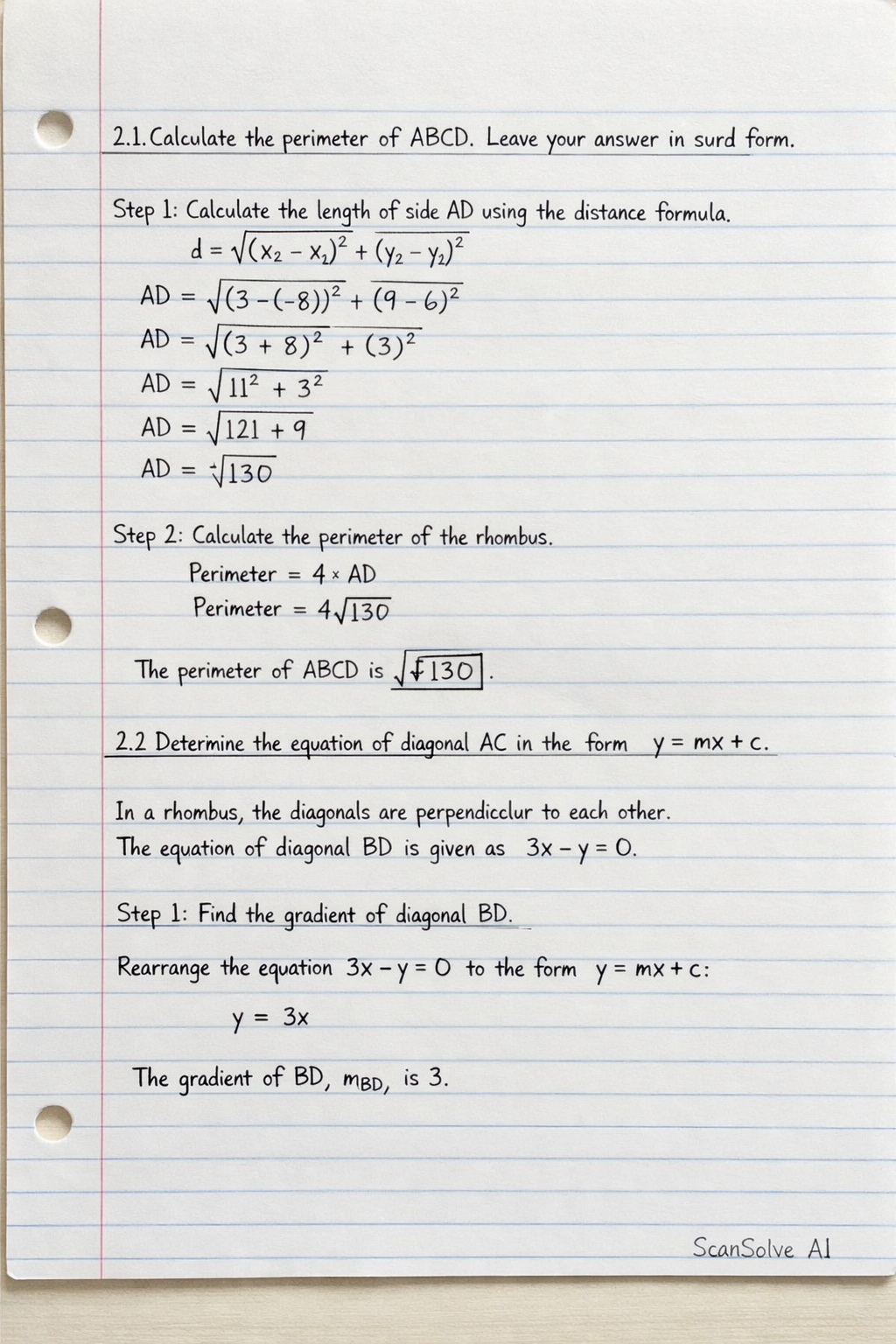
Calculate the perimeter of ABCD. Leave your answer in surd form.
A rhombus has four equal sides. We can calculate the length of one side, for example, AD, and then multiply it by 4 to find the perimeter.
Given points A and D .
Calculate the length of side AD using the distance formula .
Calculate the perimeter of the rhombus.
Perimeter
The perimeter of ABCD is .
Part 2.2
Determine the equation of diagonal AC in the form .
In a rhombus, the diagonals are perpendicular to each other.
The equation of diagonal BD is given as .
Find the gradient of diagonal BD.
Rearrange the equation to the form :
The gradient of BD, , is 3.
Find the gradient of diagonal AC.
Since the diagonals are perpendicular, the product of their gradients is .
Use the point A and the gradient to find the equation of AC.
Using the point-slope form :
Add 6 to both sides:
The equation of diagonal AC is .
Try one yourself
A new problem that tests the same skill.
Still stuck on this one?
Ask a follow-up, and the answer starts from this question.
More Mathematics Questions
Handwritten Step-by-Step Solution
Get this as a handwritten image on WhatsApp — like a tutor wrote it for you.
Try on WhatsApp