
We read your photo as:
In the diagram, ABCD is a parallelogram with AB = 14 units. AD is produced to E such that AD:DE = 4:3. EB intersects DC in F. EB = 21 units. Calculate, with reasons, the length of FB.
ScanSolve AI Answer
Answers
2 partsStep-by-step solution
7 stepsHere are the solutions to your geometry problem.
Part 9.1· 3 steps
Calculate, with reasons, the length of FB.
Identify similar triangles.
Since ABCD is a parallelogram, AB is parallel to DC. This means AB is parallel to DF.
Consider and :- (Common angle)
- (Corresponding angles, since DF AB and AE is a transversal)
- (Corresponding angles, since DF AB and EB is a transversal) Therefore, (AAA similarity).
Use the ratio of corresponding sides to find EF.
Given AD : DE = 4 : 3. Let and .
Then .
The ratio of corresponding sides is .
From the similarity, we have .Calculate FB.
Part 9.2· 2 steps
Prove, with reasons, that .
To prove that is similar to , we need to show that their corresponding angles are equal.
Identify equal angles.
- (Common angle)
- Since ABCD is a parallelogram, . Therefore, .
- (Corresponding angles, as and AE is a transversal)
- (Corresponding angles, as and EB is a transversal)
Conclude similarity.
Since all three corresponding angles are equal, by the Angle-Angle-Angle (AAA) similarity criterion:
Part 9.3
Calculate, with reasons, the length of FC.
Use the ratio of corresponding sides to find DF.
From the similarity (proven in 9.2), we have:
We know (from 9.1) and units.
Calculate FC.
Since ABCD is a parallelogram, opposite sides are equal in length.
Now, we can find FC:
Try one yourself
A new problem that tests the same skill.
Still stuck on this one?
Ask a follow-up, and the answer starts from this question.
More Mathematics Questions
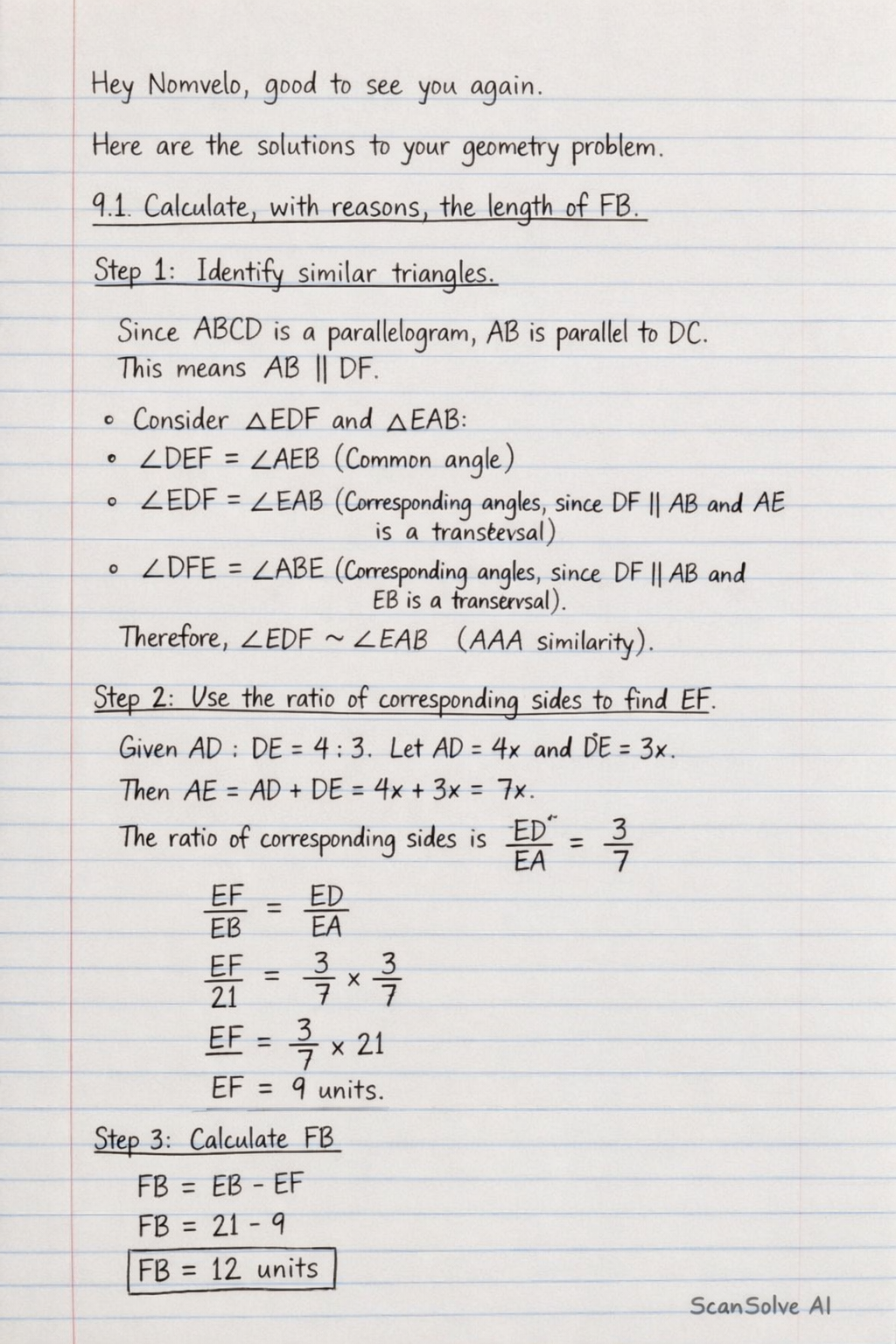
Handwritten Step-by-Step Solution
Get this as a handwritten image on WhatsApp — like a tutor wrote it for you.
Try on WhatsApp