
We read your photo as:
In the diagram below, AACD is right-angled at C.I perpendicular to AD. Write down the ratio of: 4.1.1 cos D in AACD. 4.1.2 sin D in ACED.
ScanSolve AI Answer
Step-by-step solution
21 stepshere's the solution for Question 4:
Question 4.1
In the diagram, is right-angled at C, and .
4.1.1 Write down the ratio of in .
In , the angle at C is .
The side adjacent to angle D is CD.
The hypotenuse is AD.
4.1.2 Write down the ratio of in .
In , the angle at E is .
The side opposite to angle D is CE.
The hypotenuse is CD.
Question 4.2
Given and .
4.2.1 Determine with the aid of a diagram and without using a calculator the value of .
Solve for .
Determine the quadrant.
Since and , must be in the second quadrant.
Draw a right-angled triangle in the second quadrant.
Let and .
Use Pythagoras theorem to find : .Since is in the second quadrant, is negative. So, .
Calculate .
4.2.2 Determine with the aid of a diagram and without using a calculator the value of .
From the diagram in 4.2.1, , , .
Calculate .
Substitute into the expression.
Question 4.3
Determine, WITHOUT the use of a calculator, the value of:Recall the special angle values.
Substitute the values into the expression.
Separate the terms in the numerator.
Rationalize the denominator.
Question 4.4
Solve , WITHOUT the use of a calculator: .Isolate the sine term.
Find the reference angle.
The angle whose sine is is .
Determine the quadrants where sine is positive (Quadrant I and Quadrant II).
Case 1: Quadrant I
Case 2: Quadrant II
where is an integer.
Question 4.5
Given that and . Calculate the value of .Substitute the values of A and B into the expression.
Calculate the values using a calculator.
Question 4.6
Simplify the following expression if : .Rearrange the terms.
Apply the given identity .
Use the identity .
Question 4.7
A hiker climbs 250 m at a slope of and thereafter completes 45 m at a slope of . How high is he above his starting point?Calculate the vertical height gained in the first part of the climb.
Let be the height.
Calculate the vertical height gained in the second part of the climb.
Let be the height.
Calculate the total height above the starting point.
Still stuck on this one?
Ask a follow-up, and the answer starts from this question.
More Mathematics Questions
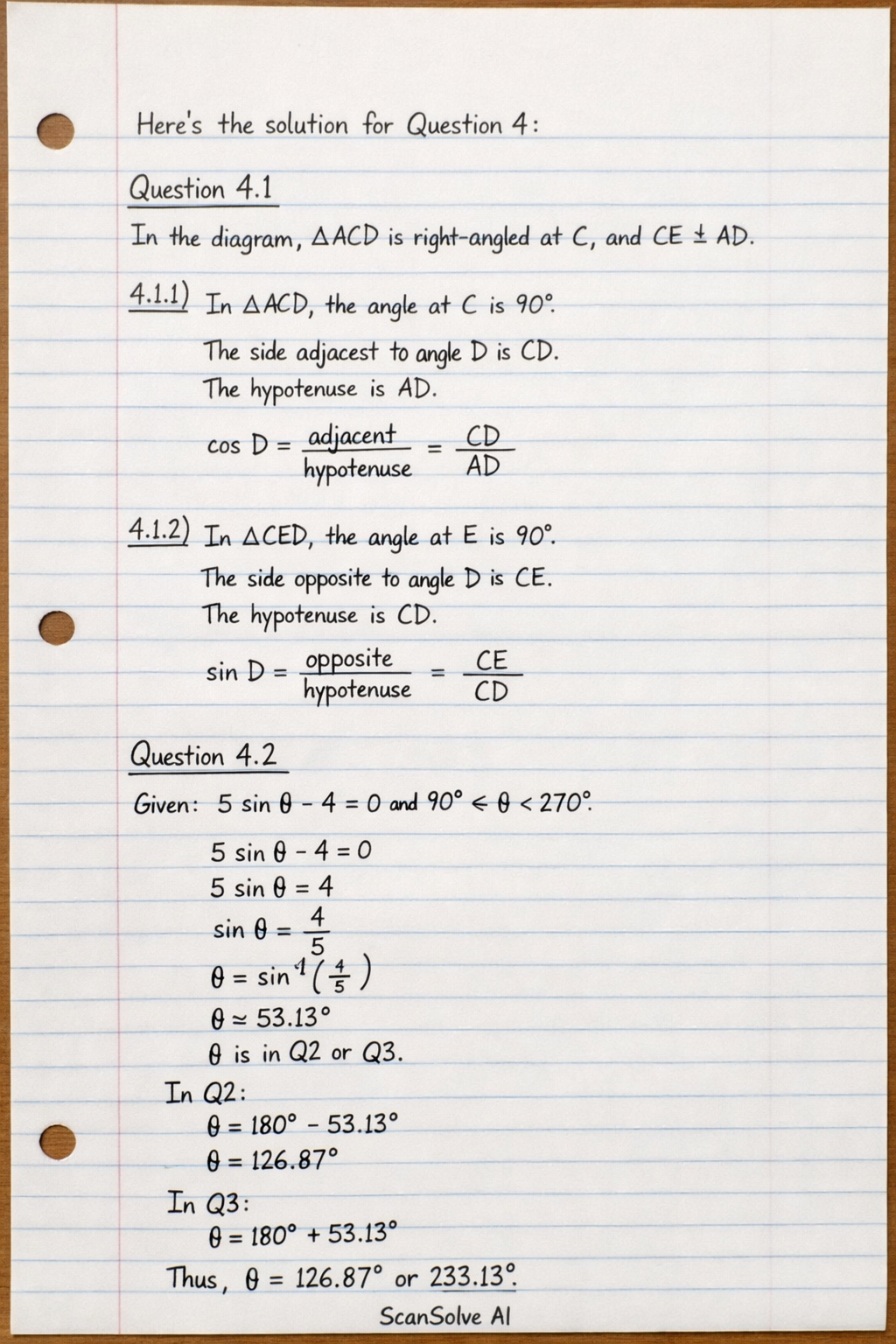
Handwritten Step-by-Step Solution
Get this as a handwritten image on WhatsApp — like a tutor wrote it for you.
Try on WhatsApp