
We read your photo as:
In the diagram, MK is a tangent to the circle at P, QRP = 50^ and SPK = 62^. Find QPS.
Mathematics
ScanSolve AI Answer
Step-by-step solution
10 stepsHere are the solutions to the problems:
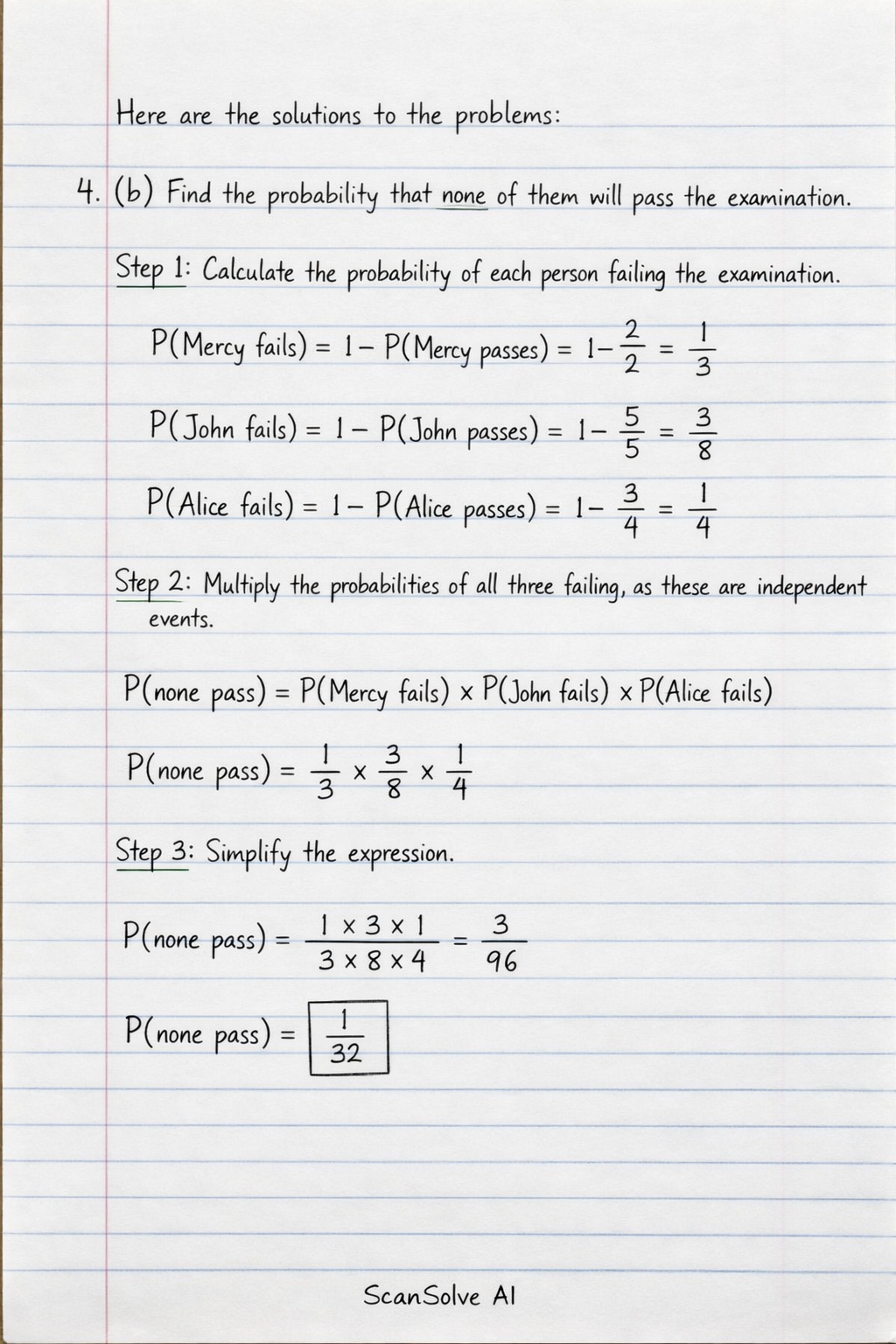
4. (b) Find the probability that none of them will pass the examination.
Calculate the probability of each person failing the examination.
Multiply the probabilities of all three failing, as these are independent events.
Simplify the expression.
4. (c) Find the probability that only Mercy and John will pass the examination.
Identify the probabilities for Mercy passing, John passing, and Alice failing.
(from part b)Multiply these probabilities together.
Simplify the expression.
5. (a) In the diagram, is a tangent to the circle at , and . Find .
Use the Alternate Segment Theorem.
The angle between a tangent and a chord through the point of contact is equal to the angle in the alternate segment.
For tangent and chord :Use the property that angles subtended by the same arc at the circumference are equal.
Arc subtends and .
Consider the triangle .
The sum of angles in a triangle is .
Substitute the known angles and solve for .
Was this helpful?
Still stuck on this one?
Ask a follow-up, and the answer starts from this question.
Got a different question?Ask your own question
More Mathematics Questions
QGiven a circle with tangent ST at S and chords PS and QS, if PST = 42^ and PQ = QR, determine QSP.QIn the diagram, O is the centre of the circle PQR, (SQ = IQR and PQR = 68^", Calculate PRS.QIn the diagram PQ // RS, QU // PT and PSR = 42^. Find angle x.QIn the diagram, PORS is a circle, centre O and ⦟RQS = 40°. Find ⦟PRSQIn the diagram, |PQ| = |PR| = |RS| and ∠RPS = 32°. Find ∠QPR.
Browse by topic:Geometry
Handwritten Step-by-Step Solution
Get this as a handwritten image on WhatsApp — like a tutor wrote it for you.
Try on WhatsApp