
We read your photo as:
In the diagram, PQ || RS, QPT = 70°, PTR = 30° and TRS = x°. Find the value of x.
ScanSolve AI Answer
Step-by-step solution
9 stepsDraw an auxiliary line through point parallel to and .
Let this line be . Let be a point on to the left of , and be a point on to the right of . So, is a straight line parallel to and .
Use the property of alternate interior angles for parallel lines and with transversal .
Since , the alternate interior angles and are equal.
Use the property of alternate interior angles for parallel lines and with transversal .
Since , the alternate interior angles and are equal.
Relate the angles around point .
From the diagram, the angle is the sum of the angles and . This is because and are on opposite sides of the auxiliary line relative to the angles formed with .
Substitute the known values:
Solve for .
This result is negative, which indicates that the initial assumption about the relationship between the angles at was incorrect based on the visual representation of the angles.
Let's re-evaluate the relationship of the angles at .
The angle is formed by and the line (left side).
The angle is formed by and the line (right side).
The angle is formed by and .Looking at the diagram, the angle is between and .
The angle is formed by and the line .
The angle is formed by and the line .It appears that the angle is composed of and .
This means that and are on the same side of the line .
Let's check the diagram again. is above . is below .
The line is above . The line is below .
So goes from (above ) to (on ).
goes from (on ) to (below ).
This means and are on opposite sides of .Let's use the method of extending to intersect .
Extend the line segment to intersect the line at a point, let's call it .
Since , and is a transversal, the alternate interior angles and are equal.
Consider the triangle .
The angles inside are , , and .
We are given . This is the same as .
So, .
We found .Find the third angle in .
The sum of angles in a triangle is .
Relate to .
The angle is the angle formed by the line segment and the line .
Since lies on the line , the angle is the same as .
Therefore, .Comparing this result with the given options:
A) 30
B) 80
C) 70
D) 100The calculated value matches option B.
The final answer is .
Still stuck on this one?
Ask a follow-up, and the answer starts from this question.
More Mathematics Questions
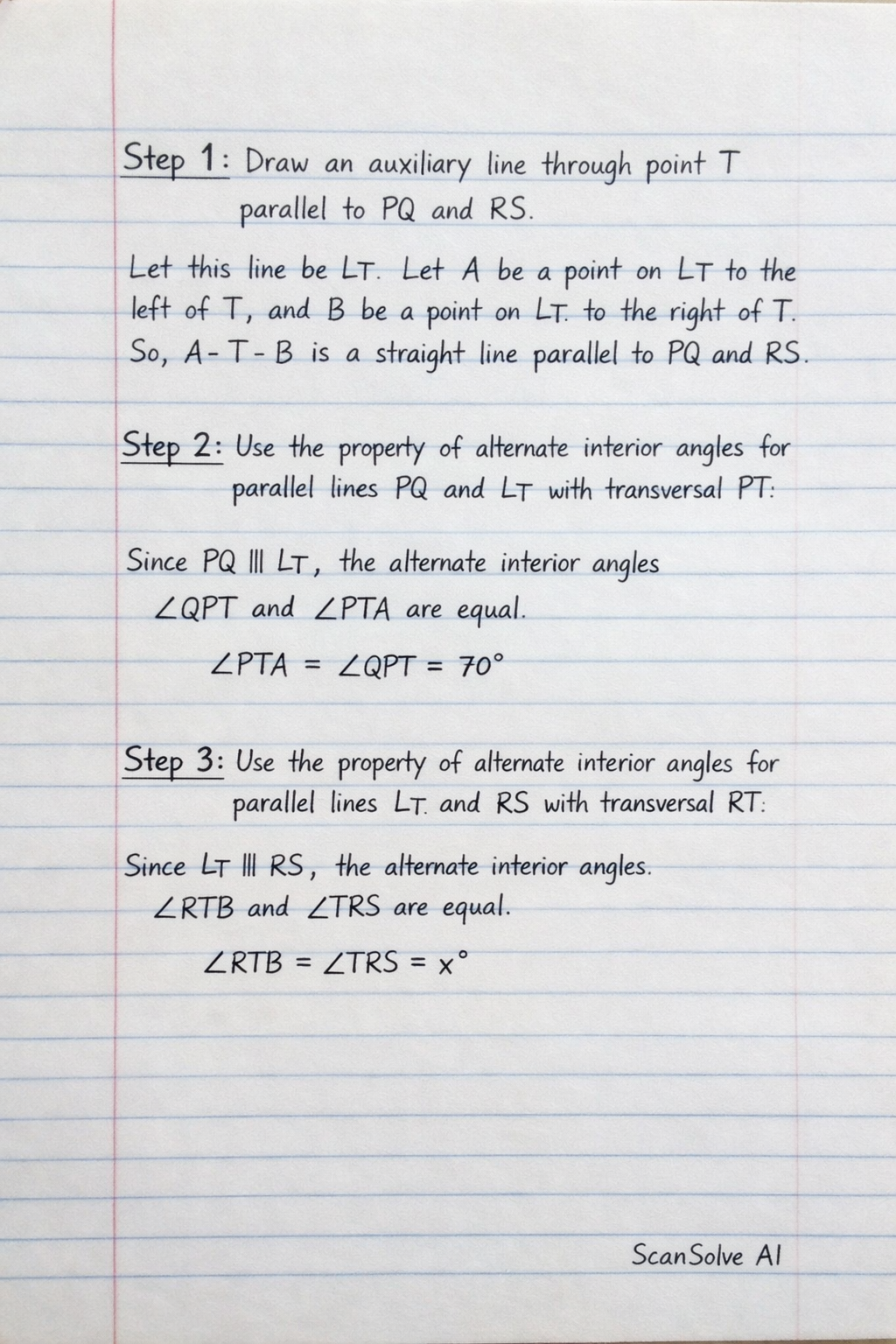
Handwritten Step-by-Step Solution
Get this as a handwritten image on WhatsApp — like a tutor wrote it for you.
Try on WhatsApp