
We read your photo as:
In the diagram, the points A, B, C and D lie on the circumference of a circle, centre O. The line ST is the tangent at A and the radius AO, when produced, meets DC at P. Given that angle ADC = 75° and angle APD = 50°.
ScanSolve AI Answer
Answers
2 partsStep-by-step solution
5 stepsHere's the solution to question 11:
Part a· 3 steps
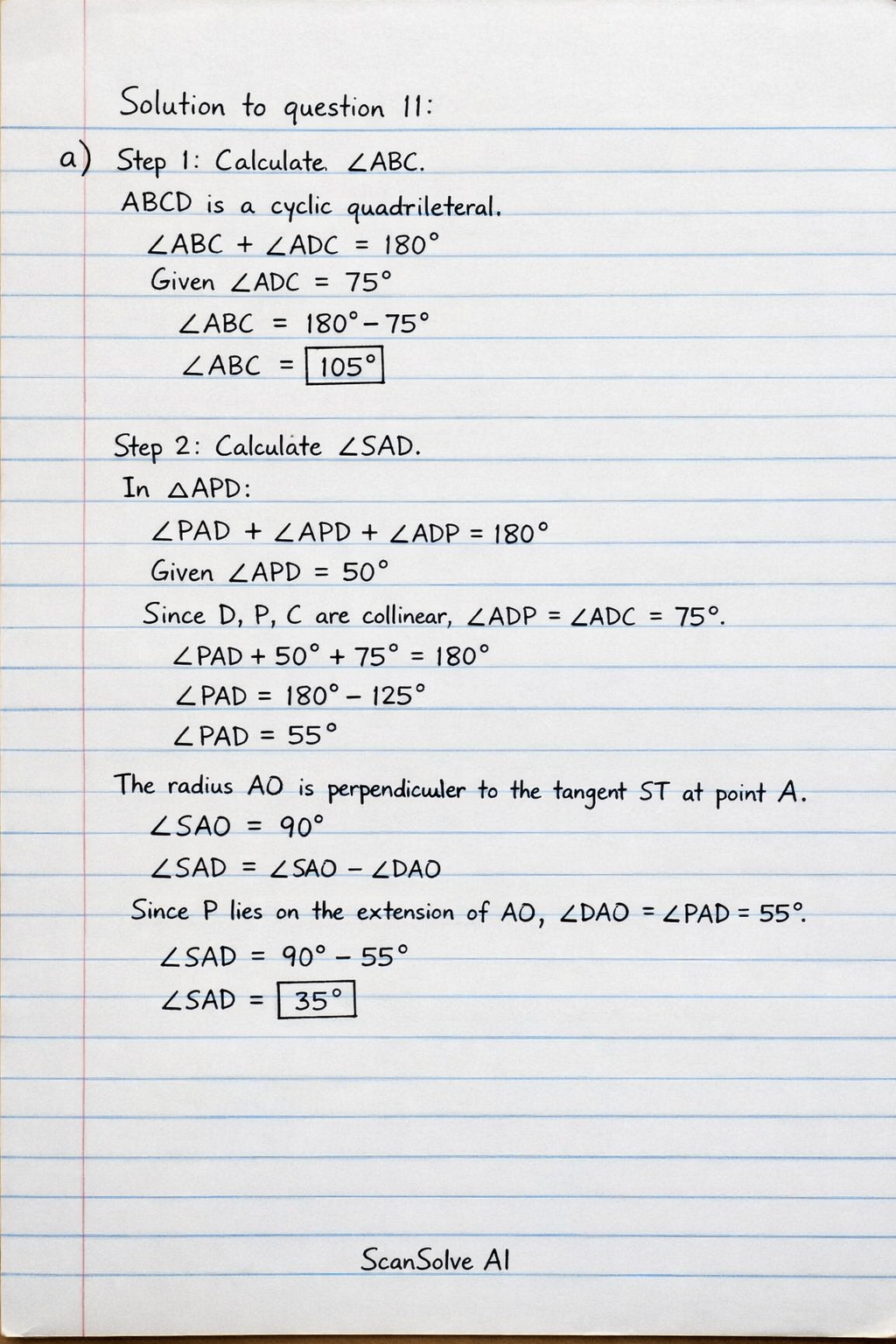
Calculate .
ABCD is a cyclic quadrilateral. The opposite angles of a cyclic quadrilateral sum to .
Given .
Calculate .
In :
The sum of angles in a triangle is .Given .
Since D, P, C are collinear, .The radius AO is perpendicular to the tangent ST at point A.
Since P lies on the extension of AO, .
Calculate .
In , OA and OD are radii, so is an isosceles triangle.
Now, find :
In , OC and OD are radii, so is an isosceles triangle.
In :
The sum of angles in a triangle is .is the same as .
is the same as .
Part b
Express in terms of .
The diagonals of a rhombus intersect at right angles. Therefore, .
In , the sum of angles is .Given .
Express in terms of .
The diagonals of a rhombus bisect the angles of the rhombus.
Given . This means is half of .Opposite angles of a rhombus are equal.
Try one yourself
A new problem that tests the same skill.
Still stuck on this one?
Ask a follow-up, and the answer starts from this question.
More Mathematics Questions
Handwritten Step-by-Step Solution
Get this as a handwritten image on WhatsApp — like a tutor wrote it for you.
Try on WhatsApp