We read your photo as:

In the diagram below O is the center, A, C and B are points on the circumference of the circle. PCD and TBD are tangents to the circle at points C and B respectively. C1 = 36° and B1 = 62°.

Mathematics

ScanSolve AI Answer

Step-by-step solution

7 steps

Here are the solutions to the geometry problems:

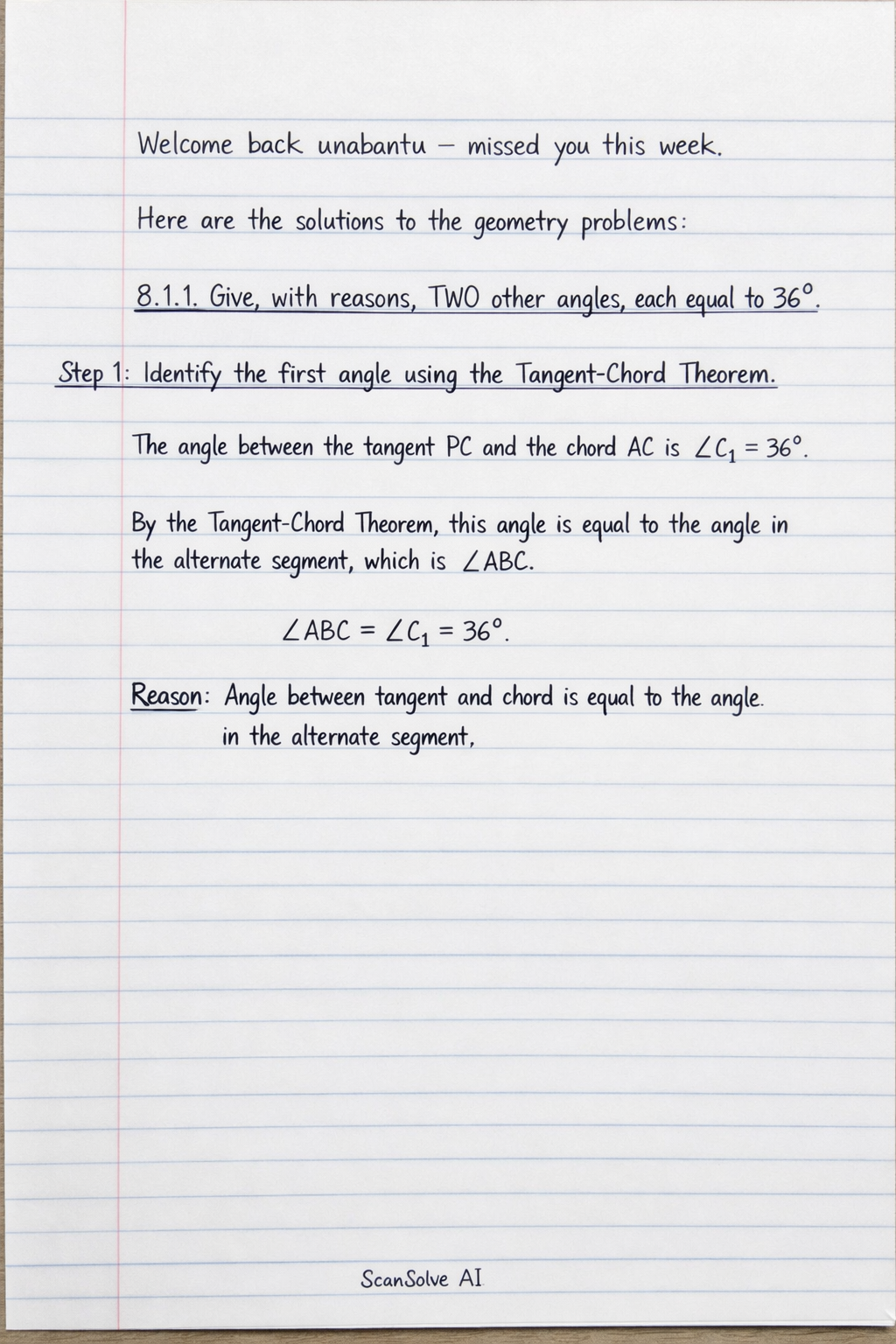
8.1.1 Give, with reasons, TWO other angles, each equal to 36∘36^\circ.

  1. Identify the first angle using the Tangent-Chord Theorem.

    The angle between the tangent PC and the chord AC is ∠C1=36∘\angle C_1 = 36^\circ. By the Tangent-Chord Theorem, this angle is equal to the angle in the alternate segment, which is ∠ABC\angle ABC.

    ∠ABC=∠C1=36∘\angle ABC = \angle C_1 = 36^\circ

    Reason: Angle between tangent and chord is equal to the angle in the alternate segment.

  2. Identify the second angle by calculating angles in △ADC\triangle ADC.

    First, find ∠BAC\angle BAC and ∠ABC\angle ABC.
    The angle between the tangent TB and the chord BC is ∠B1=62∘\angle B_1 = 62^\circ. By the Tangent-Chord Theorem, this angle is equal to the angle in the alternate segment, which is ∠BAC\angle BAC.

    ∠BAC=∠B1=62∘\angle BAC = \angle B_1 = 62^\circ

    We already found ∠ABC=36∘\angle ABC = 36^\circ.
    Next, find ∠ACB\angle ACB using the sum of angles in △ABC\triangle ABC.

    ∠ACB=180∘−(∠BAC+∠ABC)\angle ACB = 180^\circ - (\angle BAC + \angle ABC) ∠ACB=180∘−(62∘+36∘)\angle ACB = 180^\circ - (62^\circ + 36^\circ) ∠ACB=180∘−98∘=82∘\angle ACB = 180^\circ - 98^\circ = 82^\circ

    Now, consider △ADC\triangle ADC.
    We have ∠DAC=∠BAC=62∘\angle DAC = \angle BAC = 62^\circ.
    We have ∠ACD=∠ACB=82∘\angle ACD = \angle ACB = 82^\circ.
    Using the sum of angles in △ADC\triangle ADC:

    ∠ADC=180∘−(∠DAC+∠ACD)\angle ADC = 180^\circ - (\angle DAC + \angle ACD) ∠ADC=180∘−(62∘+82∘)\angle ADC = 180^\circ - (62^\circ + 82^\circ) ∠ADC=180∘−144∘=36∘\angle ADC = 180^\circ - 144^\circ = 36^\circ

    Reason: Sum of angles in a triangle.

    The two other angles equal to 36∘36^\circ are:

    • ∠ABC=36∘\boxed{\angle ABC = 36^\circ} (Reason: Angle between tangent and chord is equal to angle in alternate segment)
    • ∠ADC=36∘\boxed{\angle ADC = 36^\circ} (Reason: Sum of angles in △ADC\triangle ADC)

    8.1.2 Determine with reasons the sizes of the following angles.

    a. ∠O1\angle O_1

  3. Relate ∠O1\angle O_1 to an angle at the circumference.

    ∠O1\angle O_1 is ∠AOC\angle AOC. The angle subtended by arc AC at the center is ∠AOC\angle AOC, and the angle subtended by the same arc at the circumference is ∠ABC\angle ABC.
    From 8.1.1, we know ∠ABC=36∘\angle ABC = 36^\circ.

    ∠O1=∠AOC=2×∠ABC\angle O_1 = \angle AOC = 2 \times \angle ABC ∠O1=2×36∘=72∘\angle O_1 = 2 \times 36^\circ = 72^\circ

    Reason: Angle at the center is twice the angle at the circumference.

    ∠O1=72∘\boxed{\angle O_1 = 72^\circ}

    b. ∠C3\angle C_3

  4. Relate ∠C3\angle C_3 to angles in △OBC\triangle OBC.

    ∠C3\angle C_3 is ∠OCB\angle OCB. In △OBC\triangle OBC, OB = OC (radii), so it is an isosceles triangle.
    First, find ∠BAC\angle BAC. From 8.1.1, ∠BAC=∠B1=62∘\angle BAC = \angle B_1 = 62^\circ (Angle in alternate segment).
    Next, find ∠BOC\angle BOC. The angle subtended by arc BC at the center is ∠BOC\angle BOC, and at the circumference is ∠BAC\angle BAC.

    ∠BOC=2×∠BAC\angle BOC = 2 \times \angle BAC ∠BOC=2×62∘=124∘\angle BOC = 2 \times 62^\circ = 124^\circ

    Reason: Angle at the center is twice the angle at the circumference.
    Now, in isosceles △OBC\triangle OBC:

    ∠OCB=∠OBC=180∘−∠BOC2\angle OCB = \angle OBC = \frac{180^\circ - \angle BOC}{2} ∠C3=180∘−124∘2=56∘2=28∘\angle C_3 = \frac{180^\circ - 124^\circ}{2} = \frac{56^\circ}{2} = 28^\circ

    Reason: Base angles of an isosceles triangle and sum of angles in a triangle.

    ∠C3=28∘\boxed{\angle C_3 = 28^\circ}

    c. ∠D\angle D

  5. Use the result from 8.1.1.

    ∠D\angle D is ∠ADC\angle ADC. We already calculated this in 8.1.1.

    ∠ADC=36∘\angle ADC = 36^\circ

    Reason: Sum of angles in △ADC\triangle ADC.

    ∠D=36∘\boxed{\angle D = 36^\circ}

    d. ∠ACB\angle ACB

  6. Use the sum of angles in △ABC\triangle ABC.

    From 8.1.1, we have:
    ∠BAC=62∘\angle BAC = 62^\circ (Angle in alternate segment)
    ∠ABC=36∘\angle ABC = 36^\circ (Angle in alternate segment)

    ∠ACB=180∘−(∠BAC+∠ABC)\angle ACB = 180^\circ - (\angle BAC + \angle ABC) ∠ACB=180∘−(62∘+36∘)\angle ACB = 180^\circ - (62^\circ + 36^\circ) ∠ACB=180∘−98∘=82∘\angle ACB = 180^\circ - 98^\circ = 82^\circ

    Reason: Sum of angles in a triangle.

    ∠ACB=82∘\boxed{\angle ACB = 82^\circ}

    8.1.3 Give a reason why CD = BD

  7. State the theorem for tangents from an external point.

    CD and BD are both tangents drawn from the external point D to the circle.
    Reason: Tangents drawn from an external point to a circle are equal in length.

    Tangents from an external point to a circle are equal in length.\boxed{\text{Tangents from an external point to a circle are equal in length.}}
Was this helpful?

Still stuck on this one?

Ask a follow-up, and the answer starts from this question.

Got a different question?Ask your own question
Handwritten step-by-step solution preview

Handwritten Step-by-Step Solution

Get this as a handwritten image on WhatsApp — like a tutor wrote it for you.

Try on WhatsApp