We read your photo as:

A motor car costing R200 000 depreciated at a rate of 8% per annum on the reducing balance method. Calculate how long it took for the car to depreciate to a value of R90 000 under these conditions.

Mathematics

ScanSolve AI Answer

Step-by-step solution

20 steps

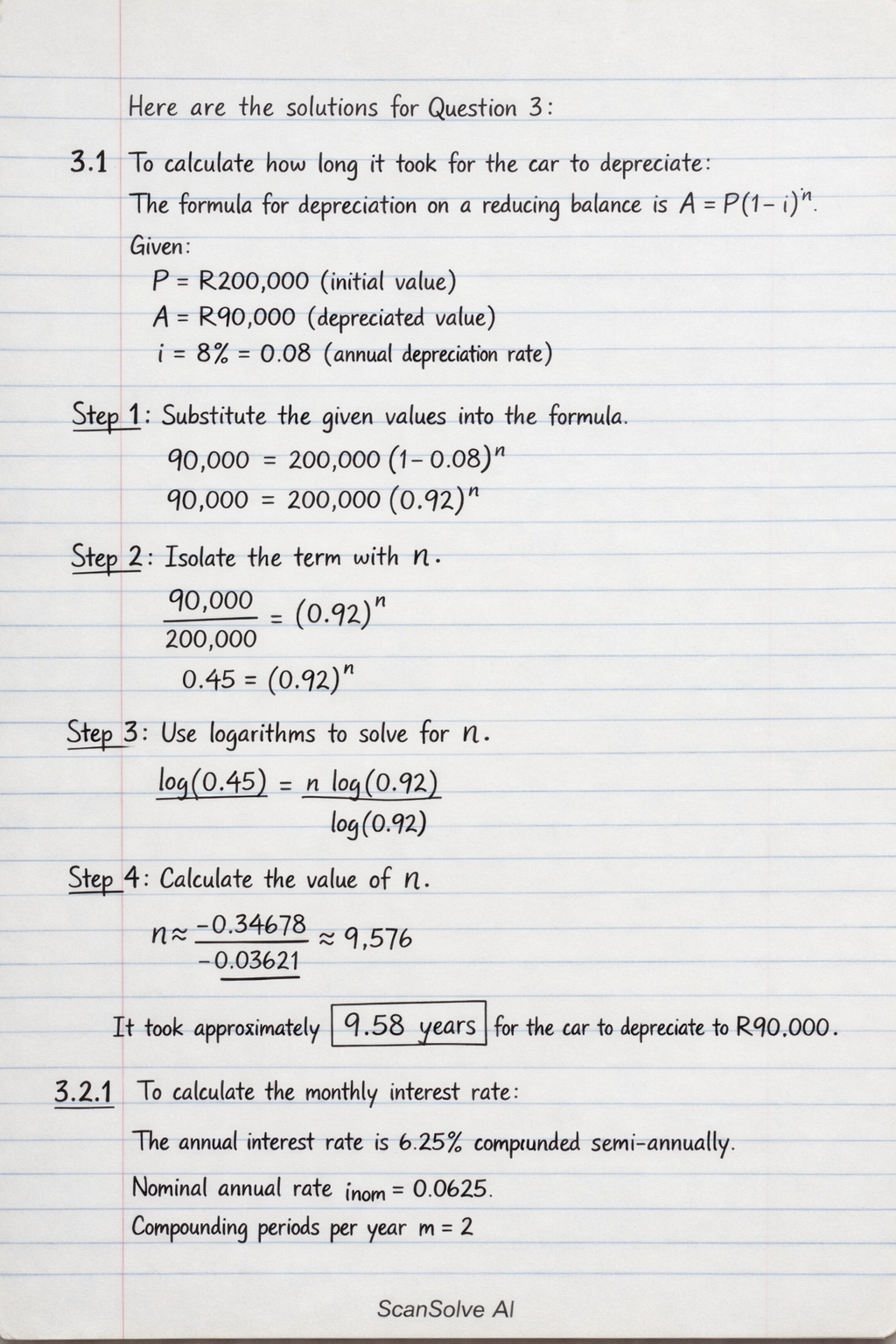
3.1 To calculate how long it took for the car to depreciate:
The formula for depreciation on a reducing balance is A=P(1−i)nA = P(1 - i)^n.
Given:
P=R200 000P = \text{R}200\,000 (initial value)
A=R90 000A = \text{R}90\,000 (depreciated value)
i=8%=0.08i = 8\% = 0.08 (annual depreciation rate)

  1. Substitute the given values into the formula.

    90 000=200 000(1−0.08)n90\,000 = 200\,000(1 - 0.08)^n 90 000=200 000(0.92)n90\,000 = 200\,000(0.92)^n
  2. Isolate the term with nn.

    90 000200 000=(0.92)n\frac{90\,000}{200\,000} = (0.92)^n 0.45=(0.92)n0.45 = (0.92)^n
  3. Use logarithms to solve for nn.

    log⁡(0.45)=nlog⁡(0.92)\log(0.45) = n \log(0.92) n=log⁡(0.45)log⁡(0.92)n = \frac{\log(0.45)}{\log(0.92)}
  4. Calculate the value of nn.

    n≈−0.34678−0.03621n \approx \frac{-0.34678}{-0.03621} n≈9.576n \approx 9.576

    It took approximately 9.58 years\boxed{9.58 \text{ years}} for the car to depreciate to R90 000.

    3.2.1 To calculate the monthly interest rate:
    The annual interest rate is 6.25% compounded semi-annually.
    Nominal annual rate inom=0.0625i_{nom} = 0.0625.
    Compounding periods per year m=2m = 2.

  5. Calculate the effective annual interest rate (ieffi_{eff}).

    (1+ieff)=(1+inomm)m(1 + i_{eff}) = \left(1 + \frac{i_{nom}}{m}\right)^m (1+ieff)=(1+0.06252)2(1 + i_{eff}) = \left(1 + \frac{0.0625}{2}\right)^2 (1+ieff)=(1+0.03125)2(1 + i_{eff}) = (1 + 0.03125)^2 (1+ieff)=(1.03125)2=1.0634765625(1 + i_{eff}) = (1.03125)^2 = 1.0634765625
  6. Convert the effective annual rate to a monthly rate (imonthlyi_{monthly}).

    (1+imonthly)12=(1+ieff)(1 + i_{monthly})^{12} = (1 + i_{eff}) (1+imonthly)12=1.0634765625(1 + i_{monthly})^{12} = 1.0634765625 1+imonthly=(1.0634765625)1/121 + i_{monthly} = (1.0634765625)^{1/12} 1+imonthly≈1.0051399081 + i_{monthly} \approx 1.005139908
  7. Calculate the monthly interest rate.

    imonthly≈1.005139908−1i_{monthly} \approx 1.005139908 - 1 imonthly≈0.005139908i_{monthly} \approx 0.005139908

    The monthly interest rate is approximately 0.00514\boxed{0.00514} or 0.514%0.514\%.

    3.2.2 To calculate the future value of his investment at the end of the five-year period:
    The total period is 5 years ×\times 12 months/year = 60 months.
    Monthly interest rate i=0.005139908i = 0.005139908.
    Phetolo makes an initial deposit of R2000 at the beginning of the first month, and then R2000 at the end of the first month, and continues with R2000 at the end of each month for 60 months.

  8. Calculate the future value of the initial R2000 deposit.

    This deposit earns interest for the full 60 months.

    FVinitial=P(1+i)nFV_{\text{initial}} = P(1+i)^n FVinitial=2000(1+0.005139908)60FV_{\text{initial}} = 2000(1 + 0.005139908)^{60} FVinitial=2000(1.005139908)60FV_{\text{initial}} = 2000(1.005139908)^{60} FVinitial≈2000×1.35620901≈R2712.42FV_{\text{initial}} \approx 2000 \times 1.35620901 \approx \text{R}2712.42
  9. Calculate the future value of the 60 monthly payments of R2000 (ordinary annuity).

    FVannuity=X(1+i)n−1iFV_{\text{annuity}} = X \frac{(1+i)^n - 1}{i} FVannuity=2000(1.005139908)60−10.005139908FV_{\text{annuity}} = 2000 \frac{(1.005139908)^{60} - 1}{0.005139908} FVannuity=20001.35620901−10.005139908FV_{\text{annuity}} = 2000 \frac{1.35620901 - 1}{0.005139908} FVannuity=20000.356209010.005139908≈2000×69.39000≈R138780.00FV_{\text{annuity}} = 2000 \frac{0.35620901}{0.005139908} \approx 2000 \times 69.39000 \approx \text{R}138780.00
  10. Calculate the total future value.

    FVtotal=FVinitial+FVannuityFV_{\text{total}} = FV_{\text{initial}} + FV_{\text{annuity}} FVtotal=2712.42+138780.00≈R141492.42FV_{\text{total}} = 2712.42 + 138780.00 \approx \text{R}141492.42

    The future value of his investment is R141 492.42\boxed{\text{R}141\,492.42}.

    3.2.3 To calculate the value of his investment if he misses the last two payments:
    This means only 60−2=5860 - 2 = 58 monthly payments were made for the annuity part. The initial R2000 still accumulates for 60 months.

  11. The future value of the initial R2000 deposit remains the same.

    FVinitial≈R2712.42FV_{\text{initial}} \approx \text{R}2712.42
  12. Calculate the future value of the 58 monthly payments of R2000 (ordinary annuity).

    FVannuity=X(1+i)n−1iFV_{\text{annuity}} = X \frac{(1+i)^n - 1}{i} FVannuity=2000(1.005139908)58−10.005139908FV_{\text{annuity}} = 2000 \frac{(1.005139908)^{58} - 1}{0.005139908} (1.005139908)58≈1.34107001(1.005139908)^{58} \approx 1.34107001 FVannuity=20001.34107001−10.005139908FV_{\text{annuity}} = 2000 \frac{1.34107001 - 1}{0.005139908} FVannuity=20000.341070010.005139908≈2000×66.35400≈R132708.00FV_{\text{annuity}} = 2000 \frac{0.34107001}{0.005139908} \approx 2000 \times 66.35400 \approx \text{R}132708.00
  13. Calculate the total future value.

    FVtotal=FVinitial+FVannuityFV_{\text{total}} = FV_{\text{initial}} + FV_{\text{annuity}} FVtotal=2712.42+132708.00≈R135420.42FV_{\text{total}} = 2712.42 + 132708.00 \approx \text{R}135420.42

    The value of his investment is R135 420.42\boxed{\text{R}135\,420.42}.

    3.3.1 To determine the number of payments required to settle the loan:
    Loan amount P=R300 000P = \text{R}300\,000.
    Monthly payment x=R5 000x = \text{R}5\,000.
    Annual interest rate = 18% compounded monthly.
    Monthly interest rate i=0.1812=0.015i = \frac{0.18}{12} = 0.015.

  14. Use the present value annuity formula.

    P=x1−(1+i)−niP = x \frac{1 - (1+i)^{-n}}{i} 300 000=5 0001−(1+0.015)−n0.015300\,000 = 5\,000 \frac{1 - (1+0.015)^{-n}}{0.015}
  15. Isolate the term with nn.

    300 000×0.0155 000=1−(1.015)−n\frac{300\,000 \times 0.015}{5\,000} = 1 - (1.015)^{-n} 45005000=1−(1.015)−n\frac{4500}{5000} = 1 - (1.015)^{-n} 0.9=1−(1.015)−n0.9 = 1 - (1.015)^{-n} (1.015)−n=1−0.9(1.015)^{-n} = 1 - 0.9 (1.015)−n=0.1(1.015)^{-n} = 0.1
  16. Use logarithms to solve for nn.

    −nlog⁡(1.015)=log⁡(0.1)-n \log(1.015) = \log(0.1) −n=log⁡(0.1)log⁡(1.015)-n = \frac{\log(0.1)}{\log(1.015)}
  17. Calculate the value of nn.

    −n≈−10.00646604-n \approx \frac{-1}{0.00646604} −n≈−154.644-n \approx -154.644 n≈154.644n \approx 154.644

    Since a payment cannot be a fraction, Jill will make 154 full payments of R5000 and one final smaller payment. Therefore, the total number of payments required is 155\boxed{155}.

    3.3.2 To calculate the balance outstanding after Jill has paid the last R5 000:
    This refers to the balance outstanding after 154 full payments of R5000.
    We use the formula for the balance outstanding on a loan: An=P(1+i)n−x(1+i)n−1iA_n = P(1+i)^n - x \frac{(1+i)^n - 1}{i}.
    Here, n=154n = 154 (number of full payments).
    P=R300 000P = \text{R}300\,000.
    x=R5 000x = \text{R}5\,000.
    i=0.015i = 0.015.

  18. Calculate the future value of the original loan after 154 months.

    FVloan=300 000(1+0.015)154FV_{\text{loan}} = 300\,000(1+0.015)^{154} FVloan=300 000(1.015)154FV_{\text{loan}} = 300\,000(1.015)^{154} (1.015)154≈9.8732000(1.015)^{154} \approx 9.8732000 FVloan≈300 000×9.8732000≈R2 961 960.00FV_{\text{loan}} \approx 300\,000 \times 9.8732000 \approx \text{R}2\,961\,960.00
  19. Calculate the future value of the 154 payments made.

    FVpayments=5000(1.015)154−10.015FV_{\text{payments}} = 5000 \frac{(1.015)^{154} - 1}{0.015} FVpayments=50009.8732000−10.015FV_{\text{payments}} = 5000 \frac{9.8732000 - 1}{0.015} FVpayments=50008.87320000.015≈5000×591.5466667≈R2 957 733.33FV_{\text{payments}} = 5000 \frac{8.8732000}{0.015} \approx 5000 \times 591.5466667 \approx \text{R}2\,957\,733.33
  20. Calculate the balance outstanding.

    Balance=FVloan−FVpayments\text{Balance} = FV_{\text{loan}} - FV_{\text{payments}} Balance=2 961 960.00−2 957 733.33≈R4226.67\text{Balance} = 2\,961\,960.00 - 2\,957\,733.33 \approx \text{R}4226.67

    The balance outstanding after Jill has paid the last R5 000 is R4226.67\boxed{\text{R}4226.67}.

Was this helpful?

Still stuck on this one?

Ask a follow-up, and the answer starts from this question.

Got a different question?Ask your own question
Handwritten step-by-step solution preview

Handwritten Step-by-Step Solution

Get this as a handwritten image on WhatsApp — like a tutor wrote it for you.

Try on WhatsApp