We read your photo as:

In the figure below BC=24cm, < APD = < PCD = < PBA = 90°. Calculate, correct to 2 decimal places, the length AD given that P is the midpoint of BC.

Mathematics

ScanSolve AI Answer

Answer

25.24 cm\text{25.24 cm}

Step-by-step solution

5 steps

here's the solution for question 15:

Question 15: In the figure below BC=24cm, ∠APD=∠PCD=∠PBA=90∘\angle APD = \angle PCD = \angle PBA = 90^\circ. Calculate, correct to 2 decimal places, the length AD given that P is the midpoint of BC.

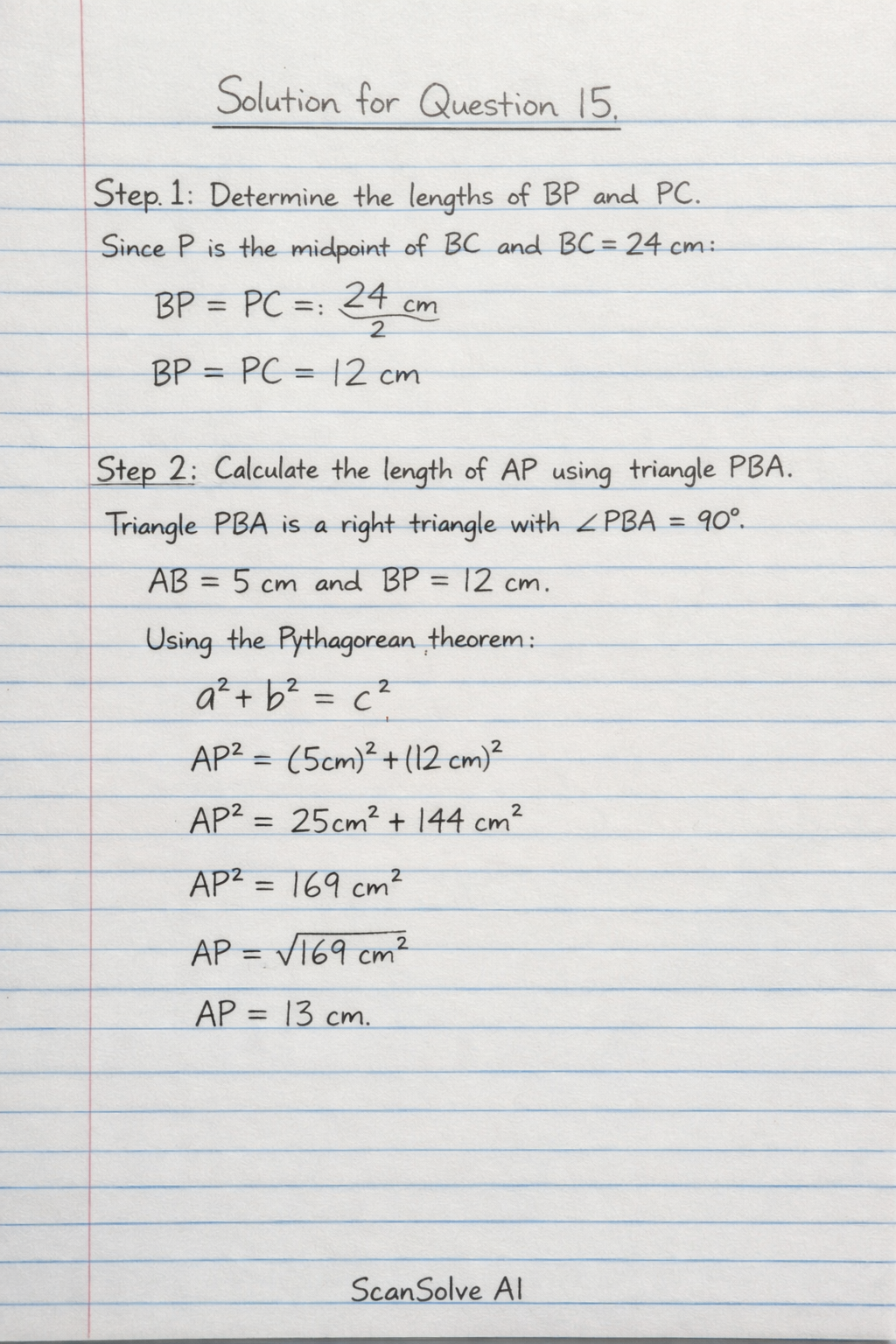
  1. Determine the lengths of BP and PC.

    Given that P is the midpoint of BC and BC = 24 cm:

    BP=PC=BC2=24 cm2=12 cmBP = PC = \frac{BC}{2} = \frac{24 \text{ cm}}{2} = 12 \text{ cm}
  2. Calculate the length of AP using triangle PBA.

    Triangle PBA is a right-angled triangle at B (∠PBA=90∘\angle PBA = 90^\circ).
    We have AB = 5 cm and BP = 12 cm.
    Using the Pythagorean theorem (a2+b2=c2a^2 + b^2 = c^2):

    AP2=AB2+BP2AP^2 = AB^2 + BP^2 AP2=(5 cm)2+(12 cm)2AP^2 = (5 \text{ cm})^2 + (12 \text{ cm})^2 AP2=25 cm2+144 cm2AP^2 = 25 \text{ cm}^2 + 144 \text{ cm}^2 AP2=169 cm2AP^2 = 169 \text{ cm}^2 AP=169 cm2=13 cmAP = \sqrt{169 \text{ cm}^2} = 13 \text{ cm}
  3. Calculate the length of PD using triangle PCD.

    Triangle PCD is a right-angled triangle at C (∠PCD=90∘\angle PCD = 90^\circ).
    We have CD = 18 cm and PC = 12 cm.
    Using the Pythagorean theorem:

    PD2=PC2+CD2PD^2 = PC^2 + CD^2 PD2=(12 cm)2+(18 cm)2PD^2 = (12 \text{ cm})^2 + (18 \text{ cm})^2 PD2=144 cm2+324 cm2PD^2 = 144 \text{ cm}^2 + 324 \text{ cm}^2 PD2=468 cm2PD^2 = 468 \text{ cm}^2 PD=468 cm2PD = \sqrt{468 \text{ cm}^2}
  4. Calculate the length of AD using triangle APD.

    Triangle APD is a right-angled triangle at P (∠APD=90∘\angle APD = 90^\circ).
    We have AP = 13 cm and PD=468PD = \sqrt{468} cm.
    Using the Pythagorean theorem:

    AD2=AP2+PD2AD^2 = AP^2 + PD^2 AD2=(13 cm)2+(468 cm2)2AD^2 = (13 \text{ cm})^2 + (\sqrt{468 \text{ cm}^2})^2 AD2=169 cm2+468 cm2AD^2 = 169 \text{ cm}^2 + 468 \text{ cm}^2 AD2=637 cm2AD^2 = 637 \text{ cm}^2 AD=637 cm2AD = \sqrt{637 \text{ cm}^2}
  5. Calculate the final value and round to 2 decimal places.

    AD≈25.23885 cmAD \approx 25.23885 \text{ cm}

    Rounding to 2 decimal places:

    AD≈25.24 cmAD \approx 25.24 \text{ cm}

    The length AD is:

    25.24 cm\text{25.24 cm}
Was this helpful?

Try one yourself

A new problem that tests the same skill.

Still stuck on this one?

Ask a follow-up, and the answer starts from this question.

Got a different question?Ask your own question
Handwritten step-by-step solution preview

Handwritten Step-by-Step Solution

Get this as a handwritten image on WhatsApp — like a tutor wrote it for you.

Try on WhatsApp