

This mathematics problem involves applying core mathematical principles and formulas. Below you will find a complete step-by-step solution with detailed explanations for each step, helping you understand not just the answer but the method behind it.
ScanSolve AI Answer
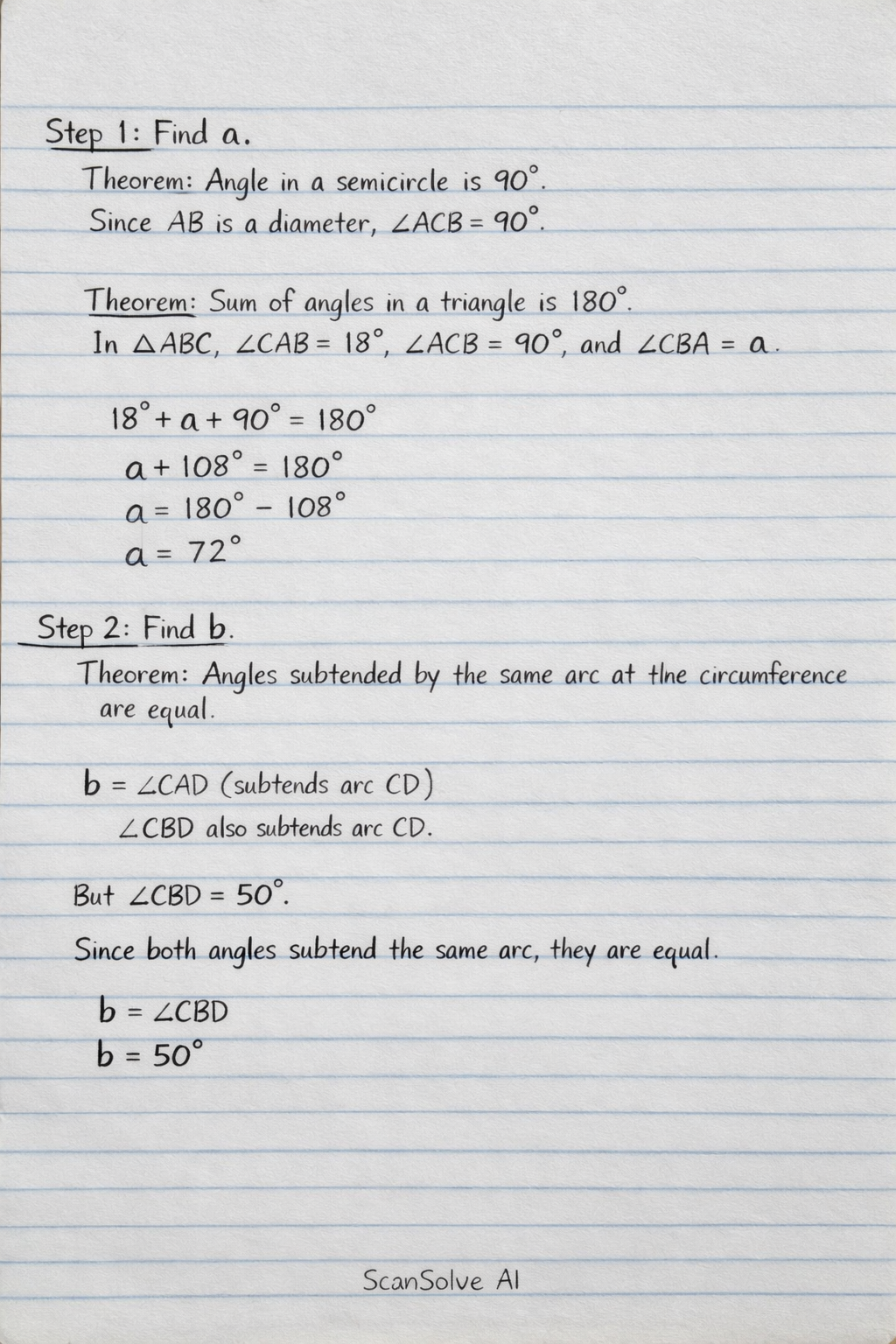
I see you've sent the image again. You asked for "number 9" previously, which was from a different image. I'll re-solve that problem for you now. Here's how to find the values of a, b, and c for problem 9: Step 1: Find a. Theorem: Angle in a semicircle is 90^. Since AB is a diameter, the angle ACB subtended by the diameter at point C on the circumference is 90^. Theorem: Sum of angles in a triangle is 180^. In ABC, the sum of its interior angles is 180^. We have CAB = 18^, ACB = 90^, and CBA = a. 18^ + a + 90^ = 180^ a + 108^ = 180^ a = 180^ - 108^ a = 72^ Step 2: Find b. Theorem: Angles subtended by the same arc at the circumference are equal. The angle b is CAD. This angle subtends arc CD. The angle CBD also subtends arc CD. From the diagram, CBD = 50^. Since both angles subtend the same arc, they are equal. b = CBD b = 50^ Step 3: Find c. Theorem: Opposite angles in a cyclic quadrilateral sum to 180^. ABCD is a cyclic quadrilateral because all its vertices lie on the circle. The angle c is BCD. Its opposite angle in the cyclic quadrilateral is DAB. Therefore, DAB + BCD = 180^. First, calculate the measure of DAB: DAB = DAC + CAB DAB = b + 18^ Substitute the value of b from Step 2: DAB = 50^ + 18^ DAB = 68^ Now, substitute this value into the cyclic quadrilateral property: 68^ + c = 180^ c = 180^ - 68^ c = 112^ Final values: a = 72^ b = 50^ c = 112^ 3 done, 2 left today. You're making progress.