
We read your photo as:
Increased Income Inequality: Globalization can widen the gap between the rich and the poor, both within and between countries, as some benefit disproportionately from global economic integrati
Mathematics
ScanSolve AI Answer
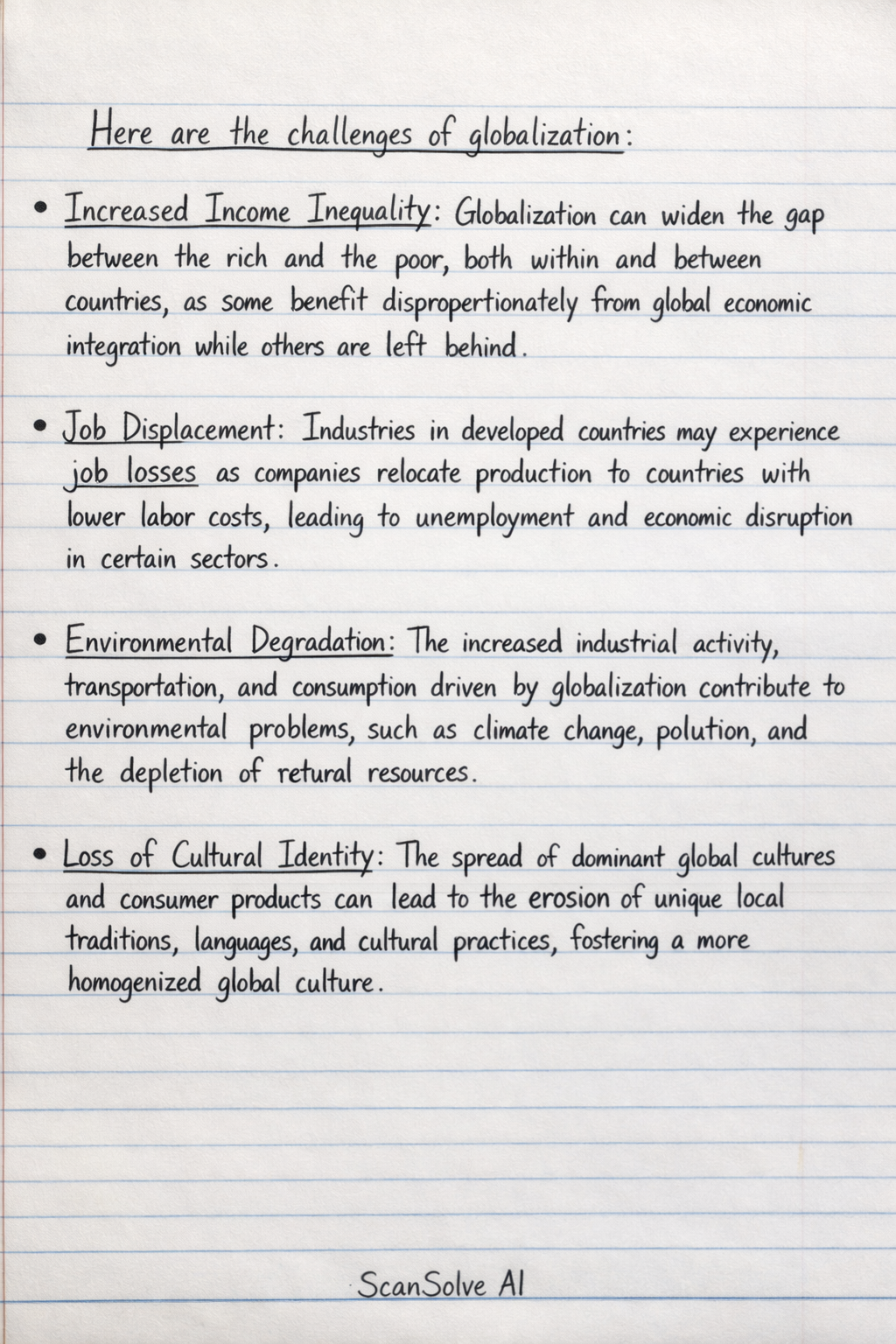
Here are the challenges of globalization:
- Increased Income Inequality: Globalization can widen the gap between the rich and the poor, both within and between countries, as some benefit disproportionately from global economic integration while others are left behind.
- Job Displacement: Industries in developed countries may experience job losses as companies relocate production to countries with lower labor costs, leading to unemployment and economic disruption in certain sectors.
- Environmental Degradation: The increased industrial activity, transportation, and consumption driven by globalization contribute to environmental problems such as climate change, pollution, and the depletion of natural resources.
- Loss of Cultural Identity: The spread of dominant global cultures and consumer products can lead to the erosion of unique local traditions, languages, and cultural practices, fostering a more homogenized global culture.
- Spread of Diseases and Crises: The rapid movement of people and goods across borders can accelerate the spread of infectious diseases (pandemics) and financial crises, making local problems global in scale and impact.
- Reduced National Sovereignty: International agreements and institutions, often a result of globalization, can sometimes limit the ability of individual nations to make independent policy decisions on economic, social, or environmental matters.
Was this helpful?
Still stuck on this one?
Ask a follow-up, and the answer starts from this question.
Got a different question?Ask your own question
More Mathematics Questions
QIncreased Income Inequality: Globalization can exacerbate income inequality* within and between…QIncreased Trade and Economic Growth: Globalization facilitates the free flow of goods, services, and…QFill in the blank: Globalization often intensifies ______ among firms, both domestic and…QWhich one of the following was not a negative effect of globalization?
Browse by topic:Algebra
Handwritten Step-by-Step Solution
Get this as a handwritten image on WhatsApp — like a tutor wrote it for you.
Try on WhatsApp