
We read your photo as:
Solve the inequality: (x-2)/(4x+3) (3x+4)/(5-6x)
ScanSolve AI Answer
Answer
Step-by-step solution
6 stepsMove all terms to one side of the inequality.
The given inequality is:
Subtract from both sides to get:
Find a common denominator and combine the fractions.
The common denominator is .
Expand and simplify the numerator.
First, expand :
Next, expand :
Now, subtract the second expanded expression from the first:
Combine like terms:
Factor out from the numerator:
Analyze the simplified inequality.
The inequality becomes:
Consider the quadratic expression . Its discriminant is .
Since the discriminant is negative () and the leading coefficient () is positive, the quadratic is always positive for all real values of .
Therefore, the numerator is always negative (a negative number multiplied by a positive number).For the entire fraction to be greater than or equal to zero, and knowing the numerator is always negative, the denominator must also be negative.
Also, the denominator cannot be zero, so we must have .Find the critical points for the denominator.
Set each factor in the denominator to zero to find the critical points:
These critical points divide the number line into three intervals: , , and .Test each interval to determine where .
- For (e.g., ): . This is negative, so the inequality holds.
- For (e.g., ): . This is positive, so the inequality does not hold.
- For (e.g., ): . This is negative, so the inequality holds.
The solution is where , which is or .
The final answer is .
Try one yourself
A new problem that tests the same skill.
Still stuck on this one?
Ask a follow-up, and the answer starts from this question.
More Mathematics Questions
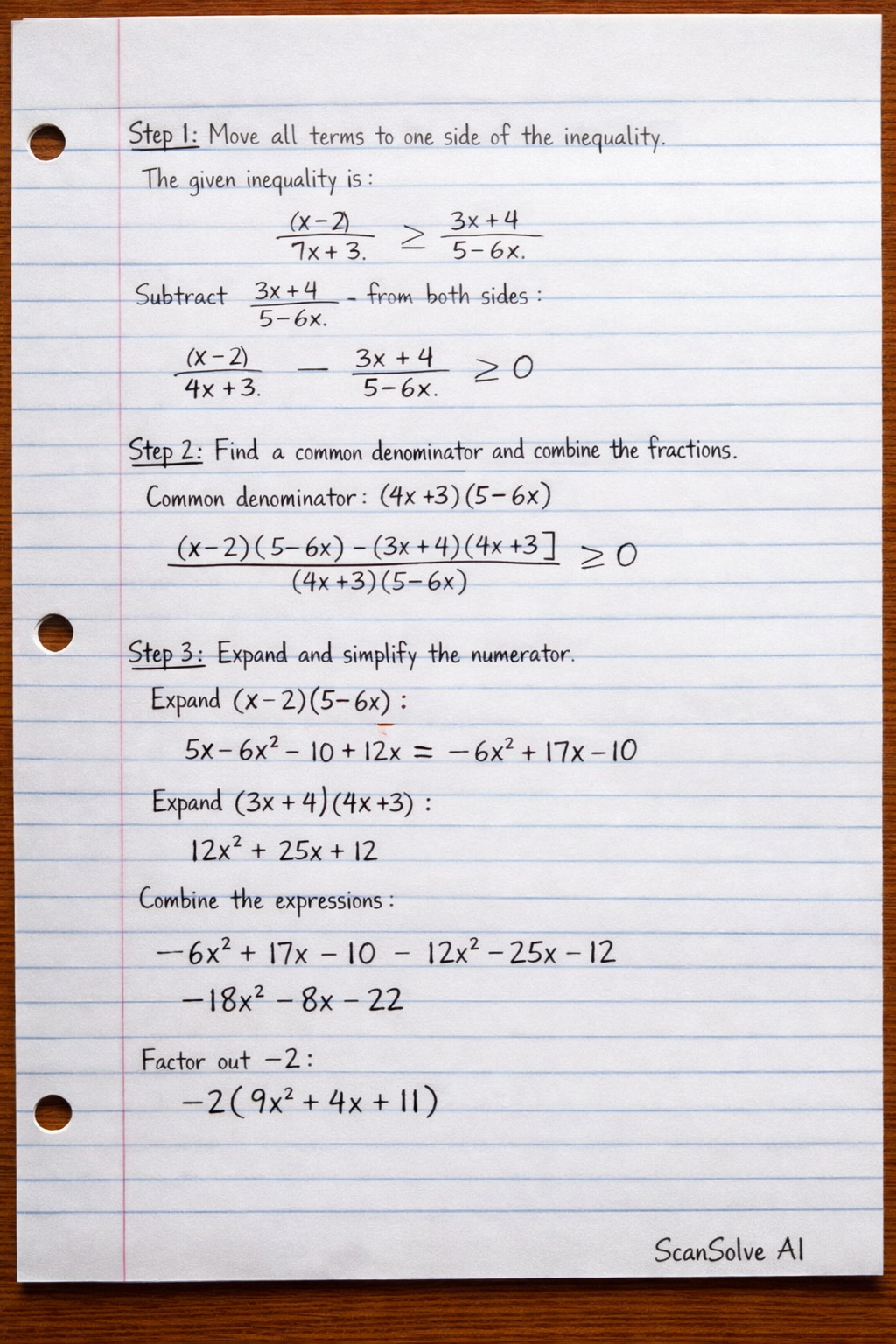
Handwritten Step-by-Step Solution
Get this as a handwritten image on WhatsApp — like a tutor wrote it for you.
Try on WhatsApp