

This mathematics problem involves applying core mathematical principles and formulas. Below you will find a complete step-by-step solution with detailed explanations for each step, helping you understand not just the answer but the method behind it.
ScanSolve AI Answer
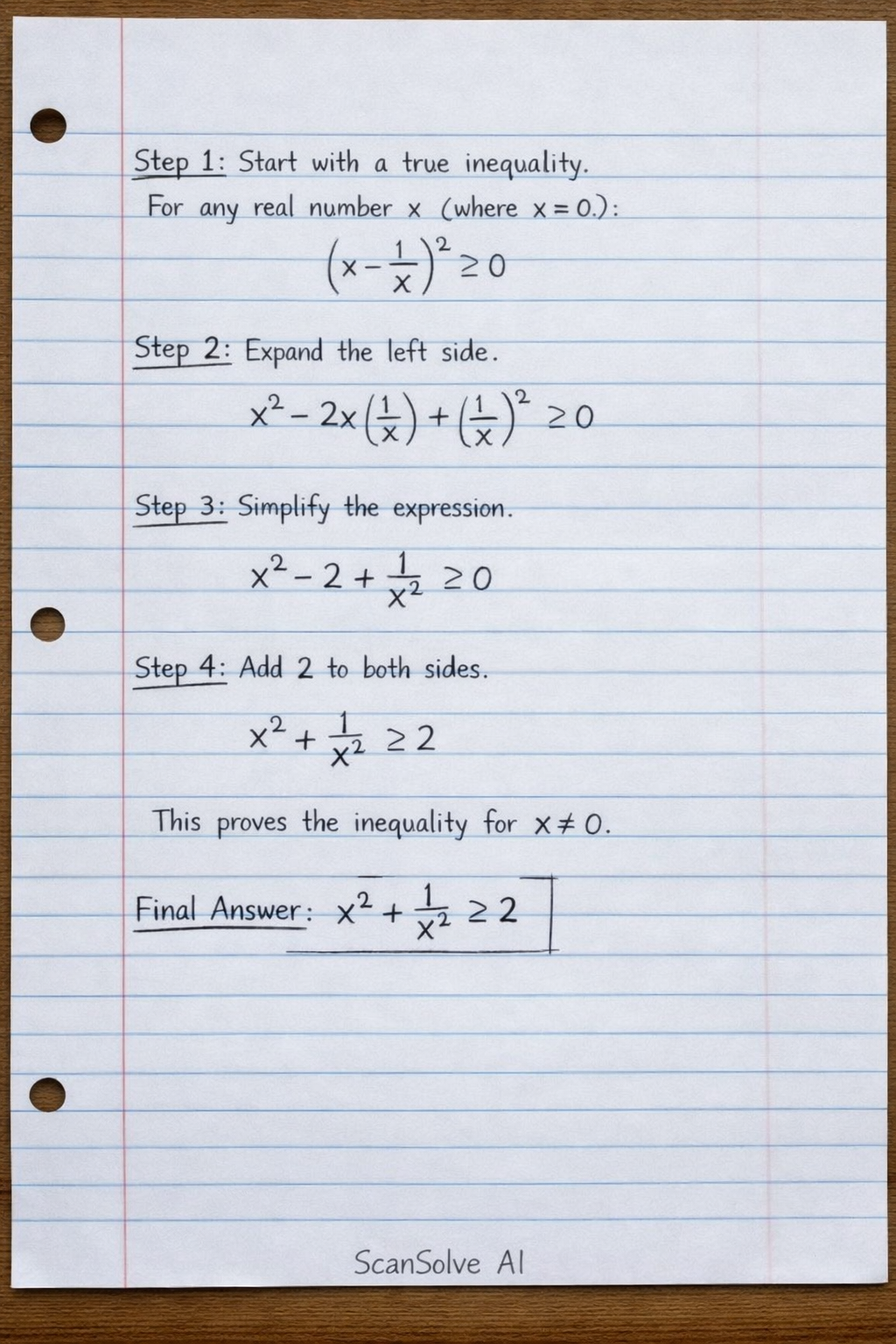
Step 1: Start with a known true inequality. For any real number x (where x 0), the square of the difference between x and (1)/(x) is always non-negative: (x - (1)/(x))^2 0 Step 2: Expand the left side of the inequality. Using the formula (a-b)^2 = a^2 - 2ab + b^2: x^2 - 2 · x · (1)/(x) + ((1)/(x))^2 0 Step 3: Simplify the expanded expression. x^2 - 2 + (1)/(x^2) 0 Step 4: Add 2 to both sides of the inequality. x^2 + (1)/(x^2) 2 This proves the inequality for x 0. The final answer is x^2 + (1)/(x^2) 2.