
We read your photo as:
Solve the inequality: (x2-12)/(x) > 1
ScanSolve AI Answer
Answer
Step-by-step solution
5 stepsRewrite the inequality by moving all terms to one side.
Factorize the numerator.
The quadratic expression can be factored as .
So the inequality becomes:Identify the critical points.
The critical points are the values of that make the numerator or the denominator equal to zero.
From the numerator: and .
From the denominator: .
The critical points are .Test intervals on the number line defined by the critical points.
The critical points divide the number line into four intervals: , , , and .
-
For (e.g., ): is negative. is negative. is negative. The expression is . So, .
-
For (e.g., ): is negative. is positive. is negative. The expression is . So, . This interval is part of the solution.
-
For (e.g., ): is negative. is positive. is positive. The expression is . So, .
-
For (e.g., ): is positive. is positive. is positive. The expression is . So, . This interval is part of the solution.
-
Combine the intervals where the inequality is satisfied.
The inequality holds for or .
The range of values for is .
Try one yourself
A new problem that tests the same skill.
Still stuck on this one?
Ask a follow-up, and the answer starts from this question.
More Mathematics Questions
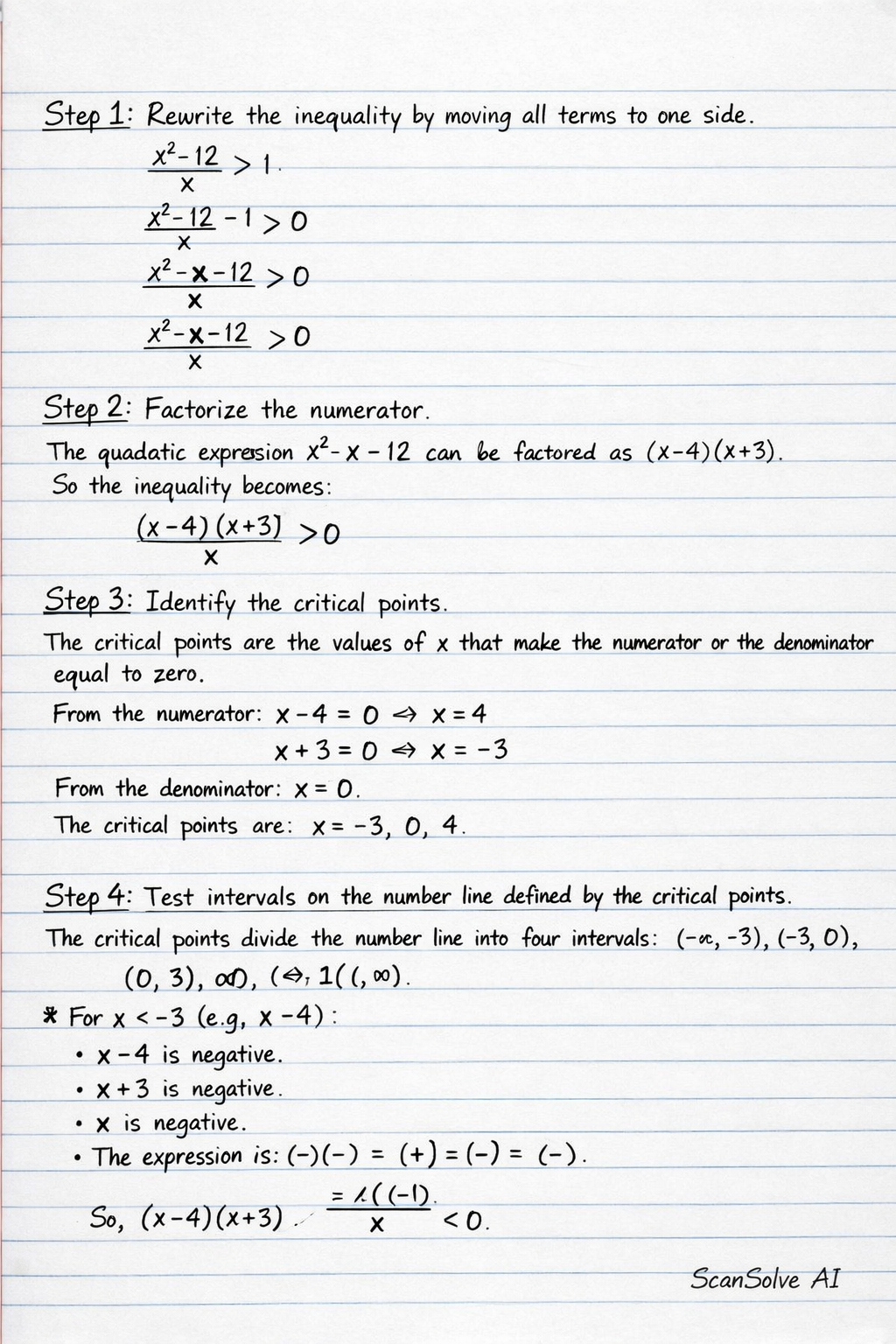
Handwritten Step-by-Step Solution
Get this as a handwritten image on WhatsApp — like a tutor wrote it for you.
Try on WhatsApp