We read your photo as:

Evaluate the integral: integral (dx)/(sqrt(9+x2))

Mathematics

ScanSolve AI Answer

Answers

2 parts
1

ln⁡∣x+x2+9∣+C\ln|x+\sqrt{x^2+9}| + C

2

ln⁡∣3x+9x2+1∣+C\ln|3x+\sqrt{9x^2+1}| + C

Step-by-step solution

8 steps

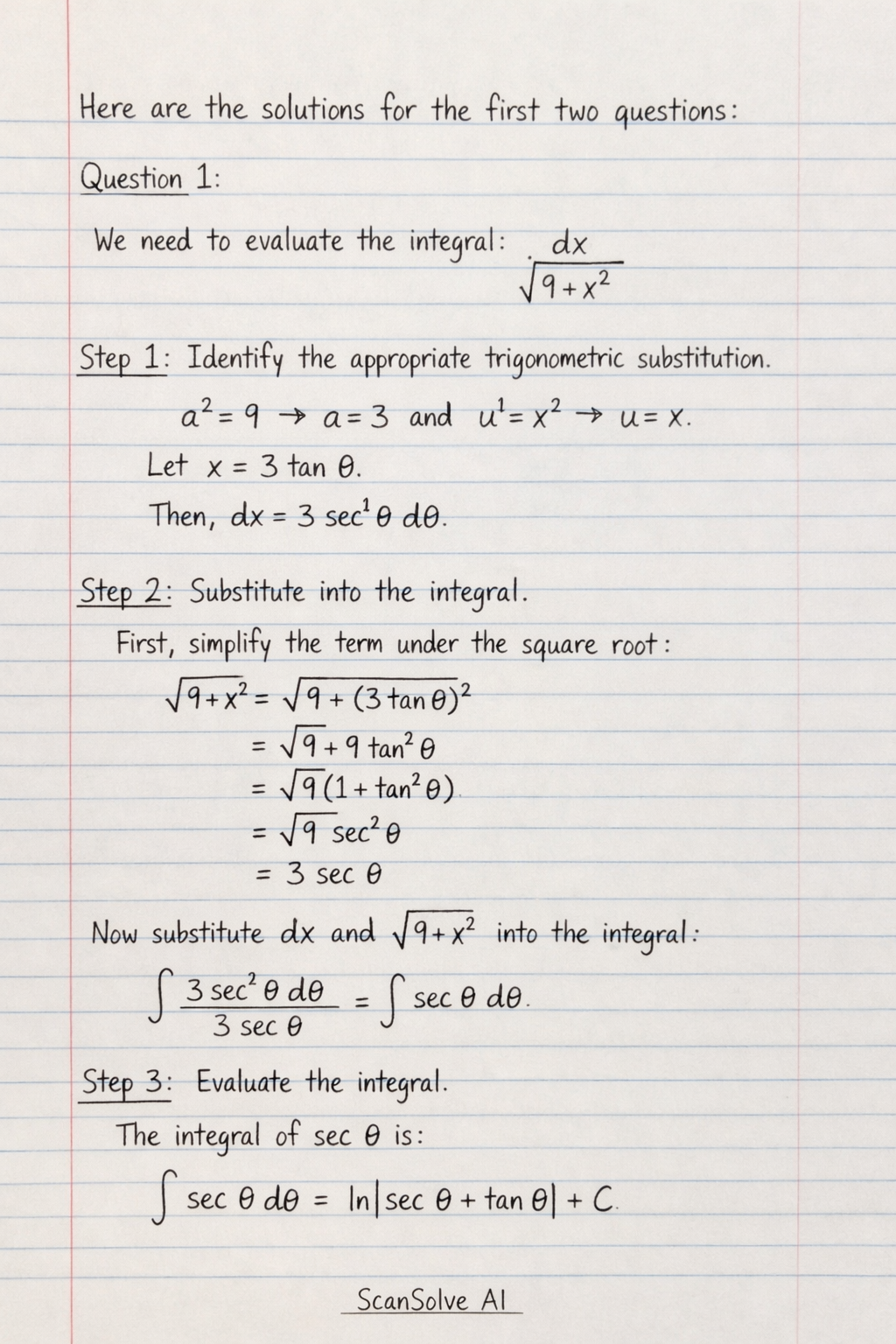
Here are the solutions for the first two questions:

Part 1· 4 steps

We need to evaluate the integral:

∫dx9+x2\int \frac{dx}{\sqrt{9+x^2}}
  1. Identify the appropriate trigonometric substitution.

    The integral is of the form ∫dua2+u2\int \frac{du}{\sqrt{a^2+u^2}}. Here, a2=9  ⟹  a=3a^2=9 \implies a=3 and u2=x2  ⟹  u=xu^2=x^2 \implies u=x.
    Let x=3tan⁡θx = 3 \tan \theta.
    Then, dx=3sec⁡2θ dθdx = 3 \sec^2 \theta \, d\theta.

  2. Substitute into the integral.

    First, simplify the term under the square root:

    9+x2=9+(3tan⁡θ)2=9+9tan⁡2θ=9(1+tan⁡2θ)=9sec⁡2θ=3sec⁡θ\sqrt{9+x^2} = \sqrt{9+(3 \tan \theta)^2} = \sqrt{9+9 \tan^2 \theta} = \sqrt{9(1+\tan^2 \theta)} = \sqrt{9 \sec^2 \theta} = 3 \sec \theta

    Now substitute dxdx and 9+x2\sqrt{9+x^2} into the integral:

    ∫3sec⁡2θ dθ3sec⁡θ=∫sec⁡θ dθ\int \frac{3 \sec^2 \theta \, d\theta}{3 \sec \theta} = \int \sec \theta \, d\theta
  3. Evaluate the integral.

    The integral of sec⁡θ\sec \theta is a standard integral:

    ∫sec⁡θ dθ=ln⁡∣sec⁡θ+tan⁡θ∣+C\int \sec \theta \, d\theta = \ln|\sec \theta + \tan \theta| + C
  4. Convert back to the original variable xx.

    From our substitution x=3tan⁡θx = 3 \tan \theta, we have tan⁡θ=x3\tan \theta = \frac{x}{3}.
    To find sec⁡θ\sec \theta, we can construct a right triangle where the opposite side is xx and the adjacent side is 3. The hypotenuse is x2+32=x2+9\sqrt{x^2+3^2} = \sqrt{x^2+9}.
    Thus, sec⁡θ=hypotenuseadjacent=x2+93\sec \theta = \frac{\text{hypotenuse}}{\text{adjacent}} = \frac{\sqrt{x^2+9}}{3}.
    Substitute these expressions back into the result from Step 3:

    ln⁡∣x2+93+x3∣+C\ln\left|\frac{\sqrt{x^2+9}}{3} + \frac{x}{3}\right| + C =ln⁡∣x+x2+93∣+C= \ln\left|\frac{x+\sqrt{x^2+9}}{3}\right| + C

    Using the logarithm property ln⁡(AB)=ln⁡A−ln⁡B\ln\left(\frac{A}{B}\right) = \ln A - \ln B:

    =ln⁡∣x+x2+9∣−ln⁡3+C= \ln|x+\sqrt{x^2+9}| - \ln 3 + C

    Since −ln⁡3-\ln 3 is a constant, we can absorb it into the arbitrary constant CC.

    =ln⁡∣x+x2+9∣+C= \ln|x+\sqrt{x^2+9}| + C

    The final answer is ln⁡∣x+x2+9∣+C\boxed{\ln|x+\sqrt{x^2+9}| + C}.


Part 2

ln⁡∣3x+9x2+1∣+C\ln|3x+\sqrt{9x^2+1}| + C

We need to evaluate the integral:

∫3 dx1+9x2\int \frac{3\,dx}{\sqrt{1+9x^2}}
  1. Identify the appropriate trigonometric substitution.

    The integral is of the form ∫k dua2+u2\int \frac{k\,du}{\sqrt{a^2+u^2}}. Here, a2=1  ⟹  a=1a^2=1 \implies a=1. For 9x29x^2, let u2=9x2  ⟹  u=3xu^2 = 9x^2 \implies u = 3x.
    Let 3x=1tan⁡θ=tan⁡θ3x = 1 \tan \theta = \tan \theta.
    Then x=13tan⁡θx = \frac{1}{3} \tan \theta.
    And dx=13sec⁡2θ dθdx = \frac{1}{3} \sec^2 \theta \, d\theta.

  2. Substitute into the integral.

    First, simplify the term under the square root:

    1+9x2=1+(tan⁡θ)2=1+tan⁡2θ=sec⁡2θ=sec⁡θ\sqrt{1+9x^2} = \sqrt{1+(\tan \theta)^2} = \sqrt{1+\tan^2 \theta} = \sqrt{\sec^2 \theta} = \sec \theta

    Now substitute dxdx and 1+9x2\sqrt{1+9x^2} into the integral:

    ∫3(13sec⁡2θ dθ)sec⁡θ=∫sec⁡2θ dθsec⁡θ=∫sec⁡θ dθ\int \frac{3 \left(\frac{1}{3} \sec^2 \theta \, d\theta\right)}{\sec \theta} = \int \frac{\sec^2 \theta \, d\theta}{\sec \theta} = \int \sec \theta \, d\theta
  3. Evaluate the integral.

    The integral of sec⁡θ\sec \theta is a standard integral:

    ∫sec⁡θ dθ=ln⁡∣sec⁡θ+tan⁡θ∣+C\int \sec \theta \, d\theta = \ln|\sec \theta + \tan \theta| + C
  4. Convert back to the original variable xx.

    From our substitution 3x=tan⁡θ3x = \tan \theta, we have tan⁡θ=3x\tan \theta = 3x.
    To find sec⁡θ\sec \theta, we can construct a right triangle where the opposite side is 3x3x and the adjacent side is 1. The hypotenuse is (3x)2+12=9x2+1\sqrt{(3x)^2+1^2} = \sqrt{9x^2+1}.
    Thus, sec⁡θ=hypotenuseadjacent=9x2+11=9x2+1\sec \theta = \frac{\text{hypotenuse}}{\text{adjacent}} = \frac{\sqrt{9x^2+1}}{1} = \sqrt{9x^2+1}.
    Substitute these expressions back into the result from Step 3:

    ln⁡∣9x2+1+3x∣+C\ln|\sqrt{9x^2+1} + 3x| + C

    The final answer is ln⁡∣3x+9x2+1∣+C\boxed{\ln|3x+\sqrt{9x^2+1}| + C}.

Was this helpful?

Try one yourself

A new problem that tests the same skill.

Still stuck on this one?

Ask a follow-up, and the answer starts from this question.

Got a different question?Ask your own question
Handwritten step-by-step solution preview

Handwritten Step-by-Step Solution

Get this as a handwritten image on WhatsApp — like a tutor wrote it for you.

Try on WhatsApp