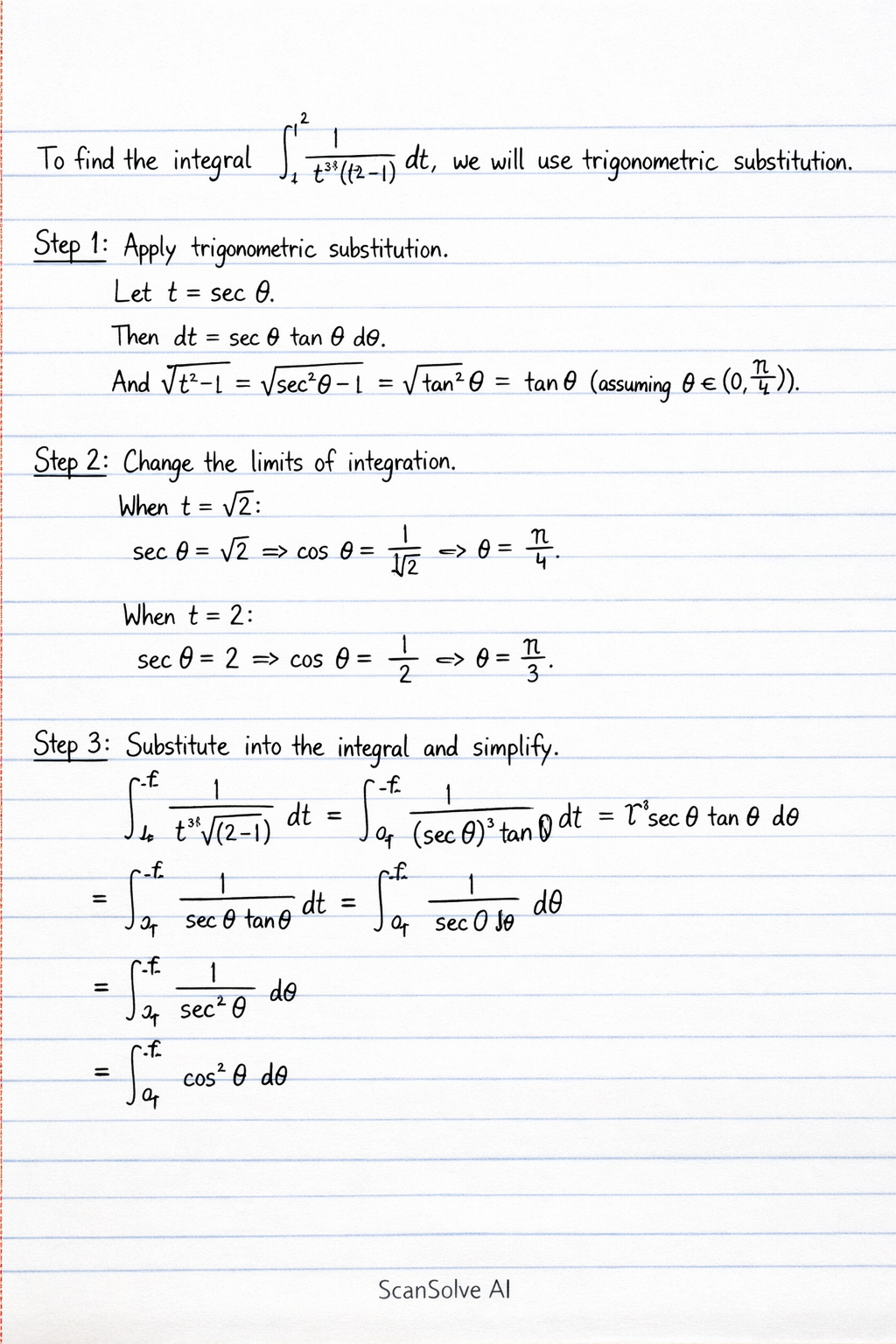
Find the integral integral_sqrt(2)2 (1)/(t3 sqrt(t2-1)) dt using trigonometric substitution.
|Mathematics
Find the integral integral_sqrt(2)2 (1)/(t3 sqrt(t2-1)) dt using trigonometric substitution.
ScanSolve AI Answer
Answer
24π+83−41
You're on a roll — To find the integral ∫22t3t2−11dt, we will use trigonometric substitution.
Step 1: Apply trigonometric substitution.
Let t=secθ.
Then dt=secθtanθdθ.
And t2−1=sec2θ−1=tan2θ=tanθ (assuming θ∈(0,π/2)).
Step 2: Change the limits of integration.
When t=2:
secθ=2⟹cosθ=21⟹θ=4π.
When t=2:
secθ=2⟹cosθ=21⟹θ=3π.
Step 3: Substitute into the integral and simplify.
∫22t3t2−11dt=∫π/4π/3(secθ)3(tanθ)1(secθtanθ)dθ=∫π/4π/3sec3θtanθsecθtanθdθ=∫π/4π/3sec2θ1dθ=∫π/4π/3cos2θdθ
Step 4: Use the power-reducing identity for cos2θ.
Recall that cos2θ=21+cos(2θ).
=∫π/4π/321+cos(2θ)dθ=21∫π/4π/3(1+cos(2θ))dθ
Step 5: Integrate and evaluate the definite integral.
=21[θ+21sin(2θ)]π/4π/3=21[(3π+21sin(2⋅3π))−(4π+21sin(2⋅4π))]=21[(3π+21sin(32π))−(4π+21sin(2π))]=21[(3π+21⋅23)−(4π+21⋅1)]=21[3π+43−4π−21]=21[(124π−3π)+43−21]=21[12π+43−21]=24π+83−41
The final answer is 24π+83−41.
What's next?
Was this helpful?
Need help with your own homework?
Get instant step-by-step solutions to any question. Free to start.
This mathematics problem involves applying core mathematical principles and formulas. Below you will find a complete step-by-step solution with detailed explanations for each step, helping you understand not just the answer but the method behind it.
ScanSolve AI Answer
You're on a roll — To find the integral _sqrt(2)^2 (1)/(t^3 sqrt(t^2-1)) dt, we will use trigonometric substitution. Step 1: Apply trigonometric substitution. Let t = . Then dt = d. And sqrt(t^2-1) = sqrt(^2 - 1) = sqrt(^2 ) = (assuming (0, /2)). Step 2: Change the limits of integration. When t = sqrt(2): = sqrt(2) = (1)/(sqrt(2)) = ()/(4). When t = 2: = 2 = (1)/(2) = ()/(3). Step 3: Substitute into the integral and simplify. _sqrt(2)^2 (1)/(t^3 sqrt(t^2-1)) dt = _/4^/3 (1)/(( )^3 ( )) ( ) d = _/4^/3 ( )/(^3 ) d = _/4^/3 (1)/(^2 ) d = _/4^/3 ^2 d Step 4: Use the power-reducing identity for ^2 . Recall that ^2 = (1 + (2))/(2). = _/4^/3 (1 + (2))/(2) d = (1)/(2) _/4^/3 (1 + (2)) d Step 5: Integrate and evaluate the definite integral. = (1)/(2) [ + (1)/(2)(2) ]_/4^/3 = (1)/(2) [ ( ()/(3) + (1)/(2)(2 · ()/(3)) ) - ( ()/(4) + (1)/(2)(2 · ()/(4)) ) ] = (1)/(2) [ ( ()/(3) + (1)/(2)((2)/(3)) ) - ( ()/(4) + (1)/(2)(()/(2)) ) ] = (1)/(2) [ ( ()/(3) + (1)/(2) · sqrt(3)2 ) - ( ()/(4) + (1)/(2) · 1 ) ] = (1)/(2) [ ()/(3) + sqrt(3)4 - ()/(4) - (1)/(2) ] = (1)/(2) [ ((4 - 3)/(12)) + sqrt(3)4 - (1)/(2) ] = (1)/(2) [ ()/(12) + sqrt(3)4 - (1)/(2) ] = ()/(24) + sqrt(3)8 - (1)/(4) The final answer is ()/(24) + sqrt(3)8 - (1)/(4). What's next?