
We read your photo as:
Evaluate the integral of tan2(x)sec(x).
Mathematics
ScanSolve AI Answer
Step-by-step solution
6 stepsUse the trigonometric identity to rewrite the integrand.
Distribute and split the integral into two parts.
Evaluate the integral of .
Evaluate the integral of using integration by parts.
Let .
We use integration by parts: .
Let and .
Then and .Substitute again:
Now, solve for :
Combine the results from Step 3 and Step 4.
Substitute the expressions for and back into the equation from Step 2:
Simplify the expression.
The final answer is .
Was this helpful?
Still stuck on this one?
Ask a follow-up, and the answer starts from this question.
Got a different question?Ask your own question
More Mathematics Questions
QEvaluate the integral of 1/(1+tan⁻¹(x))² with respect to x, from 0 to 1.QEvaluate the integral of (cos⁻¹ x)2 with respect to x.QIntegral of tan xQEvaluate the integral integral x2 (x) dx.QEvaluate; integral of sec³x dx
Browse by topic:Calculus
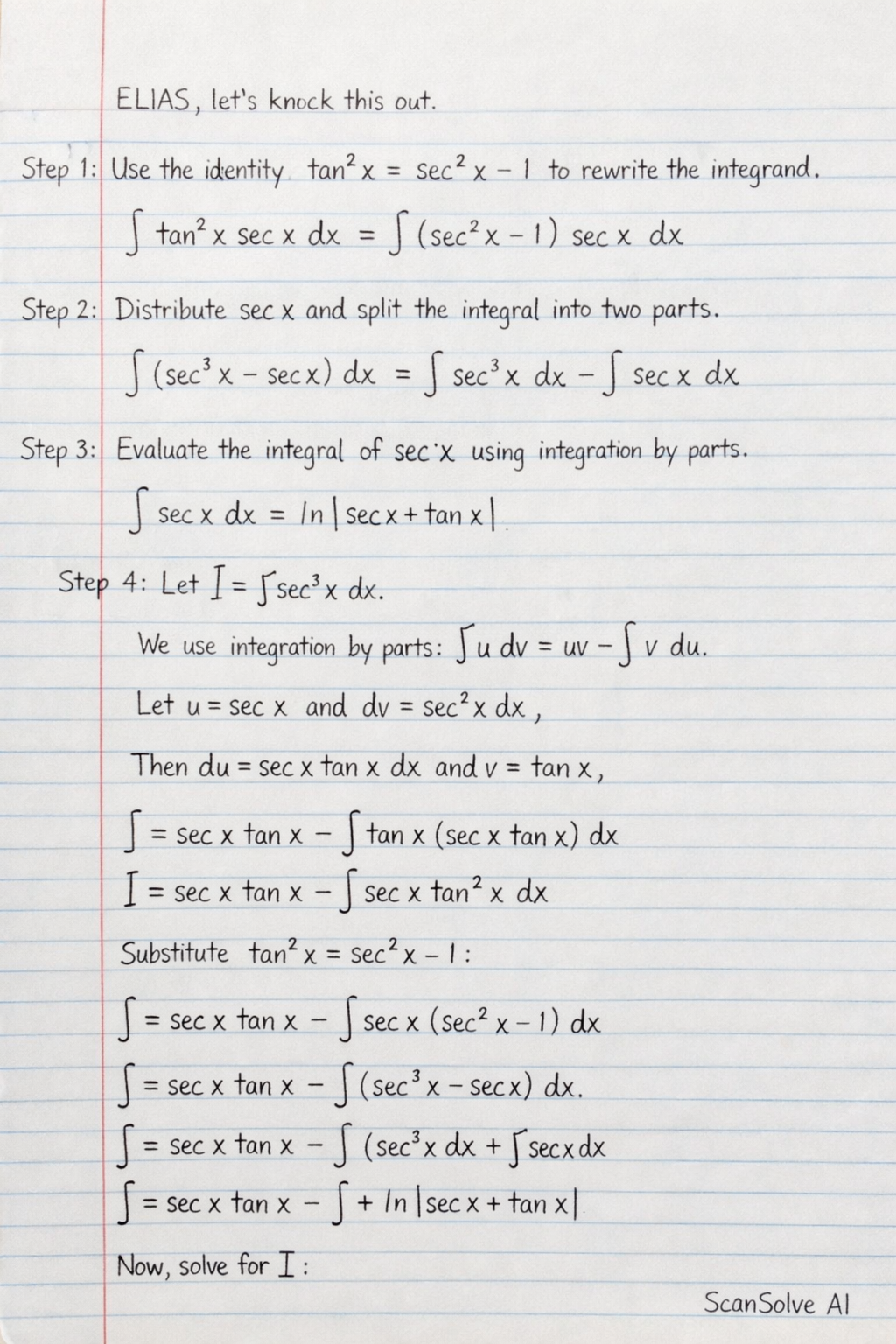
Handwritten Step-by-Step Solution
Get this as a handwritten image on WhatsApp — like a tutor wrote it for you.
Try on WhatsApp