
We read your photo as:
Using the most appropriate method, evaluate the following integrals: (a) ∫x(3x2 + 2)2 dx (b) ∫ (3x2 - 1)/(x3 - x + 4)3 dx (c) ∫_-11 (x-1)(x+3)dx
ScanSolve AI Answer
Step-by-step solution
26 stepsHere are the solutions to the integration problems:
Question 1 (a)
a) To evaluate , we use u-substitution.
Let .
Differentiate with respect to to find
Rearrange to find
Substitute and into the integral
Integrate with respect to
Substitute back
b) To evaluate , we use u-substitution.
Let .
Differentiate with respect to to find
Substitute and into the integral
Integrate with respect to
Substitute back
c) To evaluate , we first expand the integrand.
Expand the product
Integrate the polynomial
Evaluate the definite integral using the limits from -1 to 1
Calculate the values at the upper and lower limits
Subtract the values
Question 1 (b)
a) To integrate using Pythagoras' theorem of odd powers:
Rewrite as
Use the identity
Let .
Then , so .
Integrate the polynomial with respect to
Substitute back
b) To integrate using Pythagoras' theorem of odd powers:
Rewrite as
Use the identity
Let .
Then .
Integrate the polynomial with respect to
Substitute back
Still stuck on this one?
Ask a follow-up, and the answer starts from this question.
More Mathematics Questions
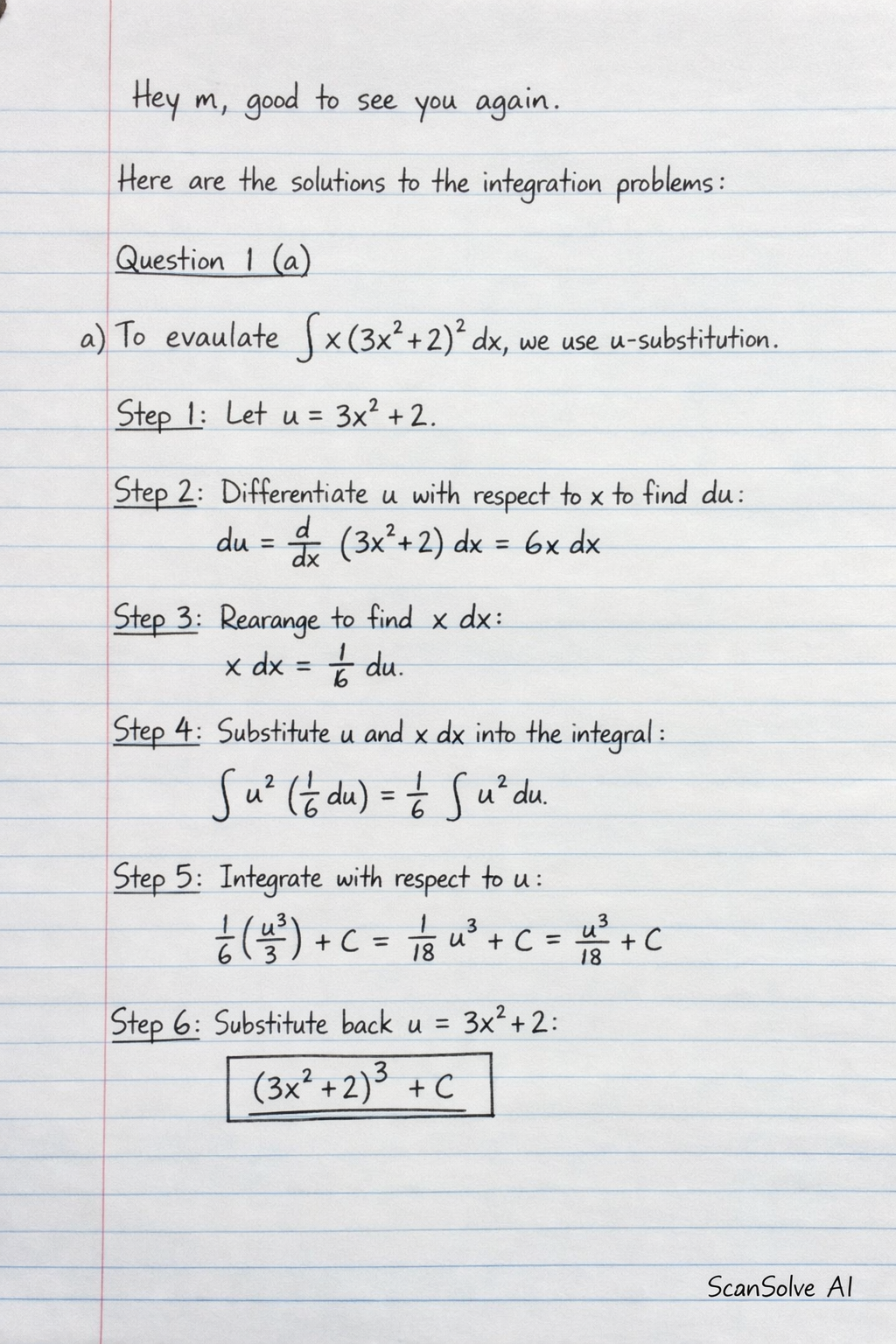
Handwritten Step-by-Step Solution
Get this as a handwritten image on WhatsApp — like a tutor wrote it for you.
Try on WhatsApp