We read your photo as:

Using integration by parts, find the following integrals: (a) ∫ x ln x dx (b) ∫ x sin x dx (c) ∫ x² e³ˣ dx. Find the following integrals: (a) ∫ (x+1)/(x²-3x+2) dx (b) ∫ (x²+1)/(x+2)² dx

Mathematics

ScanSolve AI Answer

Step-by-step solution

24 steps

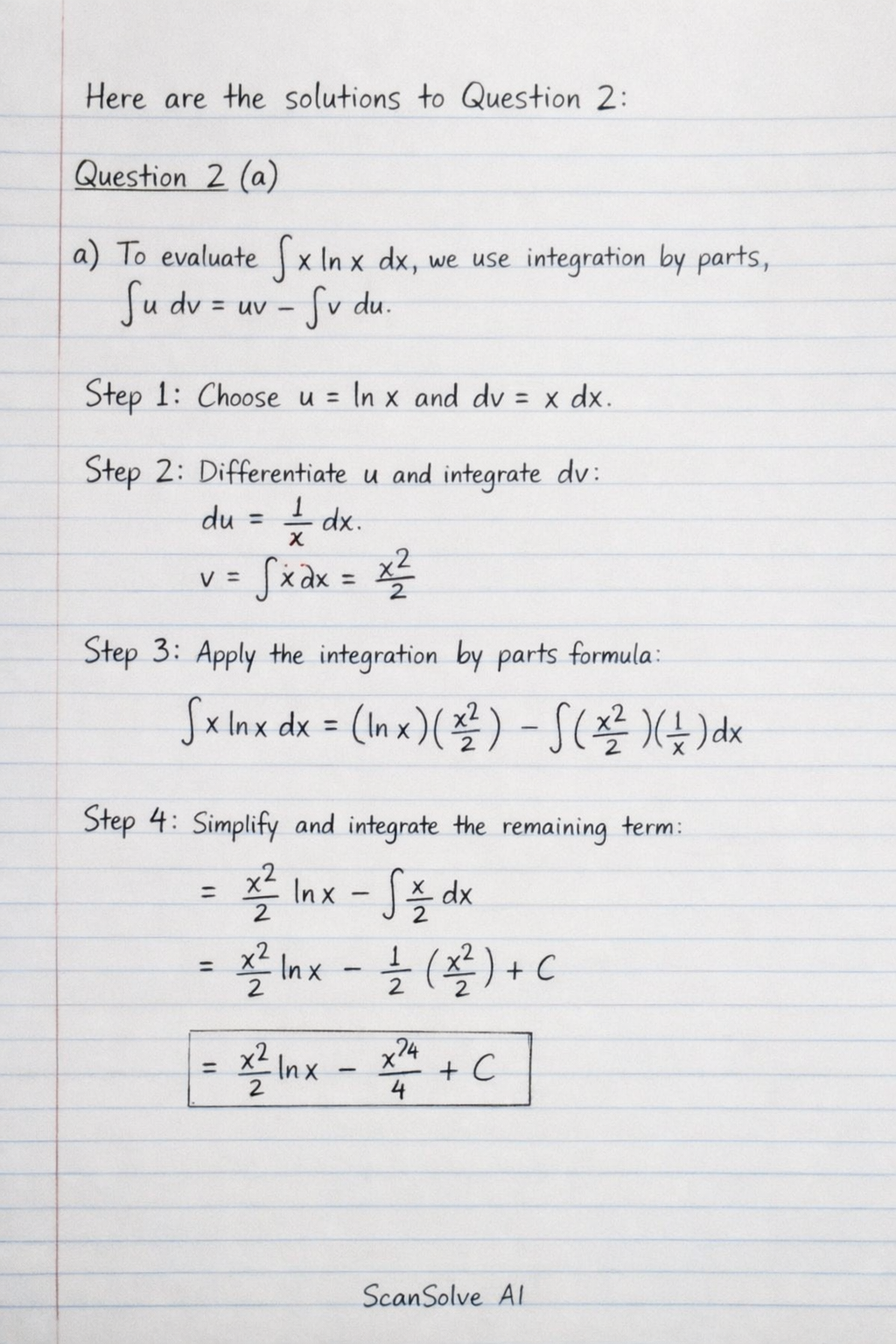
Here are the solutions to Question 2:

Question 2 (a)

a) To evaluate ∫xln⁡x dx\int x \ln x \, dx, we use integration by parts, ∫u dv=uv−∫v du\int u \, dv = uv - \int v \, du.

  1. Choose u=ln⁡xu = \ln x and dv=x dxdv = x \, dx.

  2. Differentiate uu and integrate dvdv

    du=1x dxdu = \frac{1}{x} \, dx v=∫x dx=x22v = \int x \, dx = \frac{x^2}{2}
  3. Apply the integration by parts formula

    ∫xln⁡x dx=(ln⁡x)(x22)−∫(x22)(1x) dx\int x \ln x \, dx = (\ln x)\left(\frac{x^2}{2}\right) - \int \left(\frac{x^2}{2}\right)\left(\frac{1}{x}\right) \, dx
  4. Simplify and integrate the remaining term

    =x22ln⁡x−∫x2 dx= \frac{x^2}{2} \ln x - \int \frac{x}{2} \, dx =x22ln⁡x−12(x22)+C= \frac{x^2}{2} \ln x - \frac{1}{2} \left(\frac{x^2}{2}\right) + C x22ln⁡x−x24+C\boxed{\frac{x^2}{2} \ln x - \frac{x^2}{4} + C}

    b) To evaluate ∫xsin⁡x dx\int x \sin x \, dx, we use integration by parts.

  5. Choose u=xu = x and dv=sin⁡x dxdv = \sin x \, dx.

  6. Differentiate uu and integrate dvdv

    du=dxdu = dx v=∫sin⁡x dx=−cos⁡xv = \int \sin x \, dx = -\cos x
  7. Apply the integration by parts formula

    ∫xsin⁡x dx=(x)(−cos⁡x)−∫(−cos⁡x) dx\int x \sin x \, dx = (x)(-\cos x) - \int (-\cos x) \, dx
  8. Simplify and integrate the remaining term

    =−xcos⁡x+∫cos⁡x dx= -x \cos x + \int \cos x \, dx −xcos⁡x+sin⁡x+C\boxed{-x \cos x + \sin x + C}

    c) To evaluate ∫x2e3x dx\int x^2 e^{3x} \, dx, we use integration by parts twice.

  9. For the first application, choose u=x2u = x^2 and dv=e3x dxdv = e^{3x} \, dx.

  10. Differentiate uu and integrate dvdv

    du=2x dxdu = 2x \, dx v=∫e3x dx=13e3xv = \int e^{3x} \, dx = \frac{1}{3}e^{3x}
  11. Apply the integration by parts formula

    ∫x2e3x dx=x2(13e3x)−∫(13e3x)(2x) dx\int x^2 e^{3x} \, dx = x^2 \left(\frac{1}{3}e^{3x}\right) - \int \left(\frac{1}{3}e^{3x}\right)(2x) \, dx =13x2e3x−23∫xe3x dx= \frac{1}{3}x^2 e^{3x} - \frac{2}{3} \int x e^{3x} \, dx
  12. Now, evaluate ∫xe3x dx\int x e^{3x} \, dx using integration by parts again.

    Choose u=xu = x and dv=e3x dxdv = e^{3x} \, dx.

  13. Differentiate uu and integrate dvdv

    du=dxdu = dx v=∫e3x dx=13e3xv = \int e^{3x} \, dx = \frac{1}{3}e^{3x}
  14. Apply the integration by parts formula for the second time

    ∫xe3x dx=x(13e3x)−∫(13e3x) dx\int x e^{3x} \, dx = x \left(\frac{1}{3}e^{3x}\right) - \int \left(\frac{1}{3}e^{3x}\right) \, dx =13xe3x−13(13e3x)+C1= \frac{1}{3}x e^{3x} - \frac{1}{3} \left(\frac{1}{3}e^{3x}\right) + C_1 =13xe3x−19e3x+C1= \frac{1}{3}x e^{3x} - \frac{1}{9}e^{3x} + C_1
  15. Substitute this result back into the expression from Step 3

    ∫x2e3x dx=13x2e3x−23(13xe3x−19e3x)+C\int x^2 e^{3x} \, dx = \frac{1}{3}x^2 e^{3x} - \frac{2}{3} \left( \frac{1}{3}x e^{3x} - \frac{1}{9}e^{3x} \right) + C 13x2e3x−29xe3x+227e3x+C\boxed{\frac{1}{3}x^2 e^{3x} - \frac{2}{9}x e^{3x} + \frac{2}{27}e^{3x} + C}

    Question 2 (b)

    a) To evaluate ∫x+1x2−3x+2 dx\int \frac{x+1}{x^2 - 3x + 2} \, dx, we use partial fraction decomposition.

  16. Factor the denominator

    x2−3x+2=(x−1)(x−2)x^2 - 3x + 2 = (x-1)(x-2).

  17. Set up the partial fraction decomposition

    x+1(x−1)(x−2)=Ax−1+Bx−2\frac{x+1}{(x-1)(x-2)} = \frac{A}{x-1} + \frac{B}{x-2}

    Multiply both sides by (x−1)(x−2)(x-1)(x-2):

    x+1=A(x−2)+B(x−1)x+1 = A(x-2) + B(x-1)
  18. Solve for AA and BB.

    Set x=1x=1: 1+1=A(1−2)  ⟹  2=−A  ⟹  A=−21+1 = A(1-2) \implies 2 = -A \implies A = -2.
    Set x=2x=2: 2+1=B(2−1)  ⟹  3=B  ⟹  B=32+1 = B(2-1) \implies 3 = B \implies B = 3.

  19. Rewrite the integral using the partial fractions and integrate

    ∫(−2x−1+3x−2) dx=−2∫1x−1 dx+3∫1x−2 dx\int \left( \frac{-2}{x-1} + \frac{3}{x-2} \right) \, dx = -2 \int \frac{1}{x-1} \, dx + 3 \int \frac{1}{x-2} \, dx −2ln⁡∣x−1∣+3ln⁡∣x−2∣+C\boxed{-2 \ln|x-1| + 3 \ln|x-2| + C}

    b) To evaluate ∫x2+1(x+2)2 dx\int \frac{x^2+1}{(x+2)^2} \, dx, we can manipulate the numerator.

  20. Let y=x+2y = x+2, so x=y−2x = y-2.

    Substitute this into the numerator:

    x2+1=(y−2)2+1=(y2−4y+4)+1=y2−4y+5x^2+1 = (y-2)^2+1 = (y^2 - 4y + 4) + 1 = y^2 - 4y + 5
  21. Substitute yy back into the integral.

    Note that dx=dydx = dy:

    ∫y2−4y+5y2 dy\int \frac{y^2 - 4y + 5}{y^2} \, dy
  22. Split the fraction into simpler terms

    =∫(y2y2−4yy2+5y2) dy=∫(1−4y+5y−2) dy= \int \left( \frac{y^2}{y^2} - \frac{4y}{y^2} + \frac{5}{y^2} \right) \, dy = \int \left( 1 - \frac{4}{y} + 5y^{-2} \right) \, dy
  23. Integrate each term with respect to yy

    =y−4ln⁡∣y∣+5(y−1−1)+C= y - 4 \ln|y| + 5 \left(\frac{y^{-1}}{-1}\right) + C =y−4ln⁡∣y∣−5y+C= y - 4 \ln|y| - \frac{5}{y} + C
  24. Substitute back y=x+2y = x+2

    x+2−4ln⁡∣x+2∣−5x+2+C\boxed{x+2 - 4 \ln|x+2| - \frac{5}{x+2} + C}
Was this helpful?

Still stuck on this one?

Ask a follow-up, and the answer starts from this question.

Got a different question?Ask your own question
Handwritten step-by-step solution preview

Handwritten Step-by-Step Solution

Get this as a handwritten image on WhatsApp — like a tutor wrote it for you.

Try on WhatsApp