Determine the following limit: limit x->5 (3x4 - 375x) / (3x2 - 15x)
|Mathematics
Determine the following limit: limit x->5 (3x4 - 375x) / (3x2 - 15x)
ScanSolve AI Answer
Answer
22+2
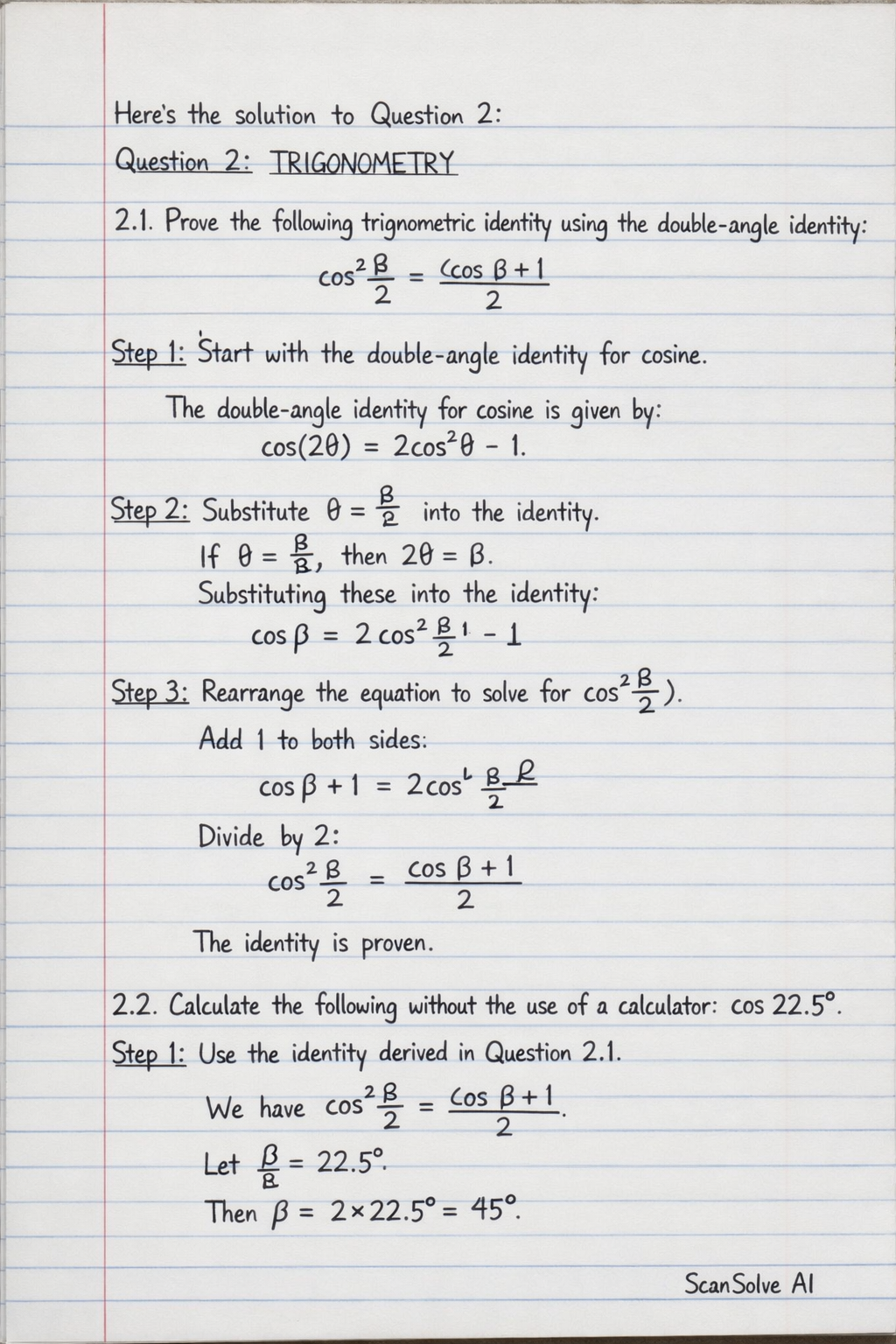
Here's the solution to Question 2:
Question 2: TRIGONOMETRY
2.1 Prove the following trigonometric identity using the double-angle identity:cos22β=2(cosβ+1)
Step 1: Start with the double-angle identity for cosine.
The double-angle identity for cosine is given by:
cos(2θ)=2cos2θ−1
Step 2: Substitute θ=2β into the identity.
If θ=2β, then 2θ=β.
Substituting these into the identity:
cosβ=2cos22β−1
Step 3: Rearrange the equation to solve for cos22β.
Add 1 to both sides:
cosβ+1=2cos22β
Divide by 2:
cos22β=2cosβ+1
The identity is proven.
2.2 Calculate the following without the use of a calculator: cos22.5∘.
Step 1: Use the identity derived in Question 2.1.
We have cos22β=2cosβ+1.
Let 2β=22.5∘.
Then β=2×22.5∘=45∘.
Step 2: Substitute β=45∘ into the identity.
cos222.5∘=2cos45∘+1
We know that cos45∘=22.
cos222.5∘=222+1
Step 3: Simplify the expression.
cos222.5∘=222+2cos222.5∘=42+2
Step 4: Take the square root of both sides.
Since 22.5∘ is in the first quadrant, cos22.5∘ is positive.
cos22.5∘=42+2cos22.5∘=42+2\cos 22.5^\circ = \frac{\sqrt{2 + \sqrt{2}}{2}}
2.3 Solve for x if 4−7sinx=2cos2x; 0∘≤x≤360∘. NB use the derived identity in QUESTION 2.1.
Step 1: Use the derived identity from Question 2.1 to express cos2x in terms of sinx.
From cos22β=2cosβ+1, we can rearrange to get cosβ=2cos22β−1.
Let β=2x. Then 2β=x.
So, cos2x=2cos2x−1.
Substitute this into the given equation:
4−7sinx=2(2cos2x−1)4−7sinx=4cos2x−2
Step 2: Convert cos2x to sin2x using the identity cos2x=1−sin2x.
4−7sinx=4(1−sin2x)−24−7sinx=4−4sin2x−24−7sinx=2−4sin2x
Step 3: Rearrange the equation into a quadratic form in terms of sinx.
4sin2x−7sinx+4−2=04sin2x−7sinx+2=0
Step 4: Solve the quadratic equation for sinx using the quadratic formula u=2a−b±b2−4ac, where u=sinx.
Here, a=4, b=−7, c=2.
sinx=2(4)−(−7)±(−7)2−4(4)(2)sinx=87±49−32sinx=87±17
Step 5: Evaluate the possible values for sinx.
sinx=87+17orsinx=87−17
Approximate values: 17≈4.123.
sinx≈87+4.123=811.123≈1.390
This value is not possible since −1≤sinx≤1.
sinx≈87−4.123=82.877≈0.3596
This value is valid.
Step 6: Find the values of x in the range 0∘≤x≤360∘.
Let sinx=87−17.
First, find the reference angle α:
α=arcsin(87−17)≈arcsin(0.3596)≈21.08∘
Since sinx is positive, x lies in Quadrant I or Quadrant II.
In Quadrant I:
x1=α≈21.08∘
In Quadrant II:
x2=180∘−α≈180∘−21.08∘=158.92∘
That's 2 down. 3 left today — send the next one.
Was this helpful?
Need help with your own homework?
Get instant step-by-step solutions to any question. Free to start.
Here's the solution to Question 2: Question 2: TRIGONOMETRY 2.1 Prove the following trigonometric identity using the double-angle identity: ^2 ()/(2) = (( + 1))/(2) Step 1: Start with the double-angle identity for cosine.
Determine the following limit: limit x->5 (3x4 - 375x) / (3x2 - 15x)
This mathematics problem involves applying core mathematical principles and formulas. Below you will find a complete step-by-step solution with detailed explanations for each step, helping you understand not just the answer but the method behind it.
ScanSolve AI Answer
Here's the solution to Question 2: Question 2: TRIGONOMETRY 2.1 Prove the following trigonometric identity using the double-angle identity: ^2 ()/(2) = (( + 1))/(2) Step 1: Start with the double-angle identity for cosine. The double-angle identity for cosine is given by: (2) = 2^2 - 1 Step 2: Substitute = ()/(2) into the identity. If = ()/(2), then 2 = . Substituting these into the identity: = 2^2 ()/(2) - 1 Step 3: Rearrange the equation to solve for ^2 ()/(2). Add 1 to both sides: + 1 = 2^2 ()/(2) Divide by 2: ^2 ()/(2) = ( + 1)/(2) The identity is proven. 2.2 Calculate the following without the use of a calculator: 22.5^. Step 1: Use the identity derived in Question 2.1. We have ^2 ()/(2) = ( + 1)/(2). Let ()/(2) = 22.5^. Then = 2 × 22.5^ = 45^. Step 2: Substitute = 45^ into the identity. ^2 22.5^ = ( 45^ + 1)/(2) We know that 45^ = sqrt(2)2. ^2 22.5^ = sqrt(2)2 + 12 Step 3: Simplify the expression. ^2 22.5^ = sqrt(2) + 222 ^2 22.5^ = sqrt(2) + 24 Step 4: Take the square root of both sides. Since 22.5^ is in the first quadrant, 22.5^ is positive. 22.5^ = sqrt(2 + 2)4 22.5^ = sqrt(2 + 2)sqrt(4) 22.5^ = sqrt(2 + 2)2 2.3 Solve for x if 4 - 7 x = 2 2x; 0^ x 360^. NB use the derived identity in QUESTION 2.1. Step 1: Use the derived identity from Question 2.1 to express 2x in terms of x. From ^2 ()/(2) = ( + 1)/(2), we can rearrange to get = 2^2 ()/(2) - 1. Let = 2x. Then ()/(2) = x. So, 2x = 2^2 x - 1. Substitute this into the given equation: 4 - 7 x = 2(2^2 x - 1) 4 - 7 x = 4^2 x - 2 Step 2: Convert ^2 x to ^2 x using the identity ^2 x = 1 - ^2 x. 4 - 7 x = 4(1 - ^2 x) - 2 4 - 7 x = 4 - 4^2 x - 2 4 - 7 x = 2 - 4^2 x Step 3: Rearrange the equation into a quadratic form in terms of x. 4^2 x - 7 x + 4 - 2 = 0 4^2 x - 7 x + 2 = 0 Step 4: Solve the quadratic equation for x using the quadratic formula u = -b ± sqrt(b^2 - 4ac)2a, where u = x. Here, a=4, b=-7, c=2. x = -(-7) ± sqrt((-7)^2 - 4(4)(2))2(4) x = 7 ± sqrt(49 - 32)8 x = 7 ± sqrt(17)8 Step 5: Evaluate the possible values for x. x = 7 + sqrt(17)8 or x = 7 - sqrt(17)8 Approximate values: sqrt(17) ≈ 4.123. x ≈ (7 + 4.123)/(8) = (11.123)/(8) ≈ 1.390 This value is not possible since -1 x 1. x ≈ (7 - 4.123)/(8) = (2.877)/(8) ≈ 0.3596 This value is valid. Step 6: Find the values of x in the range 0^ x 360^. Let x = 7 - sqrt(17)8. First, find the reference angle : = (7 - sqrt(17)8) ≈ (0.3596) ≈ 21.08^ Since x is positive, x lies in Quadrant I or Quadrant II. In Quadrant I: x_1 = ≈ 21.08^ In Quadrant II: x_2 = 180^ - ≈ 180^ - 21.08^ = 158.92^ That's 2 down. 3 left today — send the next one.