This mathematics problem involves applying core mathematical principles and formulas. Below you will find a complete step-by-step solution with detailed explanations for each step, helping you understand not just the answer but the method behind it.
ScanSolve AI Answer
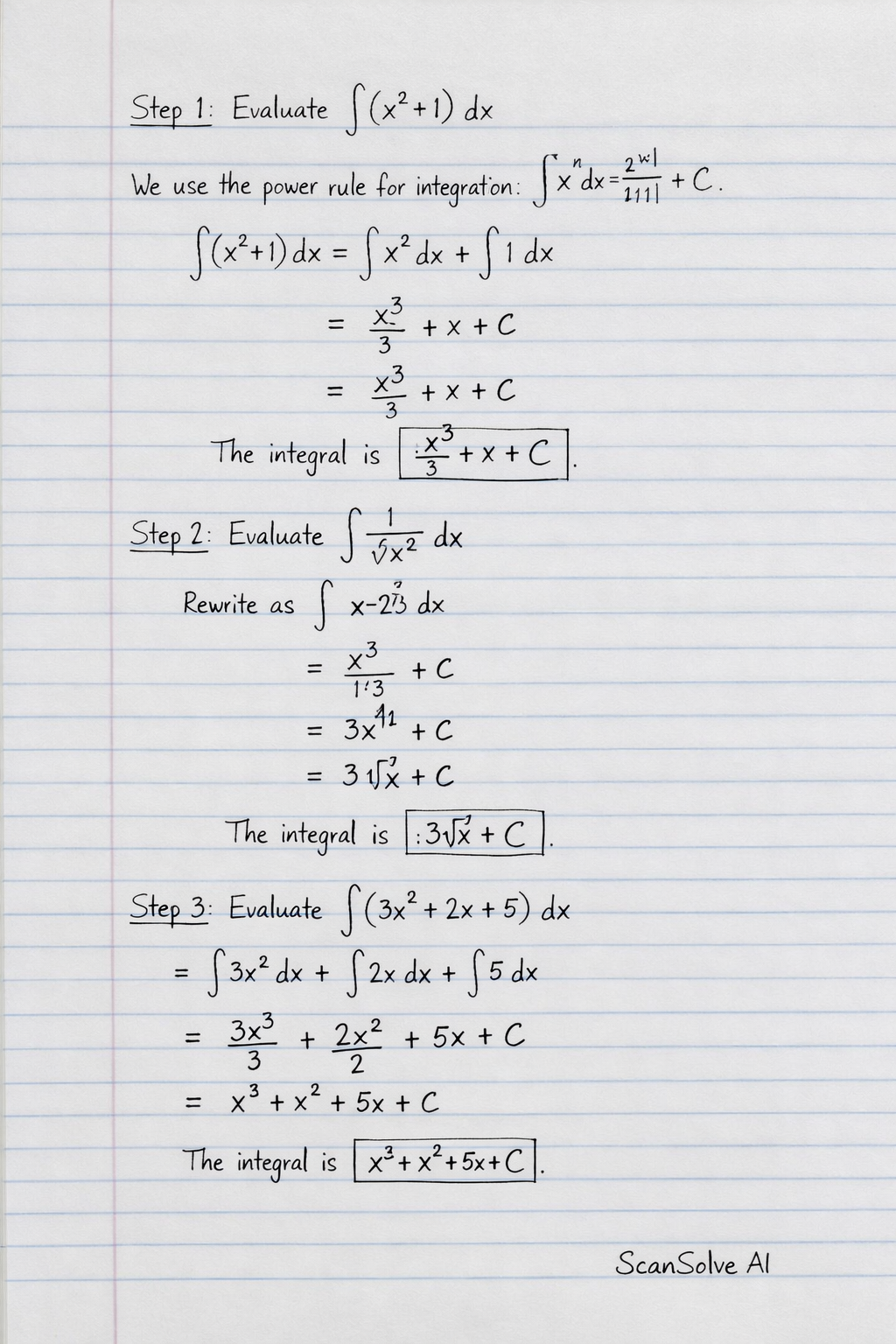
Step 1: Evaluate $\int (x^2 + 1) \,dx$
We use the power rule for integration, $\int x^n \,dx = \frac{x^{n+1}}{n+1} + C$.
$$ \int (x^2 + 1) \,dx = \int x^2 \,dx + \int 1 \,dx $$
$$ = \frac{x^{2+1}}{2+1} + x + C $$
$$ = \frac{x^3}{3} + x + C $$
The integral is $\boxed{\frac{x^3}{3} + x + C}$.
Step 2: Evaluate $\int \frac{dx}{\sqrt[3]{x^2}}$
First, rewrite the integrand using exponent notation: $\sqrt[3]{x^2} = x^{2/3}$.
Then, $\frac{1}{x^{2/3}} = x^{-2/3}$.
$$ \int x^{-2/3} \,dx $$
Apply the power rule for integration:
$$ = \frac{x^{-2/3 + 1}}{-2/3 + 1} + C $$
$$ = \frac{x^{1/3}}{1/3} + C $$
$$ = 3x^{1/3} + C $$
$$ = 3\sqrt[3]{x} + C $$
The integral is $\boxed{3\sqrt[3]{x} + C}$.
Step 3: Evaluate $\int (3x^2 + 2x + 5) \,dx$
Integrate each term using the power rule:
$$ \int (3x^2 + 2x + 5) \,dx = \int 3x^2 \,dx + \int 2x \,dx + \int 5 \,dx $$
$$ = 3\frac{x^{2+1}}{2+1} + 2\frac{x^{1+1}}{1+1} + 5x + C $$
$$ = 3\frac{x^3}{3} + 2\frac{x^2}{2} + 5x + C $$
$$ = x^3 + x^2 + 5x + C $$
The integral is $\boxed{x^3 + x^2 + 5x + C}$.
Step 4: Evaluate $\int \frac{x^4 + 3x^3 - 4x}{x^2} \,dx$
First, divide each term in the numerator by $x^2$:
$$ \frac{x^4}{x^2} + \frac{3x^3}{x^2} - \frac{4x}{x^2} = x^{4-2} + 3x^{3-2} - 4x^{1-2} = x^2 + 3x - 4x^{-1} $$
Now integrate the simplified expression:
$$ \int (x^2 + 3x - 4x^{-1}) \,dx = \int x^2 \,dx + \int 3x \,dx - \int 4x^{-1} \,dx $$
$$ = \frac{x^{2+1}}{2+1} + 3\frac{x^{1+1}}{1+1} - 4\ln|x| + C $$
$$ = \frac{x^3}{3} + 3\frac{x^2}{2} - 4\ln|x| + C $$
The integral is $\boxed{\frac{x^3}{3} + \frac{3x^2}{2} - 4\ln|x| + C}$.
Step 5: Evaluate $\int x^2 (3x^2 + 4x) \,dx$
First, expand the integrand:
$$ x^2 (3x^2 + 4x) = 3x^2 \cdot x^2 + 4x \cdot x^2 = 3x^4 + 4x^3 $$
Now integrate the expanded expression:
$$ \int (3x^4 + 4x^3) \,dx = \int 3x^4 \,dx + \int 4x^3 \,dx $$
$$ = 3\frac{x^{4+1}}{4+1} + 4\frac{x^{3+1}}{3+1} + C $$
$$ = 3\frac{x^5}{5} + 4\frac{x^4}{4} + C $$
$$ = \frac{3x^5}{5} + x^4 + C $$
The integral is $\boxed{\frac{3x^5}{5} + x^4 + C}$.
Step 6: Evaluate $\int \frac{x^2 - 1}{x} \,dx$
First, divide each term in the numerator by $x$:
$$ \frac{x^2}{x} - \frac{1}{x} = x - \frac{1}{x} $$
Now integrate the simplified expression:
$$ \int \left(x - \frac{1}{x}\right) \,dx = \int x \,dx - \int \frac{1}{x} \,dx $$
$$ = \frac{x^{1+1}}{1+1} - \ln|x| + C $$
$$ = \frac{x^2}{2} - \ln|x| + C $$
The integral is $\boxed{\frac{x^2}{2} - \ln|x| + C}$.
Step 7: Evaluate $\int (x-2)(2x+3)(x-5) \,dx$
First, expand the product of the three binomials:
Multiply the first two terms:
$$ (x-2)(2x+3) = x(2x) + x(3) - 2(2x) - 2(3) = 2x^2 + 3x - 4x - 6 = 2x^2 - x - 6 $$
Now multiply the result by $(x-5)$:
$$ (2x^2 - x - 6)(x-5) = 2x^2(x-5) - x(x-5) - 6(x-5) $$
$$ = (2x^3 - 10x^2) - (x^2 - 5x) - (6x - 30) $$
$$ = 2x^3 - 10x^2 - x^2 + 5x - 6x + 30 $$
$$ = 2x^3 - 11x^2 - x + 30 $$
Now integrate the expanded polynomial:
$$ \int (2x^3 - 11x^2 - x + 30) \,dx $$
$$ = \int 2x^3 \,dx - \int 11x^2 \,dx - \int x \,dx + \int 30 \,dx $$
$$ = 2\frac{x^{3+1}}{3+1} - 11\frac{x^{2+1}}{2+1} - \frac{x^{1+1}}{1+1} + 30x + C $$
$$ = 2\frac{x^4}{4} - 11\frac{x^3}{3} - \frac{x^2}{2} + 30x + C $$
$$ = \frac{x^4}{2} - \frac{11x^3}{3} - \frac{x^2}{2} + 30x + C $$
The integral is $\boxed{\frac{x^4}{2} - \frac{11x^3}{3} - \frac{x^2}{2} + 30x + C}$.
Evaluate integral (x^2 + 1) \,dx
|Mathematics
Evaluate integral (x^2 + 1) \,dx
ScanSolve AI Answer
Step 1: Evaluate ∫(x2+1)dx
We use the power rule for integration, ∫xndx=n+1xn+1+C.
∫(x2+1)dx=∫x2dx+∫1dx=2+1x2+1+x+C=3x3+x+C
The integral is 3x3+x+C.
Step 2: Evaluate ∫3x2dx
First, rewrite the integrand using exponent notation: 3x2=x2/3.
Then, x2/31=x−2/3.
∫x−2/3dx
Apply the power rule for integration:
=−2/3+1x−2/3+1+C=1/3x1/3+C=3x1/3+C=33x+C
The integral is 33x+C.
Step 3: Evaluate ∫(3x2+2x+5)dx
Integrate each term using the power rule:
∫(3x2+2x+5)dx=∫3x2dx+∫2xdx+∫5dx=32+1x2+1+21+1x1+1+5x+C=33x3+22x2+5x+C=x3+x2+5x+C
The integral is x3+x2+5x+C.
Step 4: Evaluate ∫x2x4+3x3−4xdx
First, divide each term in the numerator by x2:
x2x4+x23x3−x24x=x4−2+3x3−2−4x1−2=x2+3x−4x−1
Now integrate the simplified expression:
∫(x2+3x−4x−1)dx=∫x2dx+∫3xdx−∫4x−1dx=2+1x2+1+31+1x1+1−4ln∣x∣+C=3x3+32x2−4ln∣x∣+C
The integral is 3x3+23x2−4ln∣x∣+C.
Step 5: Evaluate ∫x2(3x2+4x)dx
First, expand the integrand:
x2(3x2+4x)=3x2⋅x2+4x⋅x2=3x4+4x3
Now integrate the expanded expression:
∫(3x4+4x3)dx=∫3x4dx+∫4x3dx=34+1x4+1+43+1x3+1+C=35x5+44x4+C=53x5+x4+C
The integral is 53x5+x4+C.
Step 6: Evaluate ∫xx2−1dx
First, divide each term in the numerator by x:
xx2−x1=x−x1
Now integrate the simplified expression:
∫(x−x1)dx=∫xdx−∫x1dx=1+1x1+1−ln∣x∣+C=2x2−ln∣x∣+C
The integral is 2x2−ln∣x∣+C.
Step 7: Evaluate ∫(x−2)(2x+3)(x−5)dx
First, expand the product of the three binomials:
Multiply the first two terms:
(x−2)(2x+3)=x(2x)+x(3)−2(2x)−2(3)=2x2+3x−4x−6=2x2−x−6
Now multiply the result by (x−5):
(2x2−x−6)(x−5)=2x2(x−5)−x(x−5)−6(x−5)=(2x3−10x2)−(x2−5x)−(6x−30)=2x3−10x2−x2+5x−6x+30=2x3−11x2−x+30
Now integrate the expanded polynomial:
∫(2x3−11x2−x+30)dx=∫2x3dx−∫11x2dx−∫xdx+∫30dx=23+1x3+1−112+1x2+1−1+1x1+1+30x+C=24x4−113x3−2x2+30x+C=2x4−311x3−2x2+30x+C
The integral is 2x4−311x3−2x2+30x+C.
Need help with your own homework?
Get instant step-by-step solutions to any question. Free to start.