We read your photo as:

Integrate (2x2+5x-1)/(x3+x2-2x) dx

Mathematics

ScanSolve AI Answer

Step-by-step solution

6 steps

To solve the integral, we will use the method of partial fraction decomposition.

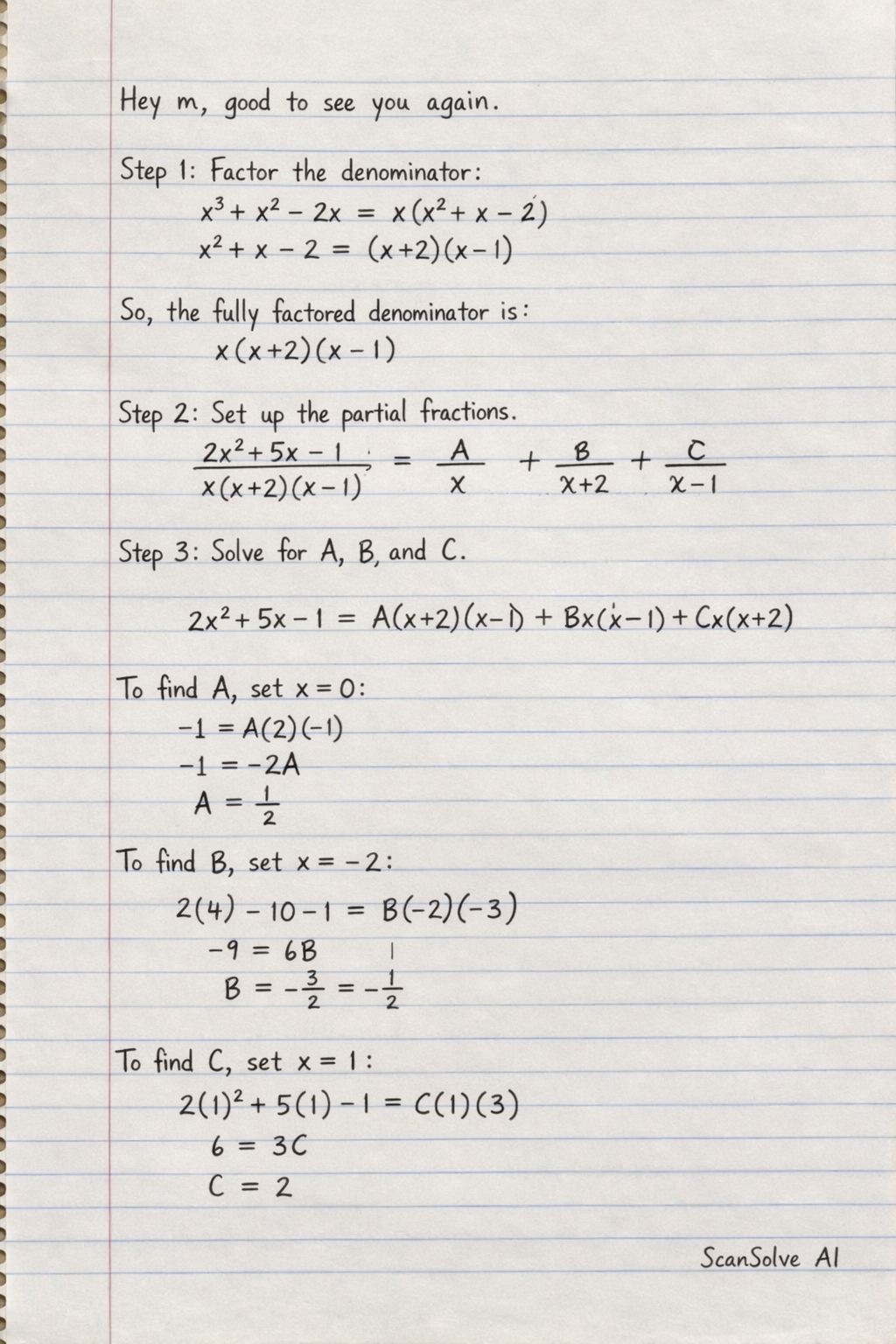
  1. Factor the denominator.

    The denominator is x3+x2−2xx^3 + x^2 - 2x.

    x3+x2−2x=x(x2+x−2)x^3 + x^2 - 2x = x(x^2 + x - 2)

    Factor the quadratic term x2+x−2x^2 + x - 2:

    x2+x−2=(x+2)(x−1)x^2 + x - 2 = (x+2)(x-1)

    So, the fully factored denominator is:

    x(x+2)(x−1)x(x+2)(x-1)
  2. Set up the partial fraction decomposition.

    We express the integrand as a sum of simpler fractions:

    2x2+5x−1x(x+2)(x−1)=Ax+Bx+2+Cx−1\frac{2x^2 + 5x - 1}{x(x+2)(x-1)} = \frac{A}{x} + \frac{B}{x+2} + \frac{C}{x-1}
  3. Solve for the constants A, B, and C.

    Multiply both sides by x(x+2)(x−1)x(x+2)(x-1):

    2x2+5x−1=A(x+2)(x−1)+Bx(x−1)+Cx(x+2)2x^2 + 5x - 1 = A(x+2)(x-1) + Bx(x-1) + Cx(x+2)

    To find A, set x=0x=0:

    2(0)2+5(0)−1=A(0+2)(0−1)2(0)^2 + 5(0) - 1 = A(0+2)(0-1) −1=A(2)(−1)-1 = A(2)(-1) −1=−2A  ⟹  A=12-1 = -2A \implies A = \frac{1}{2}

    To find B, set x=−2x=-2:

    2(−2)2+5(−2)−1=B(−2)(−2−1)2(-2)^2 + 5(-2) - 1 = B(-2)(-2-1) 2(4)−10−1=B(−2)(−3)2(4) - 10 - 1 = B(-2)(-3) 8−10−1=6B8 - 10 - 1 = 6B −3=6B  ⟹  B=−36=−12-3 = 6B \implies B = -\frac{3}{6} = -\frac{1}{2}

    To find C, set x=1x=1:

    2(1)2+5(1)−1=C(1)(1+2)2(1)^2 + 5(1) - 1 = C(1)(1+2) 2+5−1=C(1)(3)2 + 5 - 1 = C(1)(3) 6=3C  ⟹  C=26 = 3C \implies C = 2
  4. Rewrite the integral using the partial fractions.

    ∫2x2+5x−1x3+x2−2x dx=∫(1/2x−1/2x+2+2x−1) dx\int \frac{2x^2 + 5x - 1}{x^3 + x^2 - 2x} \, dx = \int \left( \frac{1/2}{x} - \frac{1/2}{x+2} + \frac{2}{x-1} \right) \, dx
  5. Integrate each term.

    =12∫1x dx−12∫1x+2 dx+2∫1x−1 dx= \frac{1}{2} \int \frac{1}{x} \, dx - \frac{1}{2} \int \frac{1}{x+2} \, dx + 2 \int \frac{1}{x-1} \, dx =12ln⁡∣x∣−12ln⁡∣x+2∣+2ln⁡∣x−1∣+C= \frac{1}{2} \ln|x| - \frac{1}{2} \ln|x+2| + 2 \ln|x-1| + C
  6. Combine the logarithmic terms using logarithm properties (ln⁡a−ln⁡b=ln⁡ab\ln a - \ln b = \ln \frac{a}{b} and cln⁡a=ln⁡acc \ln a = \ln a^c).

    =12(ln⁡∣x∣−ln⁡∣x+2∣)+ln⁡∣(x−1)2∣+C= \frac{1}{2} \left( \ln|x| - \ln|x+2| \right) + \ln|(x-1)^2| + C =12ln⁡∣xx+2∣+ln⁡∣(x−1)2∣+C= \frac{1}{2} \ln \left| \frac{x}{x+2} \right| + \ln|(x-1)^2| + C

    The final answer is 12ln⁡∣xx+2∣+ln⁡∣(x−1)2∣+C\boxed{\frac{1}{2} \ln \left| \frac{x}{x+2} \right| + \ln|(x-1)^2| + C}.

Was this helpful?

Still stuck on this one?

Ask a follow-up, and the answer starts from this question.

Got a different question?Ask your own question
Handwritten step-by-step solution preview

Handwritten Step-by-Step Solution

Get this as a handwritten image on WhatsApp — like a tutor wrote it for you.

Try on WhatsApp