We read your photo as:

Find the inverse of matrix A and solve the system of linear equations using matrices. A = [[3, 4], [2, 3]]

Mathematics

ScanSolve AI Answer

Answer

a

(3−4−23)\begin{pmatrix} 3 & -4 \\ -2 & 3 \end{pmatrix}

Step-by-step solution

8 steps

Part a· 2 steps

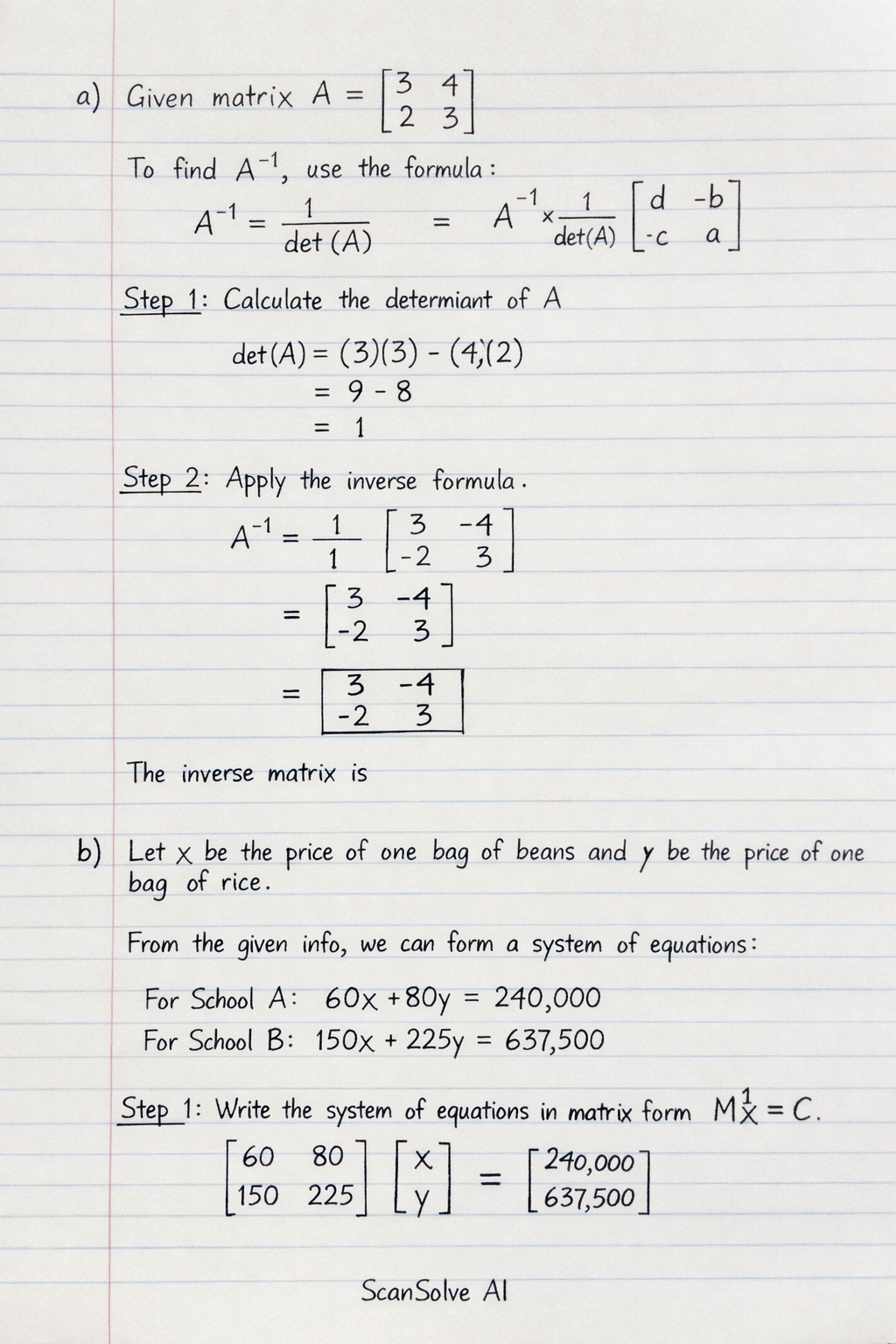
Given matrix A=(3423)A = \begin{pmatrix} 3 & 4 \\ 2 & 3 \end{pmatrix}.

To find the inverse of a 2×22 \times 2 matrix A=(abcd)A = \begin{pmatrix} a & b \\ c & d \end{pmatrix}, the formula is A−1=1det⁡(A)(d−b−ca)A^{-1} = \frac{1}{\det(A)} \begin{pmatrix} d & -b \\ -c & a \end{pmatrix}.

  1. Calculate the determinant of AA.

    det⁡(A)=(3)(3)−(4)(2)=9−8=1\det(A) = (3)(3) - (4)(2) = 9 - 8 = 1
  2. Apply the inverse formula.

    A−1=11(3−4−23)=(3−4−23)A^{-1} = \frac{1}{1} \begin{pmatrix} 3 & -4 \\ -2 & 3 \end{pmatrix} = \begin{pmatrix} 3 & -4 \\ -2 & 3 \end{pmatrix}

    The inverse matrix is (3−4−23)\boxed{\begin{pmatrix} 3 & -4 \\ -2 & 3 \end{pmatrix}}.

Part b· 4 steps

Let xx be the price of one bag of beans and yy be the price of one bag of rice.

From the given information, we can form a system of linear equations:
For School A: 60x+80y=24000060x + 80y = 240000
For School B: 150x+225y=637500150x + 225y = 637500

  1. Write the system of equations in matrix form M(xy)=CM \begin{pmatrix} x \\ y \end{pmatrix} = C.

    (6080150225)(xy)=(240000637500)\begin{pmatrix} 60 & 80 \\ 150 & 225 \end{pmatrix} \begin{pmatrix} x \\ y \end{pmatrix} = \begin{pmatrix} 240000 \\ 637500 \end{pmatrix}
  2. Find the determinant of the coefficient matrix M=(6080150225)M = \begin{pmatrix} 60 & 80 \\ 150 & 225 \end{pmatrix}.

    det⁡(M)=(60)(225)−(80)(150)=13500−12000=1500\det(M) = (60)(225) - (80)(150) = 13500 - 12000 = 1500
  3. Find the inverse of the coefficient matrix M−1M^{-1}.

    M−1=11500(225−80−15060)M^{-1} = \frac{1}{1500} \begin{pmatrix} 225 & -80 \\ -150 & 60 \end{pmatrix}
  4. Multiply M−1M^{-1} by the constant matrix CC to find (xy)\begin{pmatrix} x \\ y \end{pmatrix}.

    (xy)=11500(225−80−15060)(240000637500)\begin{pmatrix} x \\ y \end{pmatrix} = \frac{1}{1500} \begin{pmatrix} 225 & -80 \\ -150 & 60 \end{pmatrix} \begin{pmatrix} 240000 \\ 637500 \end{pmatrix} (xy)=11500((225)(240000)+(−80)(637500)(−150)(240000)+(60)(637500))\begin{pmatrix} x \\ y \end{pmatrix} = \frac{1}{1500} \begin{pmatrix} (225)(240000) + (-80)(637500) \\ (-150)(240000) + (60)(637500) \end{pmatrix} (xy)=11500(54000000−51000000−36000000+38250000)\begin{pmatrix} x \\ y \end{pmatrix} = \frac{1}{1500} \begin{pmatrix} 54000000 - 51000000 \\ -36000000 + 38250000 \end{pmatrix} (xy)=11500(30000002250000)\begin{pmatrix} x \\ y \end{pmatrix} = \frac{1}{1500} \begin{pmatrix} 3000000 \\ 2250000 \end{pmatrix} x=30000001500=2000x = \frac{3000000}{1500} = 2000 y=22500001500=1500y = \frac{2250000}{1500} = 1500

    The price of one bag of beans is Kshs. 2000 and the price of one bag of rice is Kshs. 1500.

Part c· 2 steps

Step 1: Calculate the new price of beans.

The price of beans decreased in the ratio 4:5.
New price of beans = 45×2000=4×400=1600\frac{4}{5} \times 2000 = 4 \times 400 = 1600 Kshs.

  1. Calculate the new price of rice.

    The price of rice increased by 20%.
    New price of rice = 1500×(1+0.20)=1500×1.20=18001500 \times (1 + 0.20) = 1500 \times 1.20 = 1800 Kshs.

  2. Calculate the total amount paid by the businessman.

    The businessman bought 20 bags of beans and 30 bags of rice.
    Cost of beans = 20×1600=3200020 \times 1600 = 32000 Kshs.
    Cost of rice = 30×1800=5400030 \times 1800 = 54000 Kshs.
    Total amount paid = 32000+54000=8600032000 + 54000 = 86000 Kshs.
    The businessman paid Kshs. 86,000.

Was this helpful?

Try one yourself

A new problem that tests the same skill.

Still stuck on this one?

Ask a follow-up, and the answer starts from this question.

Got a different question?Ask your own question
Handwritten step-by-step solution preview

Handwritten Step-by-Step Solution

Get this as a handwritten image on WhatsApp — like a tutor wrote it for you.

Try on WhatsApp