

This mathematics problem involves applying core mathematical principles and formulas. Below you will find a complete step-by-step solution with detailed explanations for each step, helping you understand not just the answer but the method behind it.
ScanSolve AI Answer
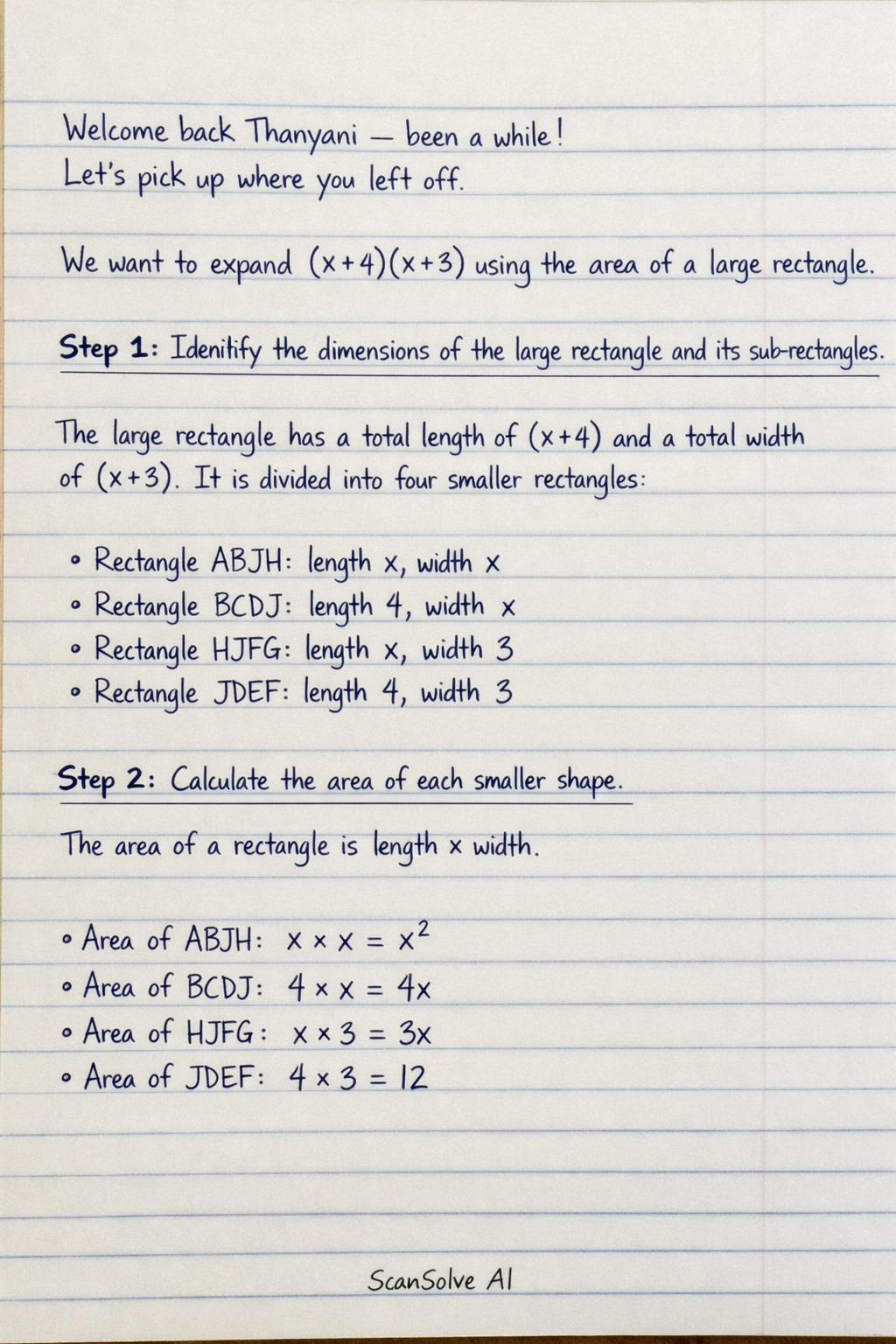
The image demonstrates how to expand the product of two binomials, (x+4)(x+3), by representing it as the area of a large rectangle. Step 1: Identify the dimensions of the large rectangle and its sub-rectangles. The large rectangle ACEG has a total length of (x+4) and a total width of (x+3). It is divided into four smaller shapes: • Rectangle ABJH: length x, width x • Rectangle BCDJ: length 4, width x • Rectangle HJFG: length x, width 3 • Rectangle JDEF: length 4, width 3 Step 2: Calculate the area of each smaller shape. The area of a rectangle is given by length × width. • Area of ABJH: x × x = x^2 • Area of BCDJ: 4 × x = 4x • Area of HJFG: x × 3 = 3x • Area of JDEF: 4 × 3 = 12 Step 3: Calculate the total area of the large rectangle by summing the areas of the smaller shapes. The total area of ACEG is the sum of the areas of ABJH, BCDJ, HJFG, and JDEF. Area of ACEG = x^2 + 4x + 3x + 12 Area of ACEG = x^2 + (4x + 3x) + 12 Area of ACEG = x^2 + 7x + 12 Step 4: Equate the total area calculated from the sum of parts to the total area calculated from the overall dimensions. The total area of the large rectangle ACEG can also be found by multiplying its total length (x+4) by its total width (x+3). Area of ACEG = (x+4)(x+3) By equating the two expressions for the area of ACEG, we get: (x+4)(x+3) = x^2 + 7x + 12 Thus, the product of (x+4)(x+3) is x^2 + 7x + 12. Drop the next question 📸