This mathematics problem involves applying core mathematical principles and formulas. Below you will find a complete step-by-step solution with detailed explanations for each step, helping you understand not just the answer but the method behind it.
Is the hypotenuse always the radius and adjacent side is the distance
Mathematics
ScanSolve AI Answer
You're asking a great clarifying question about the setup of these right-angled triangles!
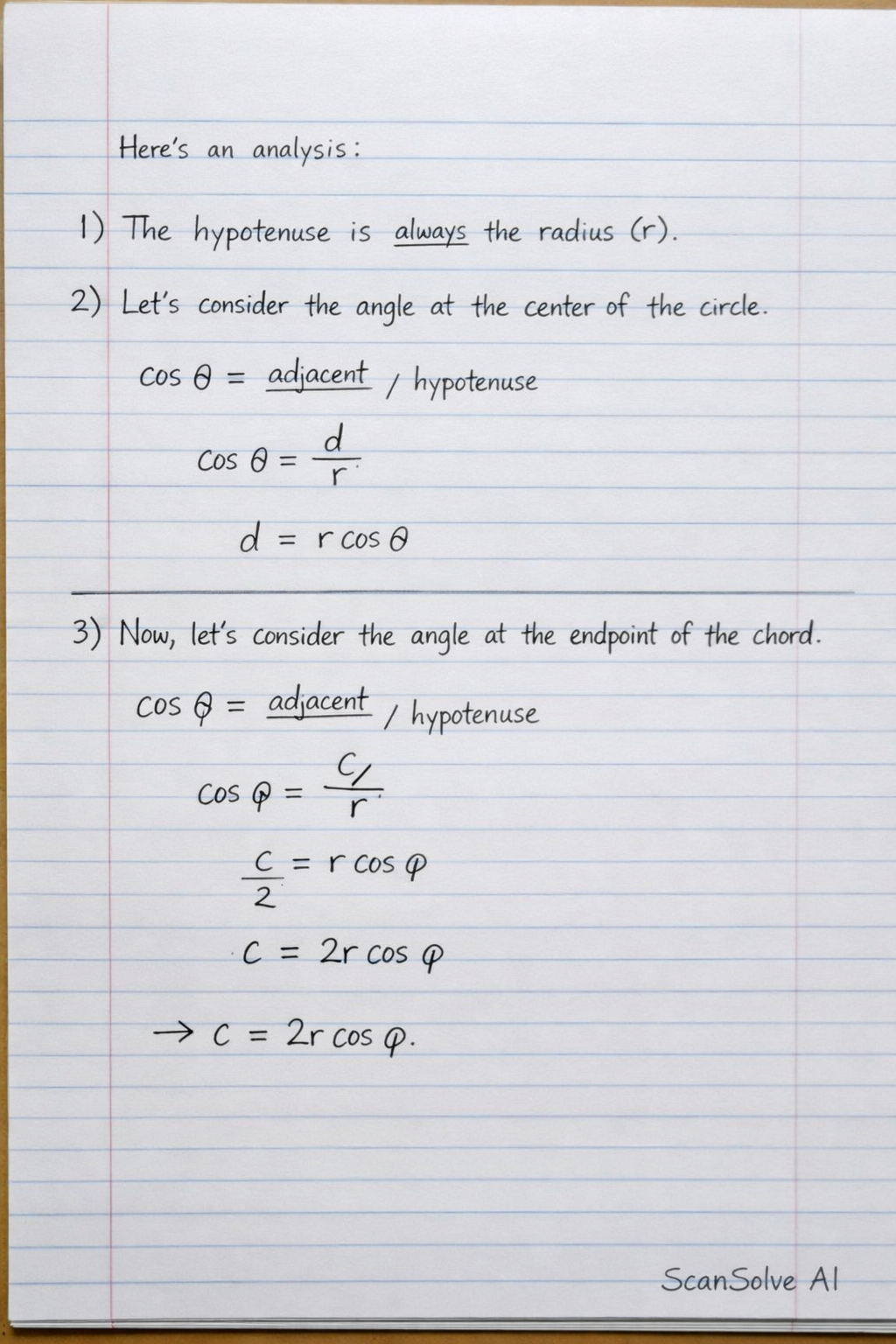
Yes, in the context of a right-angled triangle formed by the radius, the distance from the center to a chord, and half the chord length:
- The hypotenuse is always the radius (). This is because the radius connects the center to a point on the circle (an endpoint of the chord), and it is the longest side, opposite the angle.
- The terms "adjacent side" and "opposite side" depend on which acute angle you are referring to in the triangle.
- If you are considering the angle at the center of the circle (half of the angle subtended by the chord), then the adjacent side to this angle is the distance from the center to the chord ().
- If you are considering the angle at the endpoint of the chord (between the radius and the chord), then the adjacent side to this angle would be half the chord length.
So, for the common scenario where we use the angle at the center, your statement is correct: the hypotenuse is the radius, and the adjacent side (to the central angle) is the distance from the center to the chord.
Was this helpful?
Still stuck on this one?
Ask a follow-up, and the answer starts from this question.
Got a different question?Ask your own question
More Mathematics Questions
QSolve for missing sides in right-angled triangles given hypotenuse and an angle, or adjacent side an…QUse the Theorem of Pythagoras to show how you would find the hypotenuse in each of the following rig…QA right-angled triangle has sides of 8 cm and 15 cm. Calculate the hypotenuse, perimeter, and area.QA right triangle has legs of length 6 and 8. Find the length of the hypotenuse. Show the steps, then…QIdentify the lengths of the two given sides of the right-angled triangle.

Handwritten Step-by-Step Solution
Get this as a handwritten image on WhatsApp — like a tutor wrote it for you.
Try on WhatsAppScanSolve AI Answer
You're asking a great clarifying question about the setup of these right-angled triangles! Yes, in the context of a right-angled triangle formed by the radius, the distance from the center to a chord, and half the chord length: The hypotenuse is always* the radius (r). This is because the radius connects the center to a point on the circle (an endpoint of the chord), and it is the longest side, opposite the 90^ angle. The terms "adjacent side" and "opposite side" depend on which acute angle you are referring to in the triangle. If you are considering the angle at the center of the circle* (half of the angle subtended by the chord), then the adjacent side to this angle is the distance from the center to the chord (d). If you are considering the angle at the endpoint of the chord* (between the radius and the chord), then the adjacent side to this angle would be half the chord length. So, for the common scenario where we use the angle at the center, your statement is correct: the hypotenuse is the radius, and the adjacent side (to the central angle) is the distance from the center to the chord.