
We read your photo as:
Use the Theorem of Pythagoras to show how you would find the hypotenuse in each of the following right-angled triangles.
ScanSolve AI Answer
Answers
3 partsStep-by-step solution
6 stepsThe Pythagorean theorem states that in a right-angled triangle, the square of the hypotenuse (the side opposite the right angle) is equal to the sum of the squares of the other two sides (legs). If the legs are and , and the hypotenuse is , then . To find the hypotenuse, we take the square root: .
Part a· 2 steps
Identify the legs and the hypotenuse.
The legs are and . The hypotenuse is .
Apply the Pythagorean theorem to find the hypotenuse .
Part b
Identify the legs and the hypotenuse.
The legs are and . The hypotenuse is .
Apply the Pythagorean theorem to find the hypotenuse .
Part c
Identify the legs and the hypotenuse.
The legs are and . The hypotenuse is .
Apply the Pythagorean theorem to find the hypotenuse .
Try one yourself
A new problem that tests the same skill.
Still stuck on this one?
Ask a follow-up, and the answer starts from this question.
More Mathematics Questions
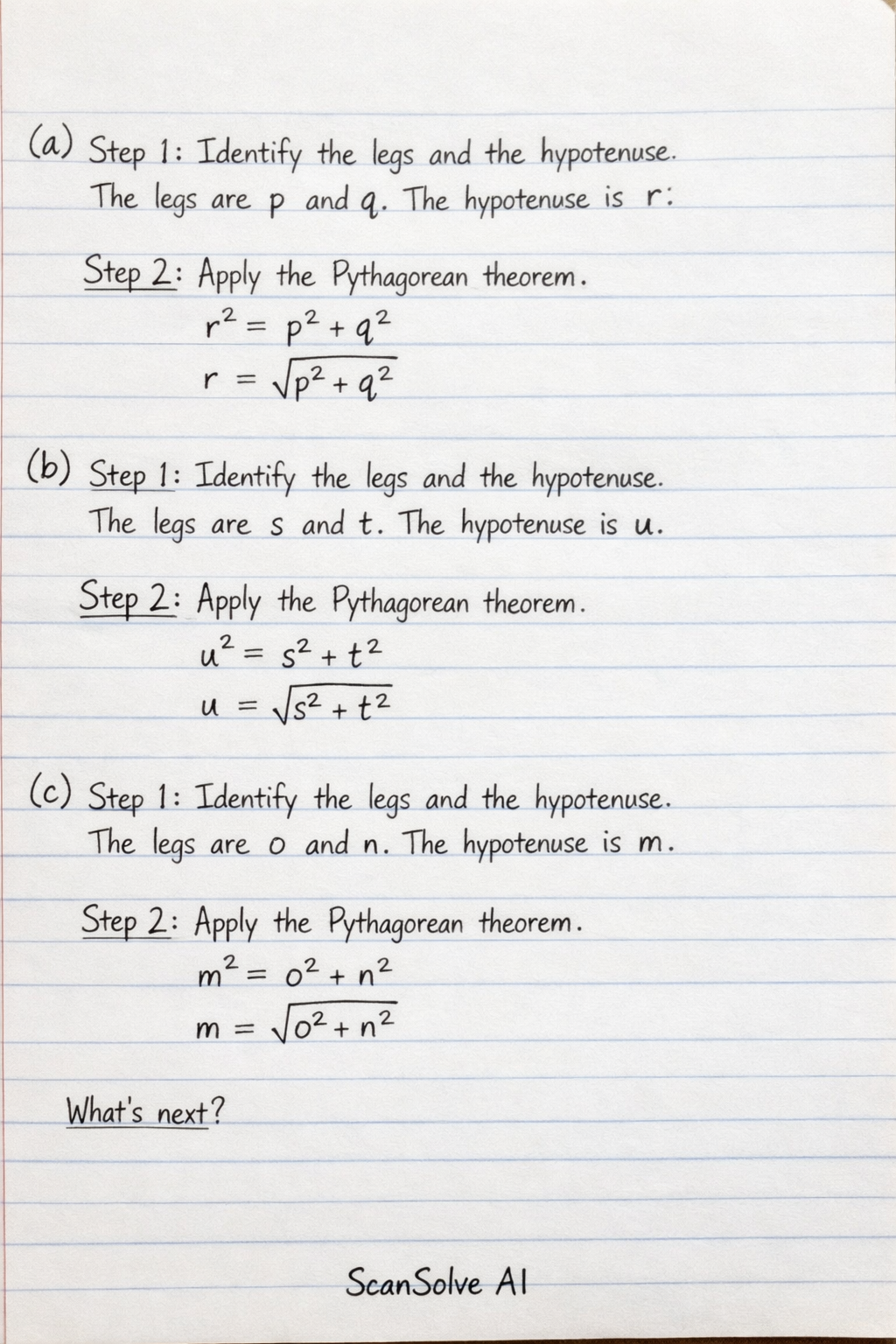
Handwritten Step-by-Step Solution
Get this as a handwritten image on WhatsApp — like a tutor wrote it for you.
Try on WhatsApp