
We read your photo as:
Is the provided 3x3 square a magic square with a total of 45? Verify the sums of rows, columns, and diagonals.
Mathematics
ScanSolve AI Answer
Step-by-step solution
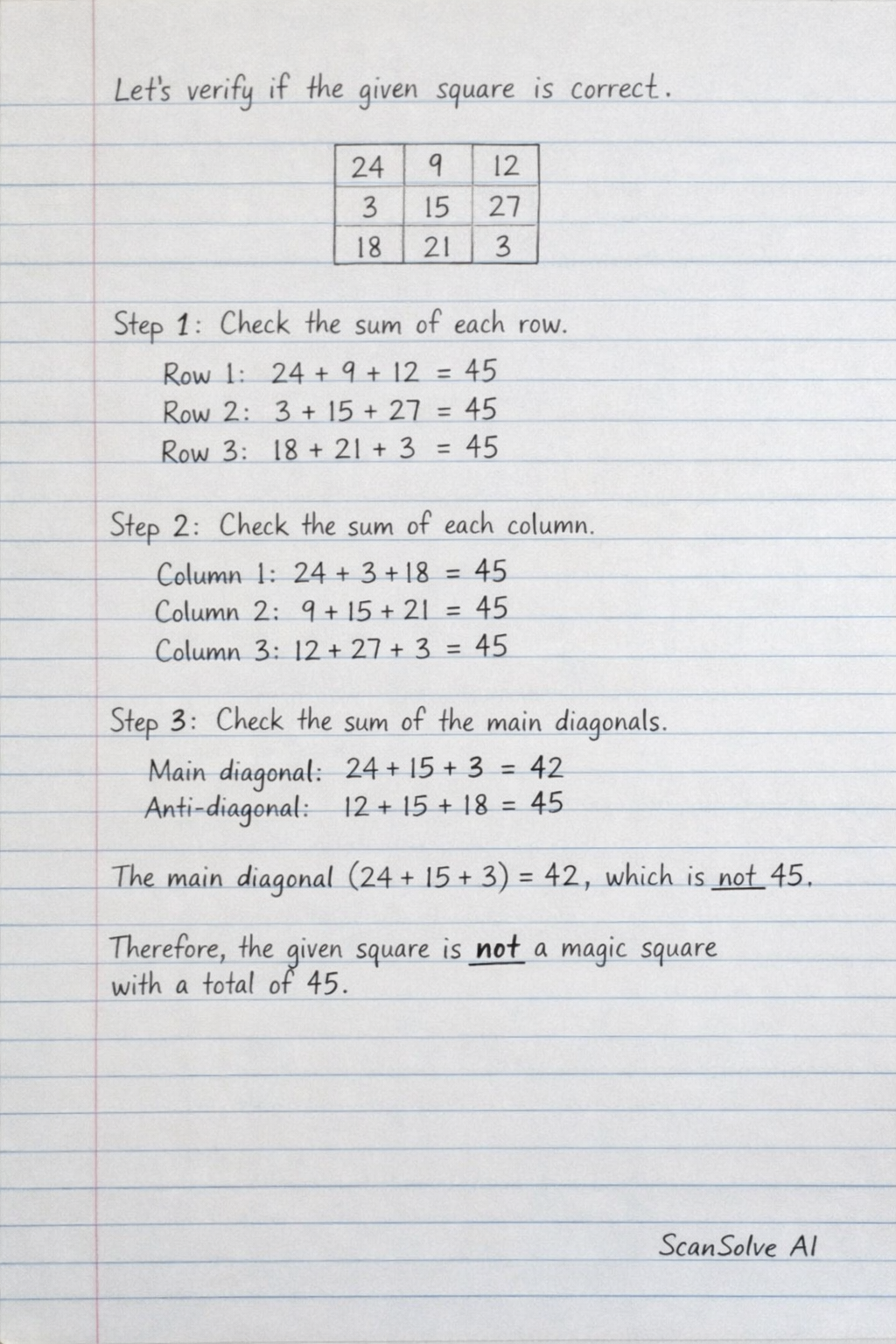
3 stepsThis image shows a completed magic square. A magic square is a square grid where the sum of the numbers in each row, each column, and both main diagonals is the same. The problem states that "The total is 45."
Let's verify if the given square is correct.
The square is:
Check the sum of each row.
- Row 1:
- Row 2:
- Row 3:
Check the sum of each column.
- Column 1:
- Column 2:
- Column 3:
Check the sum of the main diagonals.
- Main diagonal (top-left to bottom-right):
- Anti-diagonal (top-right to bottom-left):
The main diagonal () sums to 42, which is not 45. Therefore, the given square is not a magic square with a total of 45.
The given square is:
❌ Incorrect. The sum of the main diagonal () is 42, not 45.
Was this helpful?
Still stuck on this one?
Ask a follow-up, and the answer starts from this question.
Got a different question?Ask your own question
More Mathematics Questions
QVerify if the provided 3×3 magic square is correct, given that the magic sum is 15.QThe sum of each row, column, and diagonal in the magic square below is 60. Fill in the missing…QFill in the missing numbers in the magic square so that the sum of each row, column, and diagonal is…QA 3×3 magic square has a diagonal sum of 21. What are the missing values for a, b, and c?QCopy and complete the magic square so that the sum of numbers in each row or column or diagonal is…
Handwritten Step-by-Step Solution
Get this as a handwritten image on WhatsApp — like a tutor wrote it for you.
Try on WhatsApp