
We read your photo as:
The sum of each row, column, and diagonal in the magic square below is 60. Fill in the missing numbers.
ScanSolve AI Answer
Step-by-step solution
5 stepsTo fill in the missing numbers in the magic square, we use the rule that every row, column, and diagonal must add up to the given total, which is 60 for square 4.
Let the magic square be represented as:
From the image, we have the following known values:
Find the center number using the main diagonal.
The sum of the main diagonal () must be 60.
Find using the first row.
The sum of the first row () must be 60.
Find using the third row.
The sum of the third row () must be 60.
Find using the first column.
The sum of the first column () must be 60.
Find using the third column.
The sum of the third column () must be 60.
The completed magic square is:
Still stuck on this one?
Ask a follow-up, and the answer starts from this question.
More Mathematics Questions
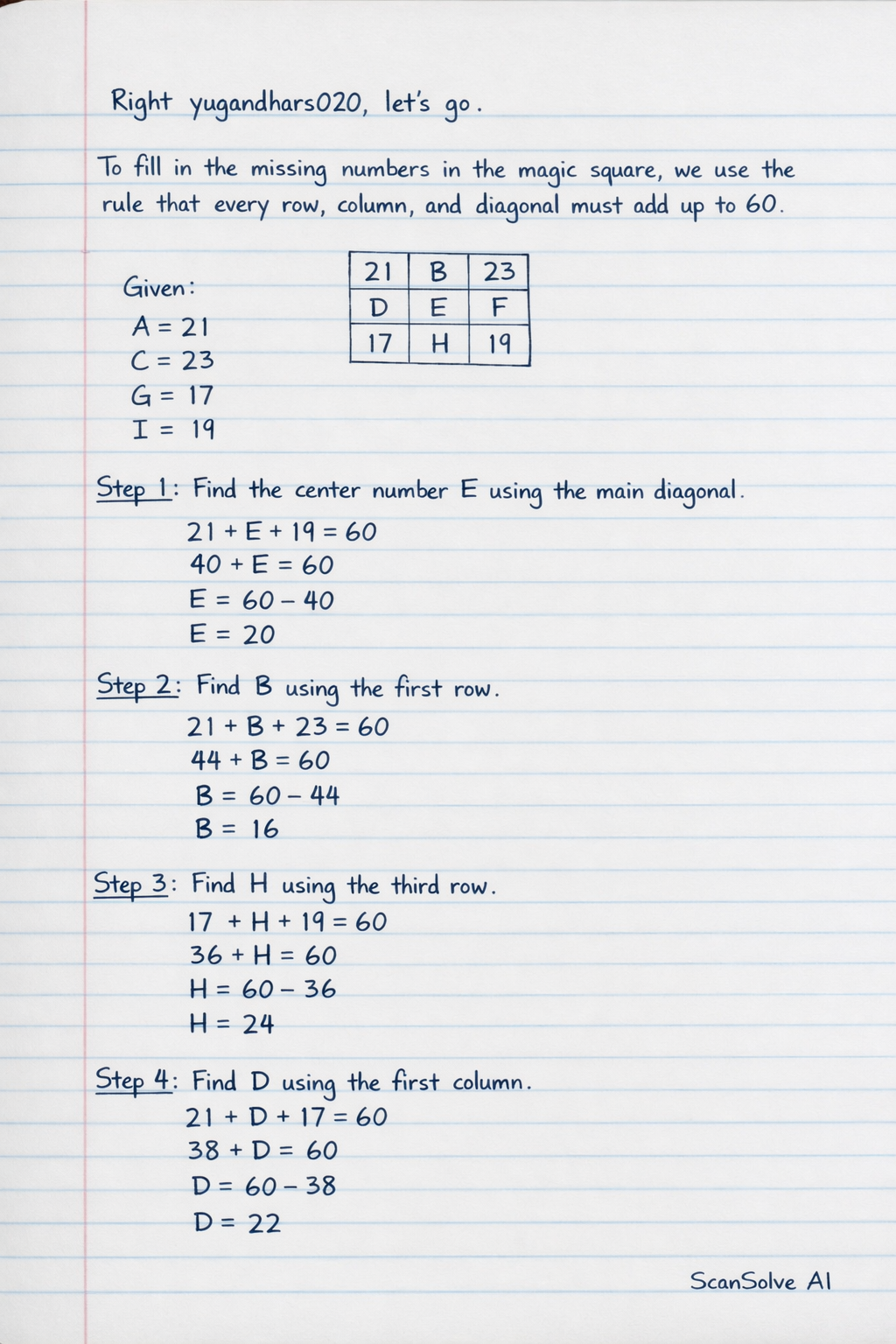
Handwritten Step-by-Step Solution
Get this as a handwritten image on WhatsApp — like a tutor wrote it for you.
Try on WhatsApp