It Cos theta plus cos theta not that sighn

Mathematics

ScanSolve AI Answer

Answer

You're right to double-check, fortune. Let's be absolutely clear about the given information for Problem 8.

Step-by-step solution

6 steps

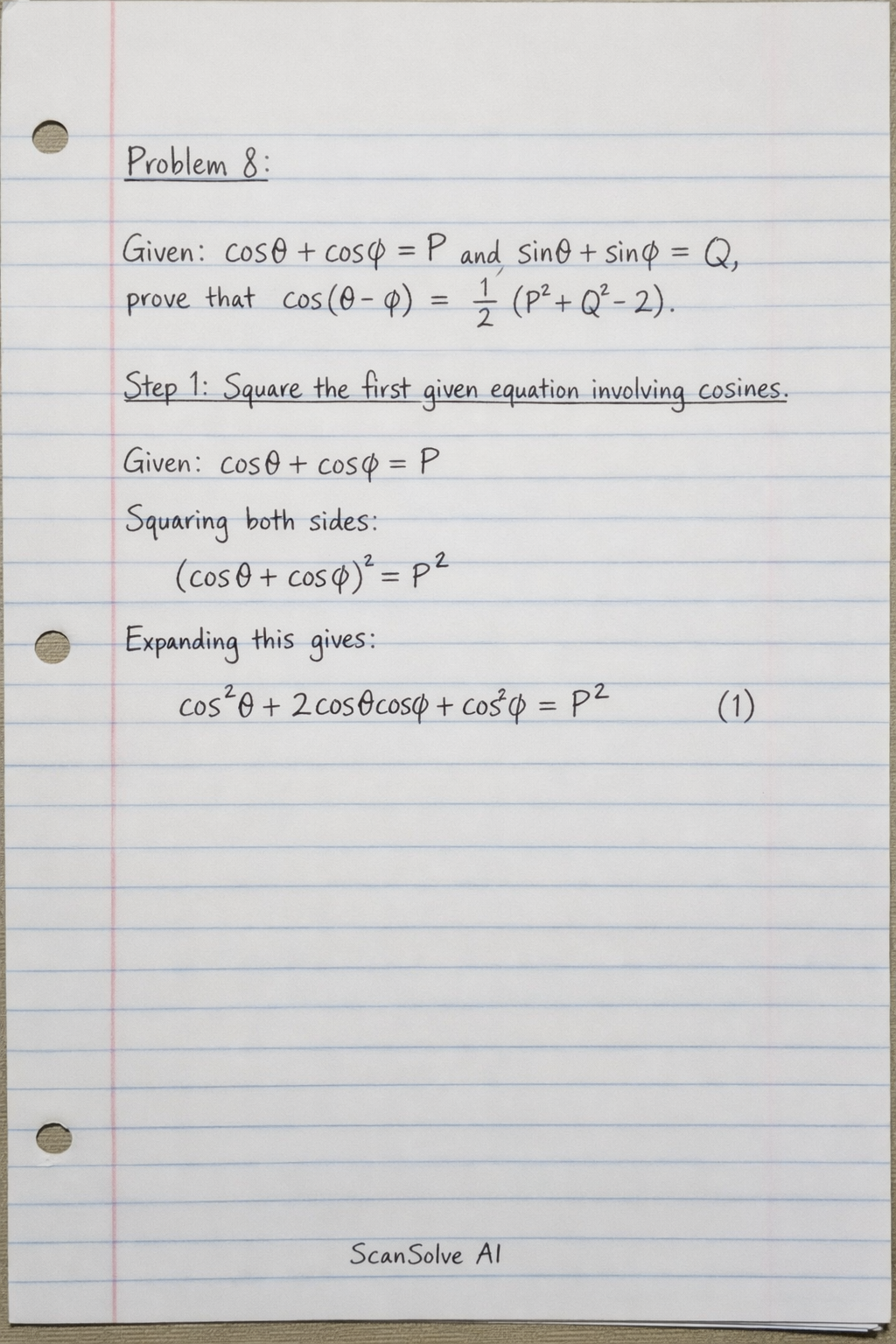
The problem statement from the image you sent is:
"Given that cos⁡θ+cos⁡ϕ=P\cos\theta + \cos\phi = P and sin⁡θ+sin⁡ϕ=Q\sin\theta + \sin\phi = Q, prove that cos⁡(θ−ϕ)=12(P2+Q2−2)\cos(\theta - \phi) = \frac{1}{2}(P^2 + Q^2 - 2)."

Notice that the problem explicitly gives one equation with cosines (cos⁡θ+cos⁡ϕ=P\cos\theta + \cos\phi = P) and another equation with sines (sin⁡θ+sin⁡ϕ=Q\sin\theta + \sin\phi = Q). My solution uses both of these distinct equations exactly as provided.

Let's go through it one more time, focusing on how each given equation is used.

:
Given cos⁡θ+cos⁡ϕ=P\cos\theta + \cos\phi = P and sin⁡θ+sin⁡ϕ=Q\sin\theta + \sin\phi = Q, prove that cos⁡(θ−ϕ)=12(P2+Q2−2)\cos(\theta - \phi) = \frac{1}{2}(P^2 + Q^2 - 2).

  1. Square the first given equation, which involves cos⁡θ\cos\theta and cos⁡ϕ\cos\phi.

    Given: cos⁡θ+cos⁡ϕ=P\cos\theta + \cos\phi = P
    Squaring both sides:

    (cos⁡θ+cos⁡ϕ)2=P2(\cos\theta + \cos\phi)^2 = P^2

    Expanding this gives:

    cos⁡2θ+2cos⁡θcos⁡ϕ+cos⁡2ϕ=P2(1)\cos^2\theta + 2\cos\theta\cos\phi + \cos^2\phi = P^2 \quad (1)
  2. Square the second given equation, which involves sin⁡θ\sin\theta and sin⁡ϕ\sin\phi.

    Given: sin⁡θ+sin⁡ϕ=Q\sin\theta + \sin\phi = Q
    Squaring both sides:

    (sin⁡θ+sin⁡ϕ)2=Q2(\sin\theta + \sin\phi)^2 = Q^2

    Expanding this gives:

    sin⁡2θ+2sin⁡θsin⁡ϕ+sin⁡2ϕ=Q2(2)\sin^2\theta + 2\sin\theta\sin\phi + \sin^2\phi = Q^2 \quad (2)
  3. Add equation (1) and equation (2).

    Adding the results from Step 1 and Step 2:

    (cos⁡2θ+2cos⁡θcos⁡ϕ+cos⁡2ϕ)+(sin⁡2θ+2sin⁡θsin⁡ϕ+sin⁡2ϕ)=P2+Q2(\cos^2\theta + 2\cos\theta\cos\phi + \cos^2\phi) + (\sin^2\theta + 2\sin\theta\sin\phi + \sin^2\phi) = P^2 + Q^2
  4. Rearrange terms and apply the Pythagorean identity.

    Group the squared terms:

    (cos⁡2θ+sin⁡2θ)+(cos⁡2ϕ+sin⁡2ϕ)+2cos⁡θcos⁡ϕ+2sin⁡θsin⁡ϕ=P2+Q2(\cos^2\theta + \sin^2\theta) + (\cos^2\phi + \sin^2\phi) + 2\cos\theta\cos\phi + 2\sin\theta\sin\phi = P^2 + Q^2

    Using the identity cos⁡2x+sin⁡2x=1\cos^2 x + \sin^2 x = 1:

    1+1+2(cos⁡θcos⁡ϕ+sin⁡θsin⁡ϕ)=P2+Q21 + 1 + 2(\cos\theta\cos\phi + \sin\theta\sin\phi) = P^2 + Q^2 2+2(cos⁡θcos⁡ϕ+sin⁡θsin⁡ϕ)=P2+Q22 + 2(\cos\theta\cos\phi + \sin\theta\sin\phi) = P^2 + Q^2
  5. Apply the compound angle formula for cos⁡(θ−ϕ)\cos(\theta - \phi).

    The formula is cos⁡(θ−ϕ)=cos⁡θcos⁡ϕ+sin⁡θsin⁡ϕ\cos(\theta - \phi) = \cos\theta\cos\phi + \sin\theta\sin\phi.
    Substitute this into the equation from Step 4:

    2+2cos⁡(θ−ϕ)=P2+Q22 + 2\cos(\theta - \phi) = P^2 + Q^2
  6. Isolate cos⁡(θ−ϕ)\cos(\theta - \phi).

    Subtract 2 from both sides:

    2cos⁡(θ−ϕ)=P2+Q2−22\cos(\theta - \phi) = P^2 + Q^2 - 2

    Divide by 2:

    cos⁡(θ−ϕ)=P2+Q2−22\cos(\theta - \phi) = \frac{P^2 + Q^2 - 2}{2}

    This is equivalent to:

    cos⁡(θ−ϕ)=12(P2+Q2−2)\cos(\theta - \phi) = \frac{1}{2}(P^2 + Q^2 - 2)

    The proof is complete.

    The solution correctly uses both the cos⁡\cos and sin⁡\sin equations given in the problem.

Was this helpful?

Still stuck on this one?

Ask a follow-up, and the answer starts from this question.

Got a different question?Ask your own question
Handwritten step-by-step solution preview

Handwritten Step-by-Step Solution

Get this as a handwritten image on WhatsApp — like a tutor wrote it for you.

Try on WhatsApp