
It's still confusing because I how did you get 3 I mean the three you divided with
Mathematics
ScanSolve AI Answer
Answer
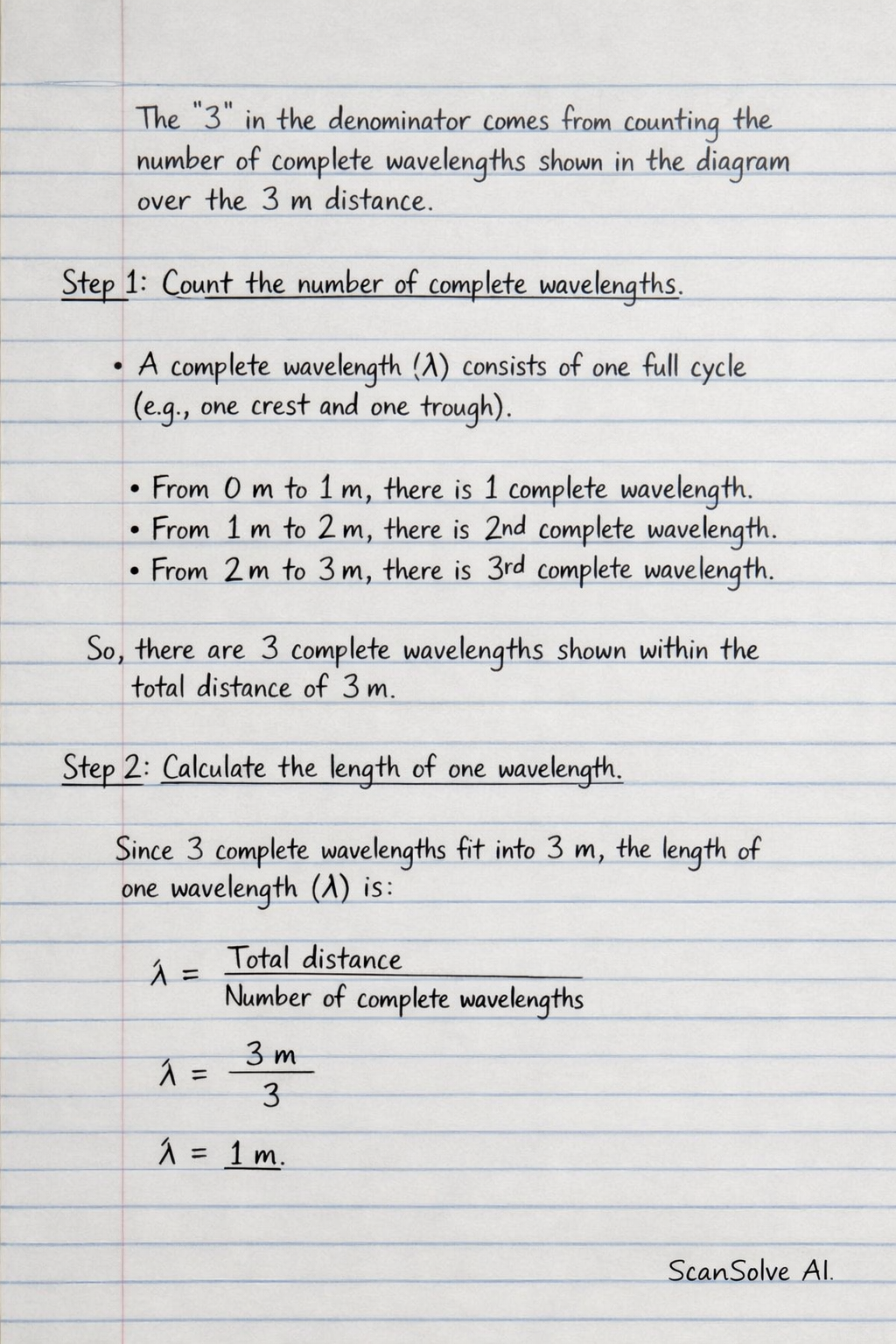
The '3' in the denominator comes from counting the number of complete wavelengths shown in the diagram over the distance.
Step-by-step solution
2 stepsCount the number of complete wavelengths.
- A complete wavelength () consists of one full cycle (e.g., one crest and one trough).
- Looking at the diagram:
- From to , there is .
- From to , there is a .
- From to , there is a .
- So, there are shown within the total distance of .
Calculate the length of one wavelength.
Since 3 complete wavelengths fit into , the length of one wavelength () is:
Was this helpful?
Still stuck on this one?
Ask a follow-up, and the answer starts from this question.
Got a different question?Ask your own question
More Mathematics Questions
Handwritten Step-by-Step Solution
Get this as a handwritten image on WhatsApp — like a tutor wrote it for you.
Try on WhatsApp